
The 10 Oldest Continuously Inhabited Cities on Earth


Most ancient cities ended up as ruins behind a ticket booth, but a few never emptied out. The oldest continuously inhabited cities still have bakeries, traffic and school runs layered on top of streets laid out thousands of years ago. Here are ten of them, from Jericho in the Jordan Valley to Gaziantep in southeastern Türkiye.
1. Jericho, Palestine

Jericho’s story starts around 9000 BC, which makes its oldest settlement roughly 11,000 years old and among the earliest anywhere.
The town sits in the Jordan Valley of the West Bank, with the Jordan River to the east and Jerusalem to the west. Archaeologists have counted more than 20 successive settlements stacked on the same mound. Its stone tower is the showpiece. Carbon dating puts its construction at around 8300 BC, and it stayed in use for some five centuries. A tower like that needs planning, shared labor and someone in charge. This was no farming hamlet. One honest caveat: Jericho was destroyed and abandoned several times, occasionally for centuries, so “continuous” applies to the site’s long story rather than every single year of it.
Today Jericho is a quiet town of about 20,000 people.
2. Damascus, Syria

Damascus has been a city since around 3000 BC, and digs at nearby Tell Ramad suggest people were farming the area as early as 6300 BC. Hellenistic kings, Romans, Byzantines and Islamic caliphs all ruled here, and caravan routes kept the markets busy for centuries.
The landmark everyone heads for is the Umayyad Mosque. Caliph al-Walid began it in 706. By 715 it was finished, which makes it one of the oldest monumental mosques still in use. Visitors are expected to dress modestly, and women are usually asked to cover their hair.
The metro area is home to about 2.8 million people. Check your government’s current travel advice before planning a trip.
3. Byblos, Lebanon

Can a small harbor town take some credit for the letters on this screen? Byblos has a decent claim. People have lived here without a break since about 5000 BC, and in the third millennium BC the fishing settlement grew into a port city that traded cedar wood with Egypt. Royal inscriptions found in Byblos, dating to around 1000 BC, are among the earliest examples of the Phoenician alphabet, the 22-letter script that Greek borrowed and that later fed into the Latin alphabet.
Egyptians, Romans, Crusaders and Ottomans all left their mark. Today the town of about 40,000 people (around 100,000 in the wider area) has a UNESCO World Heritage listing from 1984 and an old harbor that still looks the part.
4. Aleppo, Syria

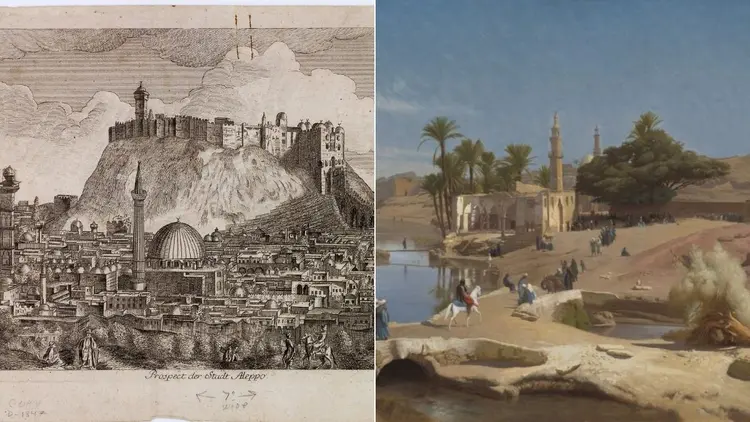
Continuously inhabited since around 5000 BC, and possibly settled as early as the sixth millennium BC, Aleppo spent centuries as a major stop on the caravan routes linking the Mediterranean to Mesopotamia and Asia.
Its rulers ran from Hittites and Persians to Greeks, Arabs and Ottomans. The Citadel of Aleppo, a fortress on a hill in the middle of the city, is the image most people know. The recent war hit the old city hard. Repairs are still under way. Even so, Aleppo remains one of the most important places in Syria’s cultural heritage.
5. Susa, Iran

Carbon dating places Susa’s first settlement at around 4200 BC.
It served as the capital of Elam, and later as the winter capital of the Achaemenid Persian Empire. Darius I launched a building program here that included a vast palace, and its remains still show how much power once gathered in this corner of what is now Iran. It even turns up in the Bible as Shushan, the setting of the Book of Esther. The modern town beside the ruins is called Shush, and the archaeological site was added to UNESCO’s World Heritage List in 2015.
6. Faiyum, Egypt

Faiyum is one of Egypt’s oldest settlements, with habitation going back to the fifth millennium BC, so more than 6,000 years. The ancient Egyptians called it Shedet. The Greeks went for a far more memorable name: Crocodilopolis, or Crocodile City.
The name was earned. Faiyum was the most important center of the cult of Sobek, the crocodile-headed god, and sacred crocodiles were kept and honored here. Crocodiles were only half the story, though. Fed by a branch of the Nile, the Faiyum basin was a farming heartland for ancient Egypt, and it kept growing under the Middle Kingdom and again in Roman times.
The city now has about 440,000 residents.
7. Athens, Greece

Athens has been continuously inhabited for at least 5,000 years, which makes it the oldest capital in Europe. It was already an important center in the Mycenaean era, but the famous chapter came later: democracy took shape here at the end of the 6th century BC and flourished in the 5th, the century the Parthenon went up on the Acropolis. Socrates, Plato and Aristotle all taught in the city. Western philosophy still runs on their arguments. Today the Greek capital is a busy modern city of millions, yet the Acropolis still looms over its rooftops and rush-hour traffic. Climbing it early, before the tour groups arrive, is the classic move.
8. Plovdiv, Bulgaria

Plovdiv, known in Turkish as Filibe, shows evidence of continuous settlement since about 6000 BC. That makes it one of the oldest cities in Europe, and older than Athens on paper.
The Thracians settled here first, and in the 4th century BC Philip II of Macedon made it a city. Under Roman rule it became a center of trade and entertainment, and its Roman theater and stadium still survive in the middle of town. A walk through the old quarter passes Roman, Byzantine, Ottoman and 19th-century Bulgarian buildings within a few streets. Bulgaria’s second-largest city keeps a busy calendar of art and music festivals.
9. Beirut, Lebanon

Beirut has been inhabited for more than 5,000 years, and its name first appears in writing in the Amarna letters of the 14th century BC as “Biruta.” Under Rome it became the colony of Berytus, and Roman ruins still turn up between the modern buildings downtown. Wars, earthquakes and invasions have knocked the city down many times. Each time, it was rebuilt. Like Byblos, just up the coast, it has outlasted nearly everyone who tried to rule it. Greater Beirut is now home to about 2.4 million people, and its cafés, galleries and old streets sit side by side.
10. Gaziantep, Türkiye

The last stop is Gaziantep, in southeastern Türkiye, a city better known abroad for its food than for its age. Its exact age is hard to pin down, but people have lived in this area for thousands of years. Gaziantep Castle is said to have started life as a Hittite lookout post, and the city is believed to stand on the site of the Hellenistic town of Antiochia ad Taurum. Romans, Byzantines, Seljuks and Ottomans followed, leaving mosaics, old bazaars and stone houses behind.
Still, most visitors come for the baklava. Gaziantep is the center of Turkish pistachio growing, its baklava became the first Turkish product with EU protected status in 2013, and in 2015 UNESCO named it a Creative City of Gastronomy. The metropolitan municipality has more than 2.2 million residents.
Sources: Wikipedia, List of oldest continuously inhabited cities, UNESCO Creative Cities Network, Gaziantep, History Defined

Bir yanıt yazın