
Holi Festival: 14 Facts About India’s Festival of Colors


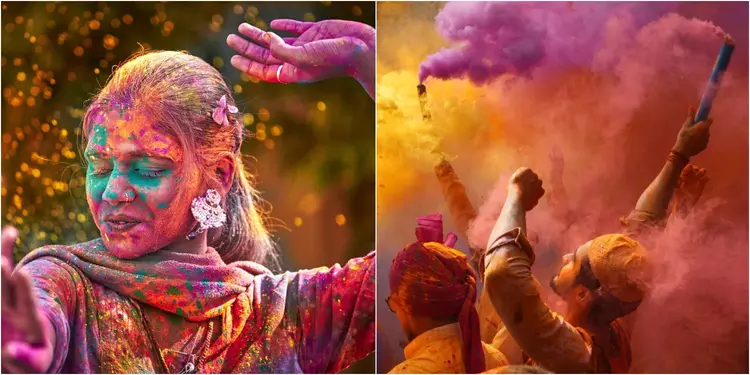
Some festivals are fun to watch; a few turn an entire country into a canvas. The Holi festival, India’s ancient Hindu celebration of spring, love and color, belongs firmly in the second group. Here is what it celebrates, where it comes from and why so many people end the day dyed pink, green and yellow.
1. Every year, India welcomes spring with the Holi festival

Holi falls on the evening of the full moon (Purnima) in the month of Phalguna, which is why its date moves around the Western calendar. It usually lands in March, occasionally in late February.
The story behind it goes back a very long way.
2. People have celebrated Holi since at least the 4th century

The festival is mentioned in works attributed to the classical poet Kālidāsa, written during the reign of Chandragupta II in the 4th century, and the 7th-century drama Ratnavali refers to a “holikotsav.” How much older the festival really is, nobody can say with certainty. Two legends sit at its heart. One is the love of Radha and Krishna: Krishna, the story goes, playfully smeared color on Radha’s face, and Holi has been tied to their love ever since. The other is the tale of Prahlada, a young devotee of Vishnu whose father, the demon king Hiranyakashipu, tried to have him killed with the help of his sister Holika. Holika burned and Prahlada walked away unharmed, so Holi also stands for the victory of good over evil.
3. At its core, Holi announces the end of winter and the start of spring

Put the threads together and Holi celebrates three things at once. Winter is over. Spring has arrived. And good, at least for a day, has beaten evil.
4. Holi is the festival of spring, love and color

Each part of that nickname fits. The timing is seasonal, the Radha and Krishna story supplies the romance, and the color comes in by the handful.
5. It starts on the last full moon of the Hindu lunar year

Phalguna is the twelfth and last month of the Hindu lunar calendar, so Holi’s full moon closes out the year.
The festival opens with prayers and runs for a night and a day.
6. Holi is celebrated well beyond India

Across most of India, Holi is a huge public celebration, and it draws in plenty of people who are not Hindu. Hindus in Nepal, Bangladesh and Pakistan mark it too. Wherever communities of Indian origin have settled, the colors follow: Holi is especially lively in Guyana, Suriname, Trinidad and Tobago, Mauritius, Fiji and South Africa.
7. The festival is one of India’s big draws for travelers

Few events show India at full volume quite like this one.
For visitors from around the world, it is a reason to plan a whole trip around a single date.
8. Many travelers time their visit to India for Holi

The festival is marked almost everywhere in the country, but some places are famous for going bigger. The Braj region, the land linked to Krishna’s childhood, leads the way, with Mathura, Vrindavan, Barsana and Nandgaon at its center. Delhi, Mumbai, Jaipur, Udaipur, Pushkar, Varanasi, Shantiniketan and Hampi are also known for lively celebrations. Expect huge crowds. And wear clothes you never want to see clean again.
9. The real star of the festival is the color

Why throw color at strangers at all? Think back to Krishna smearing it on Radha’s face. Today colored powder, known as gulal, is thrown by the fistful, and water pistols called pichkaris spray colored water at anyone in range. Drummers keep the crowd dancing.
10. People, streets, houses and sidewalks: everything gets painted

Nothing within reach stays its original shade.
Strangers, neighbors, walls and passing visitors all end up in the same rainbow. It looks like pure spectacle, yet the color-throwing is one of the festival’s oldest traditions, and the colors themselves carry meaning.
11. Red, green, yellow and blue are among the key colors of Holi

According to India’s official tourism board, green stands for rebirth, red for marriage and fertility, yellow for purity and victory, and blue for Krishna himself. Traditional powders came from plants and minerals: palash flowers and hibiscus for red, turmeric for yellow, indigo for blue, henna leaves for green. Don’t assume the powder in the bag is natural, though: many sold today are synthetic. Some have been linked to skin and eye irritation, which is why herbal colors, sunglasses and a scarf over the face are popular.
12. Beyond the dancing and games, Holi has other traditions

The night before the colors, huge bonfires are lit in a ritual called Holika Dahan, a reenactment of Holika’s burning and a symbolic way of burning away evil. People gather around the flames, singing and dancing, and wait for Holi to begin.
13. When the colors settle, everyone heads home to wash

Once scrubbed clean, people go visiting family and friends. The rest of the festival happens around the table. Its signature sweet is gujiya, a fried pastry filled with sweetened milk solids and dried fruit. As for drinks, the best-known is bhang, made with cannabis, milk and spices, while thandai, a spiced milk drink, is the version without the kick.
14. Every spring, Holi turns India into a sea of color

Each year, countless Hindus and travelers from around the world welcome the end of winter, the arrival of spring and the victory of good over evil with colored powder, music and dancing.
The bonfire is lit, the gulal flies, and by evening a whole country has to start looking for the soap.
Sources: Wikipedia: Holi, Incredible India: Holi, Wikipedia: Phalguna

Bir yanıt yazın