
Hagia Sophia Viking Graffiti: A Norseman Named Halfdan


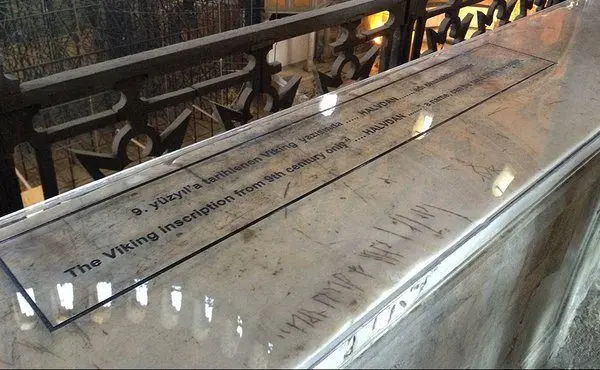
On a marble parapet in the upper gallery of Hagia Sophia, in Istanbul, a few scratches went unnoticed for centuries. They turned out to be runes, the alphabet of the Norse world, and the only word that can still be partly read is a man’s name: Halfdan. This Hagia Sophia Viking graffiti is a small, very human trace of the Scandinavians who once traveled all the way to Constantinople.
1. Heading south: how far the Vikings sailed

The Vikings were seafarers, traders and raiders from Scandinavia, and they did not stay home.
In the Viking Age, Norse ships reached the British Isles, France, the rivers of Eastern Europe and, remarkably, North America. Around the year 1000, Leif Erikson, son of the famous Erik the Red, landed on a coast the sagas called Vinland, usually read as “wine land,” nearly five centuries before Columbus crossed the Atlantic. The Norse encampment at L’Anse aux Meadows, at the tip of Newfoundland, is described by Parks Canada as the first known evidence of European presence in the Americas. Other Norsemen turned east and followed the rivers south toward the richest city they had ever seen. They called it Miklagarðr, “the Great City.” Everyone else called it Constantinople.
2. The great migration: from Normandy to Kyiv

The Norse spread in several directions at once. In Britain, Viking armies fought the Anglo-Saxon kingdoms over generations for control of the island. In France, the leader Rollo received lands on the lower Seine in 911, and his followers, the Normans, gave their name to Normandy.
The eastern route belonged mostly to Norsemen from what is now Sweden. According to the medieval Primary Chronicle, a group known as the Rus’ settled in Novgorod under Rurik in 862, and his relative Oleg took Kyiv (Kiev) in 882, founding the state later called Kievan Rus’. From there, the river roads ran straight to the Black Sea. And on to Byzantium.
3. Why didn’t the Vikings sack Constantinople?

Not for lack of trying.
The Rus’ did attack the Byzantine capital, including a naval expedition in 907, and treaties between the Rus’ and Byzantium followed in 907, 911 and 945. The city’s walls, fleet and well-organized army made it a very different target from a coastal monastery in Northumbria, so raiding gave way to something more profitable: trade, travel and paid work. Many Norsemen came to the city in small groups, as merchants or as soldiers looking for an employer, and Constantinople had plenty of both silver and jobs to offer.
4. The Varangian Guard: Vikings protecting the emperor

The Byzantines called these Norsemen Varangians. The word comes from Old Norse væringi, built from vár, “pledge,” and roughly means an oath-bound companion, which suits men who sold their loyalty by contract. Rus’ fighters appear in Byzantine service from the late 9th century, and Varangians fought as mercenaries in the imperial army by 911. The decisive moment came in 988: Emperor Basil II asked Vladimir I of Kyiv for help, and Vladimir sent 6,000 men, receiving Basil’s sister Anna in marriage in return.
Out of that deal grew the Varangian Guard.
These foreign warriors became the emperor’s personal bodyguard, swore an oath of loyalty, handled ceremonial and police duties, and were sent into battle when things got critical. The arrangement suited both sides. The Norsemen earned good pay and prestige; the emperor got guards with no stake in palace intrigue.
5. Halfdan: a Norseman in the Great City

Who was Halfdan? Honestly, nobody knows.
Popular retellings turn him into a fearless commander from the far north who traveled for years to join the Varangians, and who attended a church service as a pagan just to see the inside of Hagia Sophia. None of this is documented. The only firm evidence is his name, carved in runes, and the fact that he stood in the galleries of the most famous church in Christendom, sometime between the 9th and 11th centuries. He may well have been one of the Varangian guardsmen, as researchers suggest, though that remains a possibility rather than a fact.
6. Scratching runes into the marble

Picture a long Byzantine liturgy, sung in Greek, under a dome that seemed to float.
A visitor from Scandinavia, perhaps bored, perhaps just wanting to leave a mark, took a blade to the marble parapet of the upper gallery. It is the same impulse that makes travelers carve initials into benches and castle walls today, only about a thousand years earlier. Why he did it is anyone’s guess. His later fate is unknown too.
7. What the Hagia Sophia Viking graffiti actually says

The inscription is often translated as “Halfdan was here,” and that is a nice summary, but it is not quite what the stone says. According to the overview of the runic inscriptions in Hagia Sophia, only the end of the name, “-ftan,” survives clearly. The rest is illegible. It may have followed the standard runic formula, “Halfdan carved these runes.” Either way, that is the whole of what he left behind: a name, and not even all of it.
The scratches survived Byzantine rule, the Ottoman conquest and centuries of visitors without drawing anyone’s attention, until they were identified in 1964 and published by Swedish runologist Elisabeth Svärdström in 1970. A second runic inscription, reading Ári or Árni, was found in 1975 in a niche in the northern part of the same gallery, and researchers have since noted several more possible ones. Halfdan’s graffiti sits on a marble parapet on the upper floor of the south gallery. Hagia Sophia is a working mosque again today, and foreign visitors reach the upper gallery with a separate paid ticket, so it is worth checking current entry rules before going.
Sources: Wikipedia: Runic inscriptions in Hagia Sophia, Wikipedia: Varangian Guard, Parks Canada: L’Anse aux Meadows





Bir yanıt yazın