
14 Museums in Izmir, From the Atatürk Museum to Ephesus


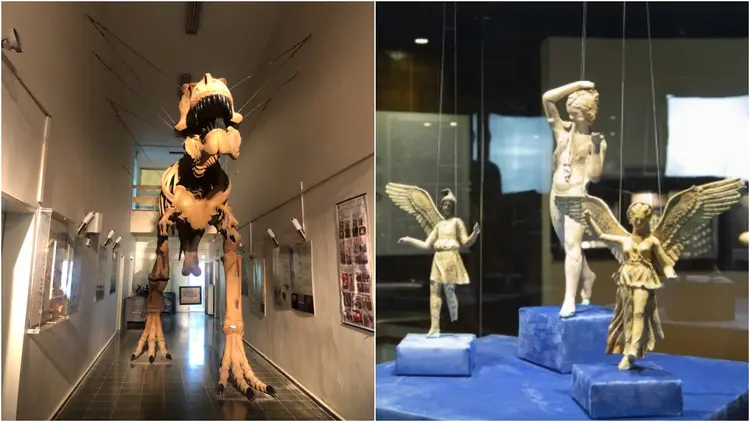
Izmir’s history reaches back roughly 8,500 years, through Ionians, Lydians, Persians, Romans, and Byzantines, and a good share of it now sits behind glass. Here are 14 places to see it, in and around Türkiye’s Aegean port city. The best museums in Izmir range from Roman sculpture halls and a former plague hospital to a mask collection, a toy museum, the mansion where Atatürk married, and, about an hour’s drive south in Selçuk, the Ephesus Museum.
1. Atatürk Museum

The Atatürk Museum faces the gulf from the First Kordon, the seafront avenue in Alsancak, so it’s one of the easiest stops on this list to reach. The carpet merchant Takfor Efendi built the house between 1875 and 1880. Then came September 9, 1922. Its owner left that day, and the building passed to the state; the Turkish army, which had just entered Izmir, used it for a while as a headquarters. On October 13, 1926, the municipality bought it and gave it to Mustafa Kemal Atatürk, founder of the Turkish Republic. He stayed here on his visits to Izmir between 1930 and 1934. After his death, the house became a museum.
Inside the neoclassical building, spread over four levels from basement to attic, you’ll find his bedroom, study, meeting hall, guest room, bathroom, library, reception room, and even a barber’s room. A private barber, by the sea. That detail alone says something about how a head of state traveled in the 1930s.
2. Izmir Ethnography Museum

Its first job was grimmer.
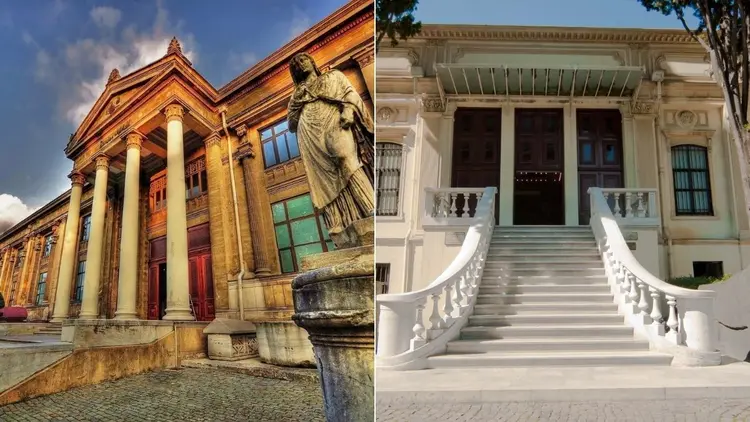
The French built it in 1831 as St. Roch, a hospital and monastery for plague patients; in the early years of the Republic it became an orphanage, then a public health institute and health directorate offices, until it was handed to the Ministry of Culture and Tourism in 1984 to become a museum.
Handy detail: it shares its grounds with the Izmir Archaeology Museum. Inside, scenes of 19th-century daily life in Izmir sit alongside mannequins demonstrating crafts that are slowly disappearing: pottery, tinsmithing, clog making, woodblock printing, felt making, carpet weaving, and the glass evil-eye beads (nazar boncuğu) sold all over Turkey.
Don’t skip the reconstructed İttihat Pharmacy. It was the city’s first Turkish pharmacy.
3. Izmir Archaeology Museum

One of the first museums in western Anatolia, the Izmir Archaeology Museum was founded in 1924 in the Ayavukla (Saint Voukolos) Church in Basmane, and since 1984 it has occupied its own building in Bahribaba Park, Konak. Start on the ground floor. This is the Stone Works Hall, packed with statues, busts, portraits, and masks.
Upstairs, the ceramics hall named after the archaeologist Ekrem Akurgal runs from prehistory to the Byzantine period. One piece is worth finding. It’s a Roman marble statue thought to show Androklos, the legendary founder of Ephesus.
4. Izmir History and Art Museum

Opened in 2004 inside Kültürpark, the big park in the city center, this museum spreads across three buildings. Where the Archaeology Museum splits its floors between stone and ceramics, this one sticks to sculpture. Archaic, Classical, Hellenistic, and Roman statues and reliefs found in and around Izmir fill the halls. The highlights? Heads and statuettes from the ancient Agora of Smyrna, a statue of the river god Kaystros that ranks among the finest Roman works here, sculpture from the Metropolis excavations, friezes from the Temple of Dionysus at Teos, and prehistoric finds from settlements around Izmir. The Precious Objects section adds glassware, bronze statues, a treasury, and coins.
5. Izmir Painting and Sculpture Museum

Right next to the Atatürk Cultural Center in Konak, this three-story museum holds more than 400 works, tracing Turkish art from painters of the late Ottoman reform era to the Çallı generation of impressionists and modernist collectives such as the D Group and the Yeniler (“the New Ones”). Two exhibition halls host temporary shows. There are classes, too. The building runs courses in traditional decorative arts: tezhip (manuscript illumination), miniature painting, ebru (paper marbling), and tile painting.
6. Ephesus Museum, Selçuk

Technically, it isn’t in Izmir city. The Ephesus Museum sits in Selçuk, about an hour’s drive south, a short hop from the ruins of ancient Ephesus. Why bother after the ruins? Because many of the best statues aren’t on site anymore. Its collection of about 64,000 works runs from Mycenaean to Ottoman times, most of it found in and around Ephesus, and the stars are two great statues of Artemis, the goddess whose temple made Ephesus famous across the ancient world. Look also for the head of Socrates, a statue of the fertility god Priapus, and a bronze Eros riding a dolphin that once decorated a fountain.
First-time visitors often only realize afterwards how much of Ephesus is indoors in Selçuk.
7. Ege University Natural History Museum

On Ege University’s Bornova campus, this museum is Turkey’s first academic museum, with its own graduate program and teaching staff, and the second largest of its kind in the country. The fossils, gathered from across Turkey, include invertebrates and plants some 350 million years old. Two pieces steal the show: a human footprint roughly 10,000 years old and a 2,000-year-old elephant skeleton. The catch: it opens on limited days only. Check before you go.
8. Izmir Mask Museum

A small museum in Alsancak run by Konak Municipality, the Mask Museum collects faces from Turkish history and letters. You’ll see masks of Atatürk, İsmet İnönü, the folk poet Âşık Veysel, the poets Attila İlhan and Nazım Hikmet, and Mehmet Akif Ersoy, who wrote the lyrics of the Turkish national anthem. The death mask of the satirist Aziz Nesin, one of Turkey’s best-known humorists, is here too.
Anatolian, theater, and ritual masks fill the rest of the rooms. There’s also a mask workshop. And yes, visitors can make their own there.
9. Latife Hanım Mansion Memorial House

This Karşıyaka mansion has a sad claim to fame. Atatürk’s mother, Zübeyde Hanım, spent her last days here. Inside the restored house, wax figures of Atatürk, Zübeyde Hanım, and Latife Hanım, Atatürk’s wife, stand among furniture and objects from the period, and in the garden grow two tall cypress trees said to have been planted for Atatürk and Latife Hanım.
Then there’s the garden café. Tucked among the greenery, it’s a good reason to linger.
10. Izmir Women’s Museum

Basmane’s Izmir Women’s Museum is small. Don’t let that fool you: it’s billed as Turkey’s first museum dedicated to women. There are 13 rooms. Each takes a theme: an exhibition hall, video art, women from past to present, pioneering women, collection pieces, and protest and women.
11. Ümran Baradan Toy Museum

Izmir-born ceramic artist and painter Ümran Baradan collected toys from around the world, and they now fill this two-floor museum, which Konak Municipality opened in 2004 and which covers roughly the 1850s to the 1970s. Alongside hang works by talented children. All won prizes in competitions.
It’s within walking distance of the Archaeology and Ethnography museums and the historic Kemeraltı Bazaar, which makes it an easy add-on to a museum day.
12. Science Museum

The first science museum in the Aegean region, this Karşıyaka museum lets you learn the principles behind science by watching and experimenting rather than reading labels. It has about 60 learning stations, around 100 experiment setups, and roughly 15 interactive kiosks. Designed for ages 7 to 70. Specialists guide you through the exhibits.
13. İsmet İnönü House

İsmet İnönü was born in this Konak house in 1884, and went on to become Atatürk’s comrade in arms, the first prime minister of the Republic of Türkiye, and its second president. Inside: his belongings and clothes.
Ceremonies are held here on the anniversaries of his birth (September 24) and death (December 25). Even the street bears his name. The municipality renamed it İnönü Sokağı (İnönü Street). His face turns up across town, too, among the masks at the Mask Museum in Alsancak.
14. Uşakizade Latife Hanım Mansion

Uşakizade Sadık Bey built this Göztepe mansion in 1860, with three floors including the basement. Its fame rests on a wedding. On January 29, 1923, Mustafa Kemal married Latife Hanım here, in a ceremony often seen as a forerunner of civil marriage in Turkey, though a year earlier, in 1922, he had already used the house for a time as the headquarters of the commander-in-chief. The private school İzmir Özel Türk Koleji acquired the mansion in 1979. It became a museum in 2001. Pair it with the Karşıyaka memorial house on the other side of the gulf: one family mansion remembers a death, the other a wedding.
Sources: Museums (Izmir Metropolitan Municipality), Selçuk Ephesus Museum (Izmir Provincial Directorate of Culture and Tourism), Ephesus Archaeological Museum (Wikipedia)

Bir yanıt yazın