
Meymand Village: 7 Facts About Iran’s Cave Homes


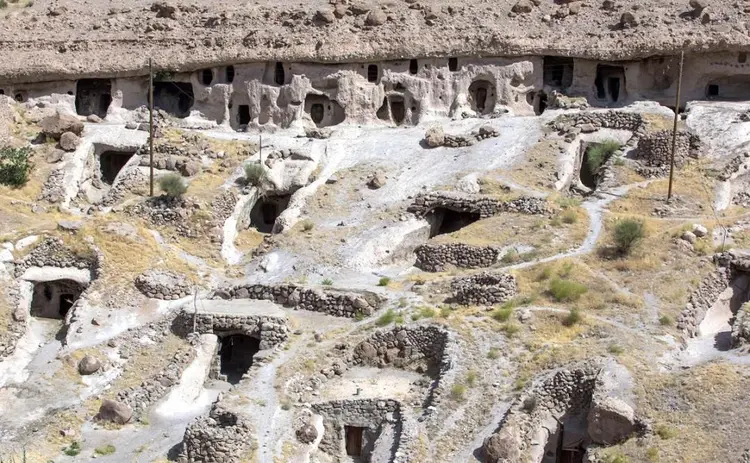
High in the mountains of Kerman Province in southeastern Iran, Meymand village is a place where people still sleep, cook and store their harvest inside rooms dug straight into the rock. Archaeological finds suggest humans were here as long as 12,000 years ago, and the cave homes themselves have been in use for thousands of years. Walking through it feels less like visiting a village and more like stepping into an open-air museum that never closed.
1. Meymand village: carved into a mountainside

Meymand sits in Shahr-e Babak County, in Iran’s Kerman Province. Its homes are not built on the rock; they are dug into it. At first glance the scene recalls Cappadocia in Türkiye, another landscape famous for rock-cut dwellings, but Meymand has a quieter, harder-edged character of its own, shaped by a dry climate with hot summers and very cold winters.
Why carve rather than build? Local tradition points to the obvious answer. Stone was everywhere. The care taken inside the rooms, though, suggests more than necessity. These were homes people meant to stay in.
2. Inside a kamar: small rooms, every one with a job

Locals call these homes kamar. According to UNESCO, each house has between one and seven rooms, traditionally used for living and storage, and some units stack single rooms four or five levels up the slope, each with its own stove area. Bedroom, kitchen, sitting room, storeroom: it is the floor plan of a small apartment, only chiseled out of soft rock.
That rock does a lot of quiet work.
It keeps the rooms cool in summer and holds warmth in winter, a natural form of insulation that no modern system had to install. Life here is simple and close to the landscape, with few of the comforts a city visitor takes for granted. After dark, the sky is the main show.
3. People who still follow the old rhythm

Meymand is not a ghost town. Its residents are largely semi-nomadic, living from farming and herding. Many are shepherds who take their flocks to higher pastures in summer and come back down to the cave dwellings for the winter, which is when the village is at its fullest. The numbers are small. The 2016 census counted 105 people in 44 households, and that smallness is part of why the old routines have survived.
4. Architecture made from what the mountain offered

From outside, the houses almost vanish. Doorways, steps and small terraces emerge from the slope as if the mountain had grown them. Up close, the scale becomes clear. The rock here is a sedimentary formation laid down roughly 100-200 million years ago, soft enough to carve by hand and solid enough to last for generations, which is exactly the combination a builder without bricks would hope for. Each room was dug to fit a purpose, whether that meant sleeping, cooking or storing grain, and the result is one of the oldest living examples of rock-cut architecture in the region. Visitors often arrive expecting a single cave or two; what they find is an entire neighborhood stacked into the hillside.
5. More than a settlement: a cultural landscape

Over the centuries, different beliefs and customs have left their mark on Meymand, and the local dialect is said to preserve old words from the Sasanian era. UNESCO’s view is wider. It treats the whole valley, not just the houses, as one heritage site: in 2015 it was inscribed on the World Heritage List as the Cultural Landscape of Maymand, recognizing a way of life that moves with the seasons.
6. Handmade crafts and a guesthouse at the gate

Meymand’s people work with what the land gives them. Handicrafts are part of the draw. Stone carving, pottery and weaving have long belonged to village life rather than a show staged for tourists. A small guesthouse near the entrance offers a handful of rooms for travelers who want to stay the night, and, at least by some accounts, the old bathhouse has been used to display petroglyphs and local stories.
7. Traces of life from 12,000 years ago

Here the dates need a little care. The often-quoted figure of 12,000 years is based on fragments of stone engravings; finds also include engravings around 10,000 years old and pottery around 6,000 years old. The cave homes are younger. Much younger. Roughly 3,000 to 4,000 years old, they sit in a village that has been lived in continuously for more than 3,000 years. Compare that with Kandovan, Iran’s other well-known cave village, which has been inhabited for about 700 years, and Meymand’s head start is enormous. Today the village counts about 406 residential cave units with some 2,560 rooms. Many stand empty. The 2015 World Heritage inscription came a decade after the village won the UNESCO Melina Mercouri prize for safeguarding cultural landscapes.
Few places let you stand inside a room that has been someone’s home for three thousand years.
Sources: Wikipedia, UNESCO World Heritage Centre, Arkeonews, The Mind Circle








Bir yanıt yazın