
11 Ancient Cities in Antalya for History Lovers to Visit


Antalya is famous for its beaches, but the ancient cities in Antalya are reason enough to make the trip. The province sits where the ancient regions of Lycia, Pamphylia, Pisidia and Cilicia met, and the city itself takes its name from Attaleia, the “land of Attalus.” Few stretches of the Mediterranean pack this many ruins into one coastline.
1. Aspendos, Best Known of the Ancient Cities in Antalya

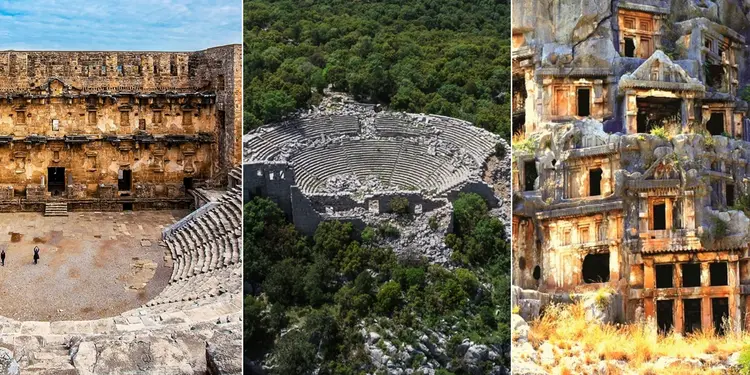
Aspendos lies in the Serik district, east of Antalya city center, beside the river the ancients called the Eurymedon. Its origins are hazy, and ancient writers credit several different founders. The theater is the draw. Built by the Romans in the 2nd century AD, it still has its tall stage building and ranks among the best-preserved theaters of the ancient world.
A city on a busy trade route was always worth fighting over, and Aspendos changed hands again and again.
2. Perge: Bronze Age Roots and a Famous Mathematician

Perge is in the Aksu district, about 15 km east of Antalya. Excavations began in 1946. Digs on its acropolis have traced settlement back to the Early Bronze Age, and a bronze treaty tablet found at the Hittite capital, Hattusa, names a city called Parha that scholars identify with Perge. In the Hellenistic period it was among the richest and best-looking cities of the region; under Rome it later served as capital of the province of Pamphylia Secunda. Anyone who survived geometry class may know the name. Apollonius of Perga, the mathematician behind the classic study of conic sections, was born here.
3. Olympos: A Harbor Town in a Wooded Valley

Olympos sits near the beach at Çıralı, in the Kumluca district, where a narrow valley opens onto the sea. When was it founded? Nobody knows. The Greek geographer Strabo is the earliest writer to mention it, and the walls that survive date from the 1st century BC or later. Like Phaselis further up the coast, it lived off the sea and trade, and it was one of the six Lycian League cities that held three votes in the league’s assembly.
Ruins half-hidden under pine and laurel make it feel less like a museum than a find.
4. Side: A Peninsula Full of Temples

Side was built on a small peninsula in ancient Pamphylia, roughly 1 km long. Alexander the Great marched through Anatolia in 333 BC. Side fell without a fight. It grew rich in the Hellenistic period, minted its own silver coins and became an important cultural center. Then came the pirates. In the 1st century BC, Cilician pirates used Side as their main naval base and a slave market. Today the Temple of Apollo at the tip of the peninsula, the Hellenistic main gate, the theater and the colonnaded street stand right beside a busy resort town.
5. Myra: Rock Tombs and the Church of St. Nicholas

Myra, in today’s Demre, was a Lycian city, and three things make it famous: tombs cut into the cliff face like little temple fronts, a Roman theater rebuilt after an earthquake in 141 AD, and the Church of St. Nicholas. Nicholas was bishop of Myra. His legend, improbably enough, grew into the Santa Claus story. The town itself is far older: coins and Lycian inscriptions found at the site are usually cited as evidence of a settlement here by the 5th century BC.
6. Phaselis: Three Harbors on One Headland

Colonists from Rhodes are thought to have founded Phaselis around 690 BC, on a small neck of land between the sea and its harbors. That position made it the most important port of eastern Lycia. Was it Lycian or Pamphylian, then? Ancient writers placed it in one or the other, because it stood right where the two regions met, and it never joined the Lycian League. Three harbors survive. The ruins run almost down to the water.
7. Patara: Lycian League Capital Beside a Turtle Beach

Patara lies at the southwestern end of the Xanthos Valley, next to the village of Gelemiş in the Kaş district. For a period it was the capital of the Lycian League, and its council house served as the league’s assembly hall. Like Olympos, it was one of the six league cities with three votes. Systematic excavations began in 1988.
Behind the ruins stretches Patara’s long beach, a protected nesting ground for loggerhead sea turtles (Caretta caretta). Ruins and turtles share an address.
8. Termessos: The City Alexander Couldn’t Take

Termessos sits on a natural plateau on Güllük Dağı, the ancient Mount Solymos, about 1,000 meters above sea level. It was founded by the Solymi, a local people mentioned by Homer, and its remote, rugged setting is a big part of why it is one of the best-preserved ancient cities in Türkiye. In 333 BC Alexander the Great surrounded the city. He failed and marched on. Side, remember, had given in without a fight. Termessos simply waited him out. After his death the city was pulled into the wars of his successors and later came under Ptolemaic rule.
9. Xanthos: Lycia’s Largest City

Xanthos, on a hill by the village of Kınık in the Kaş district, was the leading city of ancient Lycia, and Strabo called it the largest in the region. Then there is Homer. His Iliad sends Lycians under Sarpedon to fight at Troy, though the dig results tell a more modest story: the oldest remains on the acropolis date to the 8th century BC. Together with nearby Letoon, Xanthos was added to the UNESCO World Heritage List in 1988.
10. Letoon: The Sanctuary of Leto

About 4 km from Xanthos, Letoon was the religious center of Lycia rather than a city in the usual sense. Strictly speaking, it lies just across the provincial border in the Fethiye district of Muğla, but visitors almost always see it on the same trip as Xanthos. Three temples, to the goddess Leto and her twins Artemis and Apollo, dominate the site. A Hellenistic theater stands close by. Finds here go back at least to the 6th century BC. Small, yes. But it shares Xanthos’ UNESCO listing.
11. Antiochia ad Cragum: Ruins on the Cliffs

Antiochia ad Cragum stands near Güneyköy in the Gazipaşa district, on the stretch of Mediterranean coast known in antiquity as Rough Cilicia. The city takes its name from King Antiochus IV of Commagene, who lived in the 1st century AD. Its ruins spread over three areas. The first holds a colonnaded street, an agora, baths, a triumphal arch and the remains of churches, while the second is a necropolis with tombs typical of Cilicia. And the third? Perched on cliffs above the sea, it is what is left of a medieval castle.
Sources: Antalya Tourist Information: Patara, Wikipedia: Termessos, Wikipedia: Letoon

Bir yanıt yazın