
10 Museums in Ankara Worth Visiting


Ankara, the capital of Türkiye, rarely makes it onto a first-time itinerary, which is a mistake, because the museums in Ankara tell the story of Anatolia better than almost anywhere else in the country. The range is wide. Bronze Age pottery, the rooms where the modern republic was founded, a prison turned memorial and a hangar’s worth of military aircraft are all here, spread across the city, though several of these 10 sit within walking distance of each other in the old Ulus quarter.
1. Gordion Museum

The Gordion Museum stands near the village of Yassıhöyük in Polatlı, next to the site of Gordion. This was ancient Phrygia’s capital. King Midas’s city, too. Opened in 1963, the museum runs from Early Bronze Age and Hittite finds to imported Greek pottery and Hellenistic and Roman pieces, while seals and coins found at Gordion get their own displays alongside a Roman-era mosaic excavated at the village of Kayabaşı and a Galatian grave. Some of the larger pieces sit outdoors in the museum garden. The site is a half-day trip from central Ankara, so pair the museum with a walk around the excavations and the great burial mounds.
2. Ethnography Museum

Built between 1925 and 1928 to a design by architect Arif Hikmet Koyunoğlu, the Ethnography Museum of Ankara was one of the first museums of the Turkish Republic. Between 1938 and 1953 it also held the coffin of Mustafa Kemal Atatürk, the republic’s founder, while his mausoleum, Anıtkabir, was being built. The collection is broad. It covers Turkish art from the Seljuk period onward: folk costumes, embroidery, carpets and kilims from across Anatolia, Ottoman bows, pistols and swords, Kütahya ceramics, Sufi objects and calligraphy panels. Woodwork is the real highlight. Look for the carved doors, the pulpits and a 13th-century Seljuk sultan’s throne. For scholars, there is also a specialist library on Anatolian ethnography, folklore and art history.
3. Museum of Anatolian Civilizations

If you only have time for one stop, make it this one.
Named European Museum of the Year in 1997, the Museum of Anatolian Civilizations sits in Atpazarı, one of Ankara’s oldest trading quarters, just below the walls of Ankara Castle. Two Ottoman buildings hold it: the Mahmut Paşa covered bazaar and the Kurşunlu Han, an old inn. Its growth owed much to Atatürk’s wish for a Hittite museum. The order is chronological. Galleries lead from the Paleolithic through the Neolithic, the Bronze Age, the Assyrian trading colonies, the Hittites, the Phrygians and the Urartians, with finds from landmark excavations such as Çatalhöyük, Alacahöyük, Kültepe, Boğazköy and Gordion, so one walk-through works as a crash course in Anatolian archaeology.
4. Çengelhan Rahmi M. Koç Museum

Çengelhan is a 16th-century Ottoman inn near Ankara Castle that now houses Ankara’s first industrial museum, opened in 2005 by the family behind Koç Holding, one of Türkiye’s largest business groups. Vehbi Koç, the group’s founder, started his working life in a shop in this very building. The museum recreates it. Its collection traces the history of industry, design and engineering through old cars and trains, maritime objects, machines, scientific instruments, and equipment from farming, printing, communications, medicine and pharmacy. Not everything is industrial, though. Toys, dollhouses and a street of reconstructed artisans’ workshops tend to win over anyone who arrived expecting only engines.
5. War of Independence Museum

This stone building on Ulus Square housed the first Grand National Assembly of Türkiye from 1920 to 1924, the years of the War of Independence and the birth of the republic. Later it served as the headquarters of the Republican People’s Party and as a law school. It became a museum in 1961. First called the Grand National Assembly Museum, it took its current name in 1981. Inside are personal belongings of Atatürk and the first members of parliament, medals, weapons, drafts of the 1921 constitution, and early communication equipment such as telephones and Morse telegraph printers. War-era oil paintings hang alongside.
6. Republic Museum

A few steps from the first parliament, on Cumhuriyet Caddesi in Ulus, stands its successor. Designed by architect Vedat Tek, the building took over as the home of the Turkish parliament in 1924, once the first assembly building had become too small. It served until 1960.
Since 1981 it has been the Republic Museum. Photographs of former presidents and prime ministers, assembly records and stationery, banknotes and coins from the Republican era, and material on Atatürk’s reforms cover the early decades of the republic.
Visit the two back to back. Seen alongside the War of Independence Museum, this building makes it easy to follow how a wartime assembly grew into a state.
7. Ulucanlar Prison Museum

Ulucanlar was a working prison from 1925 until 2006. For much of that time it held people jailed for their political views or their writing. It reopened as a museum in 2011 and is now one of the most affecting stops in the city.
The cells and courtyards display the stories, photographs and personal belongings of the journalists, writers, poets and politicians who served time here. Families donated many of them. Wax figures fill recreated dormitories and isolation cells. Then there is the library. It collects books by prominent political prisoners, court records and hard-to-find first editions, reason enough to give the museum more time than a quick walk past the cells would take.
8. MTA Natural History Museum

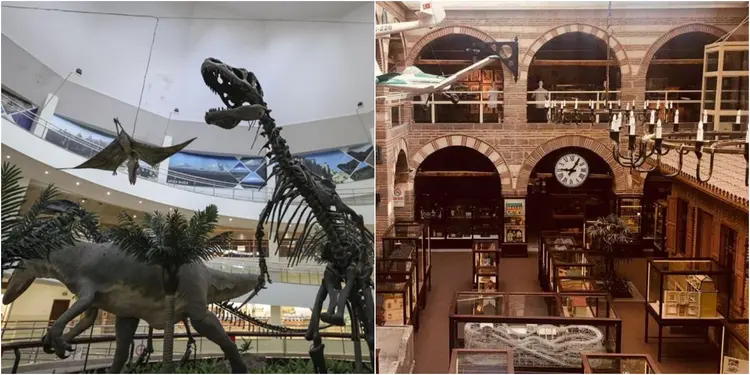
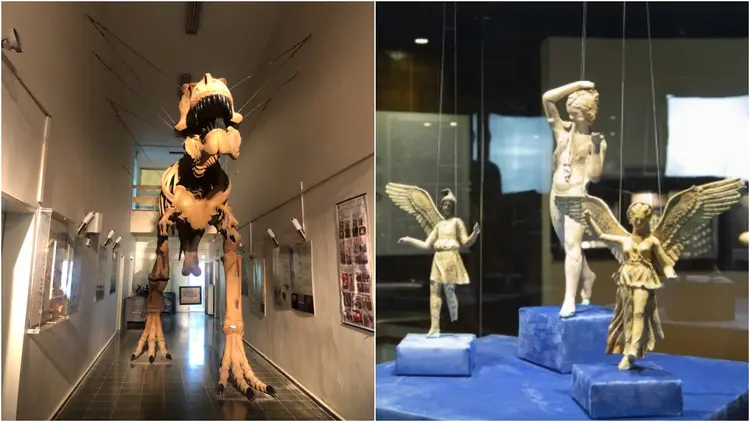
The MTA Natural History Museum is Türkiye’s first natural history museum, opened in 1968 inside the campus of the General Directorate of Mineral Research and Exploration (MTA) in the Çankaya district. Most of its collection came from the institute’s own geological, mineralogical and paleontological digs, and the highlights include a giant ammonite about 185 million years old, the roughly 3,500-year-old skeleton known as the Maraş Elephant, a whale skeleton washed ashore on Türkiye’s southern coast, and human footprints about 13,000 years old. University research material rounds out the displays. A room of dusty rocks it is not. Children head straight for the dioramas.
9. Air Force Museum

The Turkish Air Force opened this museum in Etimesgut, about 16 km (10 miles) west of central Ankara, on September 18, 1998. Sabiha Gökçen attended the opening. Atatürk’s adopted daughter and Türkiye’s first female combat pilot, she has a corner of the museum dedicated to her.
Outside, MiG-series jets stand on the apron. A replica of an early Blériot aircraft keeps them company. Indoors you’ll find models of Turkish Air Force aircraft since 1911, uniforms, flags and models of the gliders attributed to the 17th-century Ottoman aviators Hezârfen Ahmed Çelebi and Lagâri Hasan Çelebi. “Attributed” is the key word there. How far did those early flights really go? Nobody can say with any certainty.
Truth be told, the T-33 and F-5 cockpits that visitors can climb into are the part most people remember.
10. State Art and Sculpture Museum

The State Art and Sculpture Museum fills a building completed in 1930 for the Turkish Hearths, a cultural association, and designed by Arif Hikmet Koyunoğlu, the same architect behind the Ethnography Museum. It is one of the finest examples of the First National Architectural Movement, the early republic’s style that borrowed from Seljuk and Ottoman forms. It became a museum in 1980. Six halls show around 750 works of Turkish painting and sculpture, split between artists from before and after the founding of the republic, and the building also holds galleries for temporary national and international exhibitions, painting, sculpture, ceramics and restoration workshops, a library and a theater and concert hall. Concerts, film screenings, folk dance performances and talks are staged here too. Check the program before you go.
Sources: Wikipedia: Museum of Anatolian Civilizations, Wikipedia: Ethnography Museum of Ankara, Turkish Museums (Ministry of Culture and Tourism): Ankara Museums of Rahmi M. Koç

Bir yanıt yazın