
5 Sunken Cities in Turkey You Can Still Visit


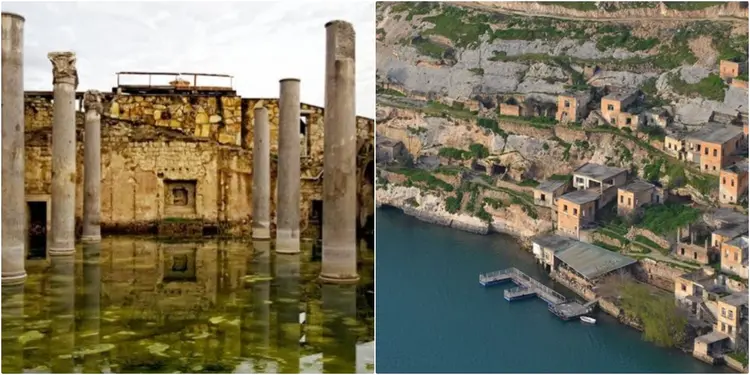
Most of the world’s sunken cities were swallowed by earthquakes, but the sunken cities in Turkey mostly tell a different story. Only one place on this list went under because the ground moved; the other four disappeared beneath reservoirs built in the late 20th and early 21st centuries. What is left is a strange kind of sightseeing in Türkiye: minarets, tombs and old streets seen from a boat, or not seen at all.
1. Dolichiste, Kekova (Antalya)

Kekova is a small, uninhabited island off the coast of Demre, in Antalya Province on Turkey’s Mediterranean coast. On its north side lie the half-drowned ruins of Dolichiste, an ancient town wrecked by an earthquake in the 2nd century AD.
The area was part of Lycia, an ancient region of southwestern Anatolia, and later came under Roman rule. Dolichiste was rebuilt and thrived again in the Byzantine period. Then Arab raids emptied it. Today you can still make out building foundations, staircases cut into the rock and the outlines of old houses slipping into clear, shallow water, while Lycian tombs dot the shoreline across the bay at Kaleköy, the ancient Simena.
You see it from the deck, not with a mask.
The Kekova region was declared a specially protected area in 1990, and swimming and diving are not allowed around the sunken city itself. Boat tours run from the nearby coast, with Üçağız and Kaleköy the usual bases.
2. Eğil (Diyarbakır)

Eğil, a district about 50 km (31 miles) from the city of Diyarbakır in southeastern Turkey, is a center of faith tourism, known for shrines associated with several prophets and for its rock-cut royal tombs. The Dicle Dam, completed on the Tigris in 1997, flooded parts of the town and turned it into a lakeside settlement.
Under the reservoir, gendarmerie divers have filmed rock-cut tombs, a mosque, a madrasa and a bathhouse, with some remains dated to roughly 2,400 years ago, according to Hürriyet Daily News. Before the water rose, the tombs of the prophets Zulkifl and Elyesa were moved to higher ground. When drought lowers the lake, outlines of the drowned buildings sometimes reappear. Boats are the easiest way in: trips on the lake pass the castle, the tombs and the cliffs.
3. Hasankeyf (Batman)

Of all the sunken places in Turkey, Hasankeyf is the one that drew the loudest protests.
The town on the Tigris, in Batman Province, went under the reservoir of the Ilısu Dam in 2020. Its history runs deep: the town may appear in the Mari tablets of around 1800 BC, the cliffs around it hold thousands of carved caves, and the site is often described as up to 12,000 years old. Roman, Byzantine, Arab and later Turkic and Kurdish rulers all left their marks on it. By July 2020 it was underwater. Only a handful of monuments, among them the Zeynel Bey Mausoleum, were moved to a cultural park near the new town of Yeni Hasankeyf, built on a hill above the lake.
Put simply, the reservoir itself is now the attraction. Boats cruise over the old town, and plans to develop diving tourism around the submerged ruins have been announced.
4. Allianoi (İzmir)

Allianoi lies about 18 km (11 miles) northeast of Bergama, the ancient Pergamon, in İzmir Province. Like Hasankeyf, it is a heritage site that could not be saved.
Early Bronze Age finds, including pottery and stone axes, show people lived here long before the Romans. The site’s fame, though, comes from its hot springs: a thermal bath complex existed by the Hellenistic period, and in Roman times it grew into a major spa with baths and a nymphaeum, a monumental fountain, making it one of the best-preserved healing centers of the ancient world. Rescue excavations began only in the late 1990s, once the dam was already planned. Sand came first. The ruins were buried in it for protection, and the Yortanlı Dam began filling on December 31, 2010. By February 2011, Allianoi was underwater, nine years before the same fate reached Hasankeyf.
5. Savaşan Village, Halfeti (Şanlıurfa)

Halfeti, in Şanlıurfa Province, is known for its old stone houses and its black roses, often billed online as growing nowhere else on Earth. That last part is internet legend, not botany.
It is also home to what may be Turkey’s most photogenic sunken village. Savaşan went under when the reservoir of the Birecik Dam on the Euphrates filled around 2000. Not all of it, though. The upper part of the mosque’s minaret still sticks out of the water, and the lake around it makes this steppe landscape look more like a seaside resort. Halfeti’s main draw? Boat cruises on the Euphrates, many of which pass Savaşan on the way to Rumkale, a hilltop fortress upriver.
Sources: Wikipedia, Kekova, Wikipedia, Hasankeyf, Wikipedia, Allianoi, Wikipedia, Halfeti, Hürriyet Daily News, structures beneath the Dicle Dam

Bir yanıt yazın