
Istanbul Archaeology Museum History in 8 Moments


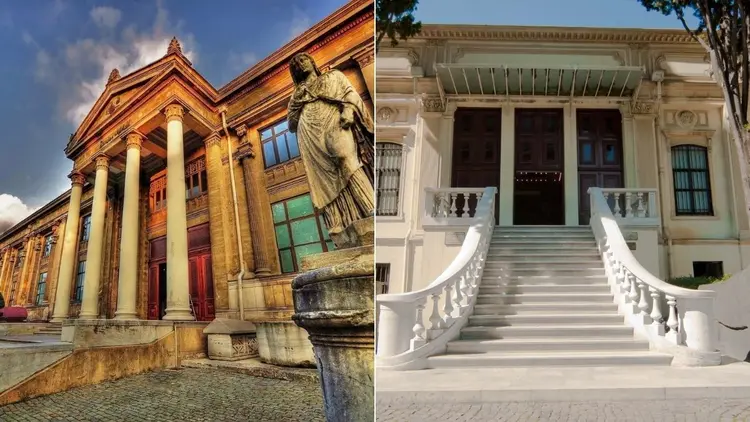
The Istanbul Archaeology Museum is widely described as Türkiye’s first museum, and it sits just below Topkapı Palace in the historic Sultanahmet area. It is really three museums in one: the Archaeology Museum, the Museum of the Ancient Orient and the Tiled Kiosk. Here is how a pile of antiquities in a former armory became a complex holding around a million objects.
1. It began as the Imperial Museum in 1869

The museum was founded in 1869 as the Müze-i Hümayun, the Imperial Museum, when the Ottoman state decided to turn its habit of collecting antiquities into a proper institution. The interest itself was older. It went back to Mehmed II, the sultan who conquered Constantinople in 1453. The first collection was gathered in Hagia Irene, a Byzantine church next to Topkapı Palace that for a long stretch served as an armory—and from the mid-19th century also held archaeological finds. Weapons and statues, side by side. That odd mix was where Ottoman museum culture took its first steps.
2. The collection moved into the Tiled Kiosk

Hagia Irene soon ran out of room. The answer was the Tiled Kiosk (Çinili Köşk), a pavilion Mehmed II had built back in 1472, and after the antiquities were moved there in the 1870s (sources don’t agree on the exact year), the kiosk opened to visitors in 1880.
A year later came the turning point. Osman Hamdi Bey became director, and the museum’s collecting went into high gear.
3. Osman Hamdi Bey took charge in 1881

Osman Hamdi Bey wore several hats. A painter and an archaeologist, he is the man who shaped the museum as visitors know it today, and he led excavations at Mount Nemrut, at the Temple of Hecate in Lagina and, in 1887-1888, at the royal necropolis of Sidon in present-day Lebanon.
Sidon alone sent back the Alexander Sarcophagus and the Sarcophagus of the Mourning Women. Finds on that scale needed a much larger home.
4. Digs across the empire filled the storerooms

Thanks to Osman Hamdi Bey, excavations started across the Ottoman Empire, from Anatolia to the Levant. Crates of sculpture and sarcophagi kept arriving in Istanbul. Space ran short. The Alexander Sarcophagus shows why. Despite the name, this carved marble chest was not Alexander the Great’s coffin, although it was once believed to be. It is far too grand for a small pavilion, and so are many objects like it.
5. Alexandre Vallaury designed a purpose-built museum

Designed by Alexandre Vallaury, the architect behind the Pera Palace Hotel, the new main building opened on June 13, 1891. The style is neoclassical. More unusually, it was one of the first buildings in the country designed from the start as a museum, and its facade even borrows motifs from the Alexander Sarcophagus and the Sarcophagus of the Mourning Women that it was built to hold. Look up at the entrance. The Ottoman Turkish inscription reads “Asar-ı Atika Müzesi” (Museum of Antiquities), crowned with the tughra, the calligraphic monogram, of Sultan Abdulhamid II. Two wings followed in 1903 and 1907, giving the building its present form.
6. Around a million objects from across the empire

The collection holds roughly one million objects from the many cultures of the former Ottoman lands. A million objects? That figure is less dramatic than it sounds. Most are small: coins, seals and medals make up the bulk of it. The headline pieces are the sarcophagi from the royal necropolis of Sidon, namely the Alexander Sarcophagus, the Sarcophagus of the Mourning Women and the Lycian Sarcophagus.
Greek and Roman sculpture fills the galleries too, including a head of Aphrodite and a statue of Alexander the Great. Across the courtyard stands the Tiled Kiosk, the oldest building in the complex and one of the oldest surviving examples of Ottoman civil architecture in Istanbul, which now displays Turkish tiles and ceramics. It is easy to walk straight past it on the way to the sarcophagi.
7. The Museum of the Ancient Orient began as an art school

Osman Hamdi Bey had this building put up in 1883 as the Academy of Fine Arts (Sanayi-i Nefise Mektebi), with Vallaury again as architect. The academy moved out in 1917. The building then passed to the museum directorate, and in 1935 it reopened as the Museum of the Ancient Orient, displaying finds from Mesopotamia, Egypt and Anatolia. Compare it with the main building next door: same architect, eight years apart, one built for students and one built for sarcophagi.
8. The Istanbul Archaeology Museum as a model for Türkiye

Its influence reached beyond Istanbul. The success of the Istanbul Archaeology Museum helped spread the idea of public museums to other cities in Türkiye. Today the complex still has the same three parts: the Archaeology Museum, the Museum of the Ancient Orient and the Tiled Kiosk.
With around a million objects, it is often counted among the world’s major archaeology museums.
For a visit, the practical details: the official museum site lists daily opening from 09:00 to 18:30, with the ticket office closing at 17:30, and an entry price of €15 (approx. $17).
Sources: Turkish Ministry of Culture and Tourism: Istanbul Archaeological Museums, Wikipedia: Istanbul Archaeology Museums, Wikipedia: Museum of the Ancient Orient



Bir yanıt yazın