
12 Facts About Petra, Jordan’s Rose-Red City


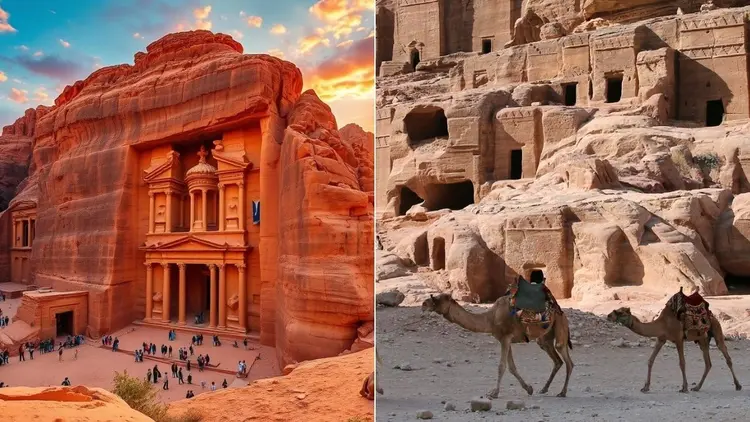
Petra is a city carved straight into the sandstone cliffs of southern Jordan. These facts about Petra run from Nabataean caravan traders to Roman rule, a long silence, and a rediscovery that still isn’t finished. UNESCO lists it as a World Heritage Site and a 2007 global vote named it one of the New 7 Wonders of the World, yet its builders left behind more puzzles than written records.
1. The Nabataeans built it more than 2,000 years ago

The Nabataeans emerged in Arabia around the 4th century BC. Hard facts about them are scarce. What is known is that they started out as nomads, used Arabic and Aramaic, and had a real talent for controlling the caravan routes, a skill that by around 100 BC had made them a regional power. Why Petra as their capital? Short answer: its sandstone mountains and cliffs made it easy to defend.
2. Rome took full control in AD 106

Nobody knows exactly when Petra was built. By the 1st century BC, though, it had become a center of art and architecture shaped by Hellenistic and Roman styles, with theaters, statues and paved streets. Then came Rome. After the death of Rabbel II, the last Nabataean king, the empire absorbed the kingdom in AD 106 as the province of Arabia Petraea.
3. Shifting trade routes slowly emptied the city

At its peak, Petra was home to an estimated 20,000 to 30,000 people. But Rome redirected trade. Merchants turned to sea routes, the city’s wealth drained away, and in AD 363 a major earthquake damaged many buildings and crippled the water system. After that, people left little by little. Crusaders built small forts in the area, including one on the summit of al-Habis, yet for centuries Petra stayed largely cut off from the outside world.
4. The Nabataeans were master stone carvers

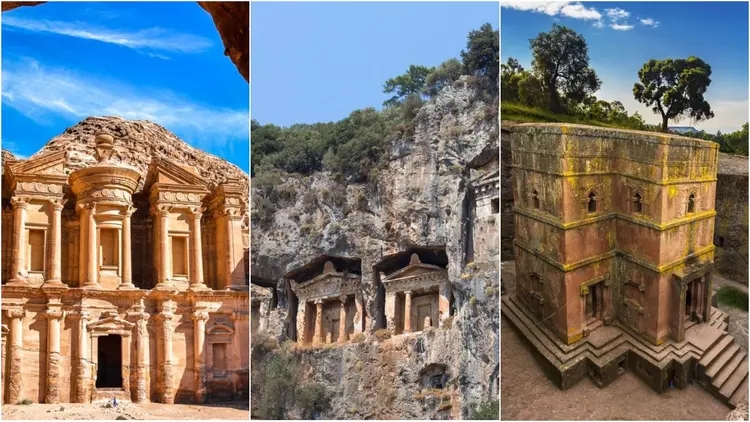
The name comes from petra, the Greek word for “rock.” Fitting, since the Nabataeans carved temples, tombs and homes directly into the sandstone, and some 3,000 structures have been documented. All of it was cut by hand. Craftsmen worked from the top of a cliff face downward, and they are believed to have used water and wooden wedges to split the rock.
5. A desert water system that still impresses engineers

Trade and stonework weren’t the Nabataeans’ only skills. The region gets only about 15 cm (6 in) of rain a year, yet they collected and stored fresh water with terracotta pipes, channels and cisterns. By one estimate, the system could deliver up to 45 million liters (12 million gallons) a day. Enough for the whole population. Flash floods were handled too: a dam diverted them into a channel known as the “dark tunnel.” Compare that with the AD 363 earthquake in item 3, and the link is clear: once the water network broke, the city’s decline sped up.
6. Petra has links to stories of Moses and Aaron

On top of Jabal Haroun (Mount Aaron), about 1,350 m (4,430 ft) high, stands a small white-domed mosque built in the 14th century. Tradition gives it a famous occupant: Aaron, the brother of Moses.
The valley around Petra is called Wadi Musa, the “Valley of Moses,” and local tradition links it to the Bible story in which Moses strikes a rock and water flows out.
7. A Swiss explorer rediscovered it in 1812

Johann Ludwig Burckhardt was born in 1784 and studied in Europe, including at Cambridge, before setting off to explore the Middle East and Egypt. In 1812, while traveling from Syria to Egypt, he reached Petra and became the first European in some 500 years to see it.
Local Bedouin had never lost track of the place; it was Europe that had forgotten it.
His account came out in 1822. Travels in Syria and the Holy Land carried his detailed description and drew a stream of Western travelers, among them the American painter Frederic Edwin Church and the English artist Edward Lear.
8. A poet who never went there named it the “rose-red city”

In 1845, John William Burgon won Oxford University’s Newdigate Prize for his poem “Petra.”
Here’s the odd part: he had never seen the place. Even so, his line “a rose-red city half as old as time” stuck, and the nickname still follows Petra today.
9. It has been a UNESCO World Heritage Site since 1985

UNESCO inscribed Petra on the World Heritage List in 1985. The same year, Jordan resettled the Bedul Bedouin, who had been living in Petra’s caves, to the nearby village of Umm Sayhoun. Protecting the site has meant balancing tourism, development and the people who live around it.
10. Millions of voters made it one of the New 7 Wonders

The New7Wonders campaign (2000-2007), led by Bernard Weber, invited people worldwide to vote for their favorite historic monuments. It was an unscientific poll. UNESCO did not endorse it.
Still, with around 100 million votes reported, it put Petra on its list alongside the Great Wall of China, the Colosseum in Rome, Chichen Itza in Mexico, Christ the Redeemer in Rio de Janeiro, Machu Picchu in Peru and the Taj Mahal in India.
11. Indiana Jones went looking for the Holy Grail here

Before Indiana Jones and the Last Crusade (1989), Petra reportedly saw only a few thousand tourists a year. The film used the Siq, the narrow canyon leading into the city, and Al-Khazneh (the Treasury) as the hiding place of the Holy Grail.
One Hollywood film later, Petra was Jordan’s best-known attraction.
12. New facts about Petra are still turning up

Archaeologists Sarah Parcak and Christopher Tuttle studied Petra with satellite imagery, Google Earth and drone photos. In 2016 they announced a previously unknown monument a short way from the city center: a huge open platform, roughly the length of an Olympic swimming pool, holding a smaller platform with columns, a small building and a large staircase. The builders? Likely the Nabataeans, around the middle of the 2nd century BC, probably for public ceremonies and possibly religious ones. More than two centuries after Burckhardt, the city keeps giving up secrets.
Sources: UNESCO World Heritage Centre, Petra, Wikipedia, Petra, Mental Floss, 12 Amazing Facts About Petra

Bir yanıt yazın