
Pluto’s Gate in Pamukkale: 7 Facts About the Gate to Hell


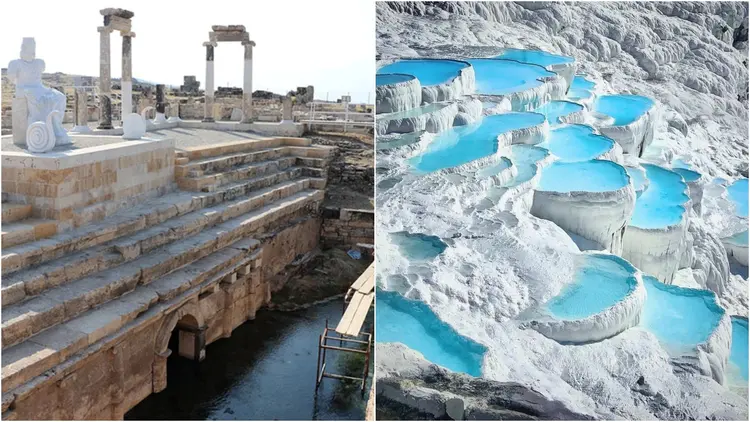
Most visitors to Pamukkale, the white travertine terraces of western Türkiye, come for the photos and leave without noticing the small cave in the ruins above them. That cave is Pluto’s Gate, the Ploutonion of ancient Hierapolis, which the ancients believed opened onto the underworld. Animals that went in died on the spot, the priests who led them walked back out, and it took modern science to explain why.
1. Hierapolis rose in the 2nd century BC

Hierapolis was founded around 190 BC. Eumenes II, king of Pergamon, gave it the status of a Greek city. When the last Pergamene king, Attalus III, left his kingdom to Rome in 133 BC, the city passed into the Roman province of Asia, where its hot springs made it a famous spa and its golden age came in the 3rd century AD, after Emperor Caracalla’s visit in 215.
Today Hierapolis and Pamukkale share a single UNESCO World Heritage listing. It dates from 1988.
2. A spa town with a dark legend

Not everything in Hierapolis was about healing. Right next to the Temple of Apollo, a small cave breathed out a gas that people believed came from Pluto (the Roman name for Hades, god of the underworld), and the sanctuary built around it was called the Ploutonion, the “place of Pluto.” A marble statue of Hades stood nearby, with Cerberus, his three-headed dog. The temple and the cave sit on the same geological fault. No coincidence.
3. Sacrifices that looked like miracles

The ritual was pure theater.
A priest led a sacrificial animal toward the opening, and the animal collapsed and died. The priest? Unharmed. According to the Greek geographer Strabo, any animal passing inside met instant death, a claim he tested himself by throwing in sparrows. There was money in it as well: priests sold birds to visitors who wanted to see the deadly air at work, and paid consultations with the oracle brought in a steady income. How much the priests themselves understood about the gas is anyone’s guess.
4. Pluto’s Gate today is quiet

It’s quiet now. Among the ruins, it’s hard to picture the drama. In Christian times the entrance was walled off, then 6th-century earthquakes brought down the temple, and the site stayed lost until Italian archaeologists rediscovered it in 1965, with excavations led by Francesco D’Andria of the University of Salento exploring it further in 2013.
Then a German biologist decided to test whether the old stories held up.
5. Pfanz measured the deadly air

Hardy Pfanz came better equipped than Strabo and his sparrows. A biologist at the University of Duisburg-Essen who studies volcanic gases, he brought portable gas sensors to the Ploutonion. Normal air holds about 0.04% carbon dioxide. Inside the grotto, his team measured concentrations of up to 91%. The university’s own figures put that in context: even 5 to 8% is enough to make someone dizzy, and levels of 60 to 80% would suffocate a person almost immediately.
6. The same faults that built Pamukkale

Where does the gas come from? The same tectonic system that created Pamukkale’s travertines. Hierapolis lies on active faults. One of them runs right under the Temple of Apollo and the cave, and through these cracks warm water rises, depositing the white terraces in one place and releasing carbon dioxide in another.
So the postcard view and the “gate to hell” are two products of the same restless ground.
7. Why the priests walked out alive

It wasn’t divine protection. Carbon dioxide is heavier than air, and it pools near the ground. Pfanz’s team found that the gas layer builds up at night and early morning, up to about 1.5 meters deep, and thins out as the sun warms the site. Animals breathed at ground level and died. The priests, standing on stones, kept their heads above the deadly layer. Roman writer Pliny the Elder offers another, far less scientific explanation: the castrated priests of Cybele were thought to be immune.
Hierapolis is well worth the climb above the terraces, and Pluto’s Gate shows how myth and geology once told the same story.
Sources: Wikipedia, Ploutonion at Hierapolis, Wikipedia, Hierapolis, University of Duisburg-Essen, “Der Hauch des Todes”









Bir yanıt yazın