
Catacombs of Rome: 7 Secrets of the City of the Dead


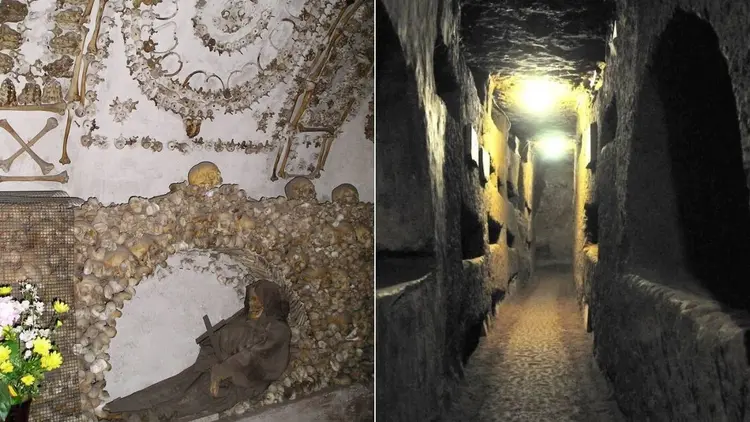
Underneath Rome lies a second city that most visitors never see. The Catacombs of Rome form a network of tunnels that runs for some 640 km beneath an area of roughly 240 hectares (about 600 acres), lined with early Christian art and the remains of hundreds of thousands of people. Its story stretches from a Roman burial law to a chance rediscovery in 1578, and a handful of its tunnels are still open to visitors.
1. Ancient Romans could not bury their dead inside the city

Cremation was the norm in ancient Rome for a long time. Burial was another matter. Roman law forbade it within the city limits, so every cemetery had to lie outside the walls. That one rule explains their location. So don’t look for them in the historic center: the catacombs sit along the old consular roads, such as the Via Appia Antica, on what were once the outskirts.
2. Jewish communities dug the first ones, and Christians followed

In the 1st century AD, Rome’s Jewish communities began cutting underground burial grounds just beyond the city walls. Contrary to the popular picture, the catacombs were not a Christian invention. Christians copied the idea. As their faith spread through the 2nd and 3rd centuries and each early Christian community came to want cemeteries of its own, the number of catacombs grew fast. Only six Jewish catacombs have been found. Christian ones run to several dozen; in total, around 60 catacombs are known in and around Rome today.
3. Graves of martyrs turned the catacombs into shrines

Once saints and martyrs were laid to rest underground, their tombs became places of pilgrimage, and ordinary believers wanted to be buried as close to them as possible. Hundreds of thousands ended up here.
Then the reason for them faded. After Emperor Constantine legalized Christianity in 313, Christians began burying their dead in cemeteries above ground, and the catacombs slowly fell out of use, though exactly how fast is hard to pin down.
4. After 313, the tunnels slipped out of memory for centuries

By the 6th century the catacombs were used mainly for memorial services at the martyrs’ tombs. Goths, Vandals and Lombards who sacked Rome also plundered them, and over time the most precious relics were carried to churches above ground. By the 10th century the galleries were practically abandoned. Forgotten, even. Then, in 1578, a buried cemetery turned up by chance. Serious exploration came later. It took a young student of Christian antiquities, Antonio Bosio, who in 1593 set out to find the lost catacombs not with a shovel but by reading early Christian texts for clues to the hidden stairways that led down into them.
5. Bosio’s first great find was the Catacombs of Domitilla

In December 1593, Bosio found his way into the Catacombs of Domitilla, a complex that today stretches for about 17 km. More sites followed. He documented each one with painstaking care, in a survey that was published only after his death as Roma Sotterranea (1632) and through which many of the burial sites known today were first mapped.
Hence his nickname: “Columbus of the Catacombs.”
6. The Catacombs of Rome hold some of the oldest Christian art

Among the most striking works is a painting in the Catacomb of Priscilla showing Jesus as the “Good Shepherd,” considered one of the oldest known images of him. It hints at how the earliest Christians imagined Christ, long before the bearded, enthroned figure of later church art.
Priscilla also holds what is thought to be the earliest known depiction of the three Magi, dating to the mid-3rd century. Elsewhere, painted walls show Jesus with his Apostles, including Peter and Paul. The catch: visitors see only a fraction of the network. Five Christian catacombs welcome visitors: San Callisto, San Sebastiano, Domitilla, Priscilla and Sant’Agnese. Two Jewish catacombs, Vigna Randanini and Villa Torlonia, can also be seen.
Not a catacomb but often paired with one on the same trip, the Capuchin Crypt beneath the Church of Santa Maria della Concezione dei Cappuccini dates from the 17th century and holds the bones of about 3,700 people.
7. More of underground Rome is still waiting to be found

In 2017, laser restoration in the Catacombs of Domitilla brought a fresco of Jesus and his Apostles back into view after centuries under grime. Finds like this matter. They suggest that plenty more lies under the city’s streets, uncatalogued. Rome has lost track of its underground once already, for centuries, and it took Bosio’s reading of old texts to win it back.
Who knows what the next tunnel holds?
Sources: Wikipedia: Catacombs of Rome, All That’s Interesting: Inside the Catacombs of Rome







Bir yanıt yazın