
The 20 Most Beautiful Castles in the World


Castles were built to keep people out, which is exactly why so many of them are still standing centuries later. The most beautiful castles in the world range from fairy-tale palaces in the Alps to Crusader strongholds and a white “heron” in Japan. Here are 20 of them, each with a story worth the trip.
1. Neuschwanstein Castle, Germany

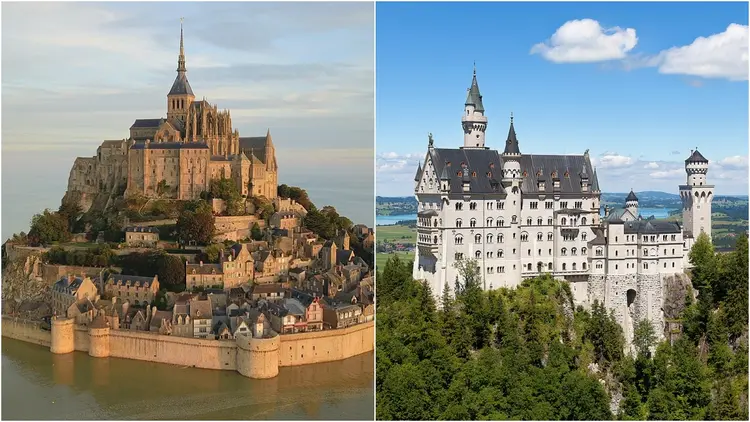
Neuschwanstein sits in the far south of Germany, in the Alpine foothills near the Austrian border, and King Ludwig II of Bavaria wanted it there precisely because it was far from everyone else. He never saw it finished. Ludwig died in June 1886, and within weeks the regent opened the castle to paying visitors, the very crowds the king had tried to escape. The castle was never finished at all. Only about 15 rooms were done, and the planned keep and chapel were never built. Today well over a million people visit each year, making it one of the most visited castles in Europe, and in 2025 it joined the UNESCO World Heritage List along with Ludwig’s other palaces.
2. Alcázar of Segovia, Spain

Perched on a rocky ridge in the city of Segovia, with the Guadarrama mountains in the distance, the Alcázar looks built for a film. The comparison is apt. Its silhouette is credited as an inspiration for the castle in Disney’s 1937 Snow White and the Seven Dwarfs. It began as a fortress, later served as a royal palace and now houses both an armory museum and the General Military Archive of Segovia, which gives one building three very different careers.
The name is Arabic. Al-qasr means “the castle.”
3. Balmoral Castle, Scotland

Queen Victoria and Prince Albert first came to Balmoral in 1848. They were smitten. By 1852 the estate had been bought outright, and the castle you see today was built between 1853 and 1856. It is not an official residence. Unlike Buckingham Palace, Balmoral is the private property of the monarch. The gardens and grounds open seasonally, and since 2024 a limited number of guided tours have gone inside rooms used by the royal family.
4. Bojnice Castle, Slovakia

Often called Slovakia’s most romantic castle, Bojnice has a written history going back to 1113.
What you see, though, is largely the work of Count János Pálffy, who rebuilt it between 1888 and 1910 in the image of the Loire Valley châteaux. The result looks like a storybook. Directors noticed, and fairy-tale films have been shot here. The Slovak National Museum runs the castle museum.
5. Mont-Saint-Michel, France

Mont-Saint-Michel is a tidal island off the coast of Normandy. The outline is unmistakable. The abbey at the summit dominates the skyline, while ramparts and narrow medieval streets wrap around the rock below, and every year millions of visitors arrive to climb those streets. Expect company.
6. Bodiam Castle, England

Sir Edward Dalyngrigge built Bodiam in 1385. It remains the textbook picture of a medieval castle. The plan is a near-perfect square: towers at the corners, a wide moat all around, an inner courtyard and living quarters built into the walls that surround it, so the whole castle reads almost like a diagram. The National Trust looks after it today. Events run throughout the year.
7. Gyantse Dzong, Tibet

Built in the dzong style typical of the Himalayas, this fortress sits high above the town of Gyantse on a huge spur of rock, and from that height it once guarded the southern approach to Lhasa. Most of it is late 14th century. British troops stormed it in 1904. In 1967 it was dynamited.
Restoration since then has been gradual. It still dominates the town and plains exactly as it always has.
8. Schwerin Castle, Germany

Schwerin Castle seems to float on its lake. In a sense it does. It stands on an island in Lake Schwerin, where a fort stood as early as 973. Fires, wars and rebuilds followed. Most of the present palace went up between 1845 and 1857, which is why it’s nicknamed the “Neuschwanstein of the North.” Both castles are 19th-century romantic visions, but Neuschwanstein was a king’s private retreat that was never finished, while Schwerin was completed and still does real work. It houses the state parliament of Mecklenburg-Vorpommern alongside a palace museum, and in 2024 it became part of a UNESCO World Heritage site.
9. Himeji Castle, Japan

Himeji was one of Japan’s first two sites added to the UNESCO World Heritage List, in 1993. Its main buildings date from a rebuild completed in 1609, and the brilliant white walls earned it the name Shirasagi-jō, the “White Heron” (or White Egret) Castle. Then came 1871. When Japan abolished its feudal domains, the castle was abandoned, and a year later it was taken over for military use. From the top floor, the view stretches over the city of Himeji. Timing matters. Come in spring, when the grounds fill with cherry blossoms and the white walls look even whiter.
10. Castel del Monte, Italy

Castel del Monte in southern Italy is all about the number eight. Emperor Frederick II began it in the 1240s as an octagon with an octagonal tower at each corner, and each of its two floors has eight rooms around an eight-sided courtyard. His motive is still debated. It was long described as a hunting lodge, but scholars now lean toward a citadel. UNESCO listed it in 1996. Its verdict: a unique masterpiece of medieval military architecture.
11. Veste Coburg, Germany

Once linked to the dukes of Saxe-Coburg and Gotha, the Veste Coburg is one of Germany’s most impressive medieval fortress complexes. It crowns a hill above the town of Coburg in Upper Franconia. It is first mentioned in 1056. Martin Luther stayed here in 1530. The fortress is now a museum, with collections of arms and armor, coaches and sleighs, prints and coins, and sculpture by the 15th-century master woodcarver Tilman Riemenschneider.
12. Leeds Castle, England

Despite the name, Leeds Castle is in Kent, not in the city of Leeds.
In 1119, Robert de Crevecoeur rebuilt an earlier fort in stone, and in 1278 it was bought by Queen Eleanor of Castile and became a favorite residence of Edward I. The castle sits on islands in a lake. That setting makes it one of the prettiest in England. A charitable foundation runs it today. It has been open to the public since 1976, with guided and audio tours available.
13. Carcassonne, France

Carcassonne, in southern France, sits on an old route between the Mediterranean and the Atlantic and has been settled since Roman times. The real draw? Its fortified city, ringed by about 3 kilometers of double walls with 52 towers. Fair warning: much of it is a restoration. The architect Viollet-le-Duc restored large parts in the 19th century, and inside the walls you can tour the Château Comtal, the castle of the Trencavel viscounts, and visit the Basilica of Saint-Nazaire.
14. Krak des Chevaliers, Syria

Few castles say “Crusades” as loudly as Krak des Chevaliers. The Knights Hospitaller held it from 1142 to 1271 and used it as their main base and administrative center in the region. It stands on a hill about 650 meters high west of Homs, controlling the route between Tripoli and Homs, and it is one of the best-preserved Crusader castles anywhere.
War has left its mark. It was damaged during the Syrian civil war and has been on UNESCO’s List of World Heritage in Danger since 2013, so check current travel advice before planning a visit.
15. Castle of Good Hope, South Africa

In Cape Town, the star-shaped Castle of Good Hope is considered the oldest existing building in South Africa. The Dutch East India Company (VOC) built it between 1666 and 1679. Its job: protecting the company’s supply station at the Cape. The entrance later moved. In 1682 a new gateway replaced the original one, which had faced the sea, and today the walls enclose the Castle Military Museum, a heritage museum and the William Fehr Collection of paintings and antique furniture.
16. Chapultepec Castle, Mexico

Mexico City has a castle in the middle of a park.
Construction of Chapultepec Castle began in 1785. It was a viceroy’s summer house. Emperor Maximilian and Empress Carlota moved in and remodeled it from 1864, and from 1882 to 1934 it served as the official residence of Mexico’s presidents, a long run for a building first meant for the Spanish viceroy’s summers. Since 1944 it has been open as the National Museum of History.
17. Hohensalzburg Fortress, Austria

High above Salzburg, Hohensalzburg is one of the largest medieval castles in Europe, about 250 meters long and 150 meters wide. Archbishop Gebhard of Salzburg began it in 1077, barely two decades after Veste Coburg first turns up in the records. The fortress museum displays old weapons, Roman coins and historic musical instruments, and alongside the state rooms visitors can see the torture chamber. Getting up is easy. The Festungsbahn funicular has run since 1892.
18. Palace of the Shirvanshahs, Azerbaijan

Technically a palace rather than a castle, this 15th-century complex stands in the walled Old City of Baku, the capital of Azerbaijan. Construction began in 1411 under Shirvanshah Ibrahim I, and Khalilullah I added the family tomb in the 1430s. Its exact purpose is still argued over. Royal residence or memorial complex? Together with the Maiden Tower and the walled city, it joined the UNESCO World Heritage List in 2000.
19. Edinburgh Castle, Scotland

Edinburgh Castle is among the most famous castles in the world. Its rock, though, was home to people long before any castle. Excavations have found signs of settlement from the late Bronze Age or early Iron Age, which may make it the longest continuously occupied site in Scotland.
A royal castle has stood here since the 11th century. Sieges followed, 26 of them on record. That gives it a fair claim to being the most besieged place in Great Britain.
20. Castel Sant’Angelo, Italy

Rome’s Castel Sant’Angelo began life as a tomb, the mausoleum of Emperor Hadrian, built around AD 123 to 139. It later became a fortress. Then a papal refuge, linked to St. Peter’s by a fortified corridor. Then a prison. Not bad for a grave.
Since the early 20th century it has been the National Museum of Castel Sant’Angelo.
Sources: History Hit: 20 of the World’s Most Beautiful Castles, Wikipedia: Neuschwanstein Castle, Wikipedia: Balmoral Castle, Wikipedia: Krak des Chevaliers, Wikipedia: Palace of the Shirvanshahs

Bir yanıt yazın