
Istanbul’s Great Palace Mosaic Museum: 6 Things to Know


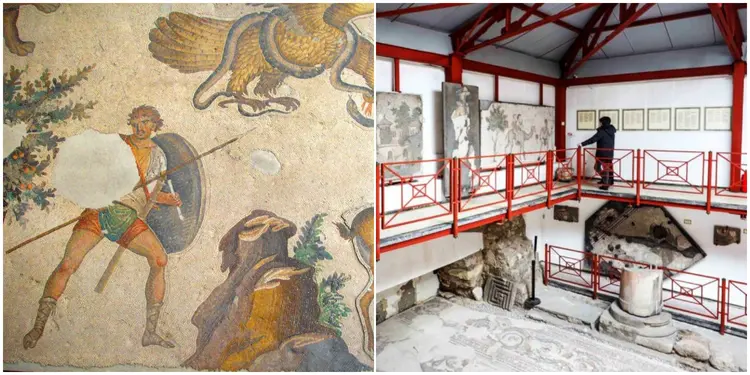
Thousands of people walk through Sultanahmet every day without realizing that a Byzantine emperor’s courtyard floor lies a few steps away, tucked behind the carpet and ceramics shops of the Arasta Bazaar. The Great Palace Mosaic Museum in Istanbul protects what survives of that floor: hunters, wild animals, children at play and mythical beasts, all set in tiny stones some 1,500 years ago. Before you add it to your Old City route, here’s what’s worth knowing.
1. The Great Palace Mosaic Museum guards the last floor of a lost palace

The mosaics once paved a colonnaded courtyard of the Great Palace of Constantinople, the sprawling residence of the Eastern Roman (Byzantine) emperors. They turned up during excavations of that courtyard and are now displayed close to Sultanahmet Square, right where they were found.
Their subject matter is the surprise. Byzantine art is often associated with saints and gold-backed religious icons. Not one religious scene appears here. Instead, the floor is filled with everyday life, nature and mythology: a Dionysian procession, fights between people and animals, lions, eagles, snakes and several griffins. The Turkish Ministry of Culture and Tourism dates the work to between 450 and 550 AD, and many historians link it to the reign of Justinian I (527-565), though some more recent research argues for a slightly later date under Emperor Heraclius. The honest answer is that nobody can pin it down to the decade.
2. Only a fraction ever saw daylight again

The scale of the loss is stark. The peristyle courtyard covered about 1,872 square meters and was decorated with mosaics from edge to edge; according to the ministry, only around 180 square meters survive today.
Roughly a tenth, in other words.
The museum sits inside the Arasta Bazaar, the old market street that belongs to the Blue Mosque (Sultanahmet Mosque) complex. It was built directly over the partly preserved mosaic floor in the northeastern corner of the courtyard, so the building is shaped around the find rather than the other way around.
3. The mosaics were found in the 1930s

British archaeologists from the University of St Andrews uncovered them in excavations between 1935 and 1938, then returned for a second campaign from 1951 to 1954. Some accounts put the first discovery in 1933. The ministry says 1935, and that’s the date to trust. Most of the palace is gone. What survived was largely below ground, which is exactly why this floor made it, and the mosaics themselves are thought to have been laid during a major renovation of the palace, a reminder that even imperial homes got makeovers.
4. You walk over the original courtyard

Because the museum was built on top of the courtyard remains, parts of the original courtyard and its paving are visible too, not just the mosaic panels. The floor shows about 150 human and animal figures across 90 different themes. Look closely. The craft becomes almost absurd. Each tessera, the small cube that makes up a mosaic, measures about 5 mm (roughly a fifth of an inch). They’re cut from limestone, terracotta and colored stone, and in the best panels the shading on an animal’s coat or a man’s face is fine enough to read as painting from a few steps back. Between 1983 and 1997, a team from the Austrian Academy of Sciences, working with Türkiye’s General Directorate of Monuments and Museums, studied and conserved the floor, so what you’d see on a visit is the result of over a decade of careful work.
5. Experts think more of it lies under nearby buildings

That tenth has a flip side: the original mosaic was far larger than the section on display, and much of the rest is believed to lie beneath the surrounding buildings, well beyond the walkways that visitors follow around the remaining panels.
Hard to prove? Very. Sultanahmet is one of the most densely built historic districts in Türkiye, and digging under it is rarely an option.
6. It’s a short walk from Hagia Sophia and the Bucoleon Palace

The museum is in the heart of the Old City, within walking distance of Sultanahmet Square, Hagia Sophia and the ruins of the Bucoleon Palace, another surviving fragment of the Great Palace complex on the Sea of Marmara shore. So it slots in easily. It’s also a useful counterpoint to the bigger sights: Hagia Sophia shows the emperors’ religious ambitions, while this floor shows what they wanted to see at home.
One caveat matters most. The museum closed for restoration in July 2023, and no reopening date had been announced in the official sources checked for this article. Check the Ministry of Culture and Tourism’s museum page before you go.
Address: Sultanahmet Mah., Kabasakal Cad., Arasta Çarşısı Sok. No: 53, Fatih, Istanbul.
Sources: Republic of Türkiye Ministry of Culture and Tourism, Great Palace Mosaics Museum, History Hit, Istanbul Mosaic Museum, Wikipedia, Great Palace Mosaic Museum

Bir yanıt yazın