
33 Bosphorus Yalı Mansions in Istanbul: A Complete Guide


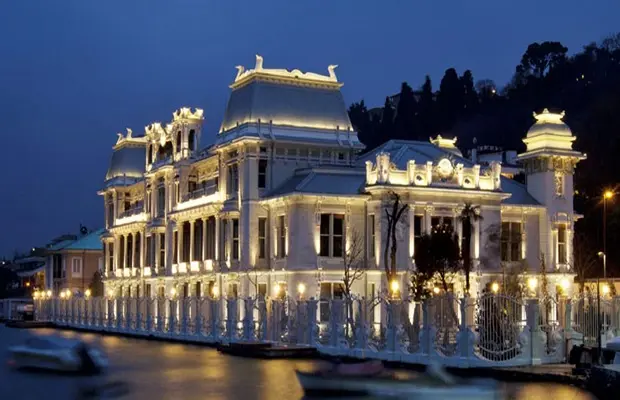
A yalı is a wooden or stone mansion built flush with the Bosphorus, close enough to the water that, in the Ottoman era, a resident could lift a floor panel and go fishing without leaving the house. Istanbul once had around 445 of them; status decided everything from neighborhood to paint color—maroon-red for state officials, light colors for Muslim families, grays for non-Muslims. Fewer than a hundred survive today. Behind the shutters of 33 of the Bosphorus yalı mansions Istanbul has held on to, strung along the shore from Eminönü to Sarıyer, sit sultans’ daughters, exiled pashas, murder plots, Hollywood film shoots, and at least one $150 million listing.
1. Emine Valide Paşa Yalısı
Sultan Abdülhamid II gave this mansion to Emine Valide Pasha, mother of Egypt’s last khedive and the only woman ever to carry the title “pasha.” She had it rebuilt by architect Raimondo D’Aronco, who gave it the longest quay on the Bosphorus. It runs 76 meters. When the Republic banned honorific titles like “pasha,” officials started addressing her as plain “Emine Hanım from Bebek”—a demotion that offended her enough to donate the mansion to Egypt instead of Türkiye.
Today it houses Egypt’s Consulate-General.
2. Mısırlı Yusuf Ziya Paşa Yalısı
Merchant Yusuf Ziya Pasha wanted his mansion to outdo the Khedive’s own palace, so he built it ten stories tall with a seven-story tower. World War I intervened. Work stopped in 1914. When Yusuf Ziya Pasha later left for Egypt in financial trouble, locals began calling the empty shell the “Haunted Mansion,” and after his death his will had the tower’s stones shipped to Egypt for his own gravestone. A 1933 restoration followed. In 2002, Borusan Holding leased the building for 25 years and moved its headquarters in—a tenancy nearing its end as of this writing.
3. Esma Sultan Yalısı
Just past Ortaköy Mosque stands the mansion built for Esma Sultan, daughter of Sultan Abdülhamid I. Which Esma, though? Historical records disagree on which of three women by that name it belonged to, but the leading candidate lived a famously colorful life between 1778 and 1848, and the building itself cycled through uses—school, tobacco warehouse, coal depot. A 1975 fire gutted it. In the 1990s, The Marmara hotel group wrapped the four surviving stone walls in glass and steel. So don’t let the facade fool you from the water: this isn’t a restored palace, it’s a shell, and it has since hosted upscale weddings and social events.
4. Ahmed Mithad Efendi Yalısı
Novelist Ahmed Mithad was born in Istanbul in 1844 and started out as an apprentice in the Spice Bazaar before a political piece got him exiled to Rhodes. Exile proved temporary. Once back in favor under Abdülhamid II, he tore down an older mansion in Beykoz and built this three-story wooden house in 1887, then spent his final 22 years there. After his death it changed hands repeatedly and was rebuilt in 1991. Today it’s split into apartments.
5. Huber Yalısı
Who built the Huber Mansion? Nobody knows, and the designer of its onion-domed tower is a mystery too, though Italian architect Raimondo D’Aronco added several of its later buildings. Its garden, statue-lined and one of the largest green spaces on the Bosphorus, once belonged to brothers August and Gustav Huber, the Ottoman representatives for the Mauser and Krupp arms manufacturers, who returned to Germany when Ottoman rule ended. Finance Minister Necmeddin Molla later bought the mansion and sold it to a khedival princess. When World War II broke out, she handed it to a Catholic school. In 1973, new owners wanted to turn the building—a mix of Chinese, English, French, Italian, Persian, Arab and Ottoman styles—into a hotel. Heritage authorities blocked every change. Since 1985, it has served as the presidential summer residence.
6. Çürüksulu (Muharrem Nuri Birgi) Yalısı
A merchant named Tırnakçızade owned this mansion first. Çürüksulu Mehmet Pasha bought it in 1890 and made major changes, planting trees shipped in from Georgia and the Caucasus. Perched over the rocks with one of the best views from the Salacak hills, it’s also known as the Belkıs Hanım Mansion, after Çürüksulu Pasha’s daughter—famous for her looks and her eventful life. Her first husband was Atatürk’s legal diplomat Ethem Menemencioğlu. Later she moved between Paris and the Bosphorus, hosting guests like Princess Bibesco and the Countess de Noailles. Then the house began to deteriorate. Her money ran out. In 1968 she sold it to diplomat Muharrem Nuri Birgi, who restored it with architect Turgut Cansever—selling three of his own properties to pay for the work. Birgi died in 1986. The mansion then passed to businessman Selahattin Beyazıt.
7. Fehime and Hatice Sultan Yalıları
Two mansions stand side by side on the shore road past Ortaköy Mosque. The first, also known as the Gazi Osman Pasha Mansion, was Sultan Abdülhamid II’s 1883 gift to the hero of the Battle of Plevna. It later passed to his son’s wife, Princess Fehime, and became a middle school. A fire in 2003 ended that.
The green mansion next door belongs to Fehime’s sister, Princess Hatice. Her story is messier. According to Hatice’s granddaughter, journalist Kenize Murad, in her book “From the Palace to Exile,” family tension kept Hatice unmarried until 31—then, married off to a man she found unappealing, she had an affair with her uncle’s son-in-law out of spite. Both buildings later served as an orphanage, a primary school and a sports club before Turkish Airlines (THY) and DO&CO restored them into the boutique Ortaköy Hotel.
8. Yılanlı Yalı (Snake Mansion)
This 18th-century mansion sits between Bebek and Rumeli Fortress. Its name was born from a lie. Sultan Mahmud II admired it during a boat trip and asked his courtier, Musahip Said Efendi, who owned it. Said Efendi wanted the house himself. So he claimed it was built on a nest of snakes and talked the sultan out of buying it—a story that stuck so well the house became the “Snake Mansion,” even though the lie cost Said Efendi the house too. It was built under Sultan Selim III for official scribe Mustafa Efendi. A 1964 fire destroyed it completely. A Bursa industrialist bought it in 1989 and restored part of it faithfully; the rest is now a concrete apartment block, about as far from an 18th-century yalı as a building can get.
9. Şerifler Yalısı
In Emirgan, this 18th-century mansion once showcased some of the finest Ottoman decorative work on the Bosphorus, before a 1945 expropriation demolished its harem wing and cut it off from the water. It belonged to Sharif Hussein of Mecca, who struck a deal with the British to lead the Arab Revolt against Ottoman rule in exchange for recognition as king, and who rose up in 1916 working with T.E. Lawrence. The Ottomans paid heavily, on two fronts. His sons went on to rule. Abdullah became Emir of Jordan in 1921; Faisal became King of Iraq. After Türkiye abolished the caliphate in 1924, Hussein declared himself caliph and lived in exile in Cyprus until 1930. Who’s there today? The Union of Historic Towns and the ÇEKÜL Foundation.
10. Recaizade Mahmud Ekrem Yalısı
Writer Recaizade Mahmud Ekrem, who co-founded the influential literary journal Servet-i Fünun with Tevfik Fikret, built this mansion on family land at the edge of Yeniköy. He was born in the house. He married his cousin there too, and turned it into a gathering place for the leading writers, poets and thinkers of his day—so central to the Servet-i Fünun literary movement that it earned the nickname “Writers’ Mansion.” Then someone reported to Abdülhamid II that Ekrem was corresponding with the exiled Khedive Abbas Hilmi Pasha. Ekrem had to sell up and relocate to Cihangir; the house later operated as a factory until the 1980s. Today a private family owns it.
11. Afif Ahmed Paşa Yalısı
On the road between İstinye and Yeniköy, this mansion’s first owner was Ferendiz Hanım, daughter of Koca Reşit Pasha. A 17,500-square-meter grove once stood behind it. The two are no longer connected. Its name comes from its second owner, Beirut-born Ahmed Afif Pasha, who demolished the original house and had Pera Palace architect Alexandre Vallaury design the neo-baroque building that stands today, blending Eastern and Western styles. Sultan Abdülhamid II’s daughter married Afif Pasha’s son here. Years later, when the mansion belonged to the family of Pera Palace’s former owner, Agatha Christie reportedly stayed there while writing “Murder on the Orient Express.” It’s a great story, though a hard one to pin down. The Uzan family owned it next. Sabancı Holding’s Suzan Sabancı Dinçer bought it for roughly $40 million. Television found it, too: it served as a filming location for the Turkish dramas “Forbidden Love” and “1001 Nights.”
12. Şehzade Burhaneddin Efendi Yalısı
Built for Prince Burhaneddin, son of Abdülhamid II, this 64-room mansion—one of the largest on the Bosphorus—was bought by his uncle Abdülaziz in 1911. The prince’s personal life was turbulent. He tired quickly of his first wife and lost his second to a finance official, then rebuilt the mansion to his own taste in 1912, and after World War I he left Istanbul for New York, dying there in 1949. With the third-longest quay on the Bosphorus, the mansion later belonged to a Turkish-Egyptian businessman, earning it the nickname “Egyptians’ Mansion,” before the Erbilgin family bought it in 1985. A decade of renovation followed. Its asking price climbed to $150 million (not a typo), briefly making it one of the five most expensive houses in the world. A Qatari buyer purchased it in March 2015.
13. Said Halim Paşa Yalısı
This mansion’s history runs back to the 1820s, when it belonged to senator Nikolas Aristarchis; his family rebuilt it in 1863. Abdülhalim Pasha bought it next. Unhappy with its size, he commissioned architect Petraki Adamanti to build bigger. His son, Said Halim, bought out his eight siblings’ shares to become sole owner. A grandson of Egypt’s Mehmed Ali Pasha and Ottoman grand vizier from 1913 to 1917, Said Halim tried to keep the empire neutral in World War I. He couldn’t stop the German alliance. In this very mansion he was forced, against his will, to sign the secret treaty on the sultan’s behalf—and was later exiled to Malta, then assassinated in Rome in 1921.
Nicknamed the “Lion Mansion” for the statue out front, the neoclassical building burned in a suspicious 1995 fire; restored since, it’s now a popular wedding venue.
14. Fethi Ahmed Paşa Yalısı
Also called the Pink Mansion, this 18th-century traditional-style house sits in Kuzguncuk. Fethi Ahmed Pasha, married to Sultan Abdülmecid’s sister, founded the Ottoman museum system (the antiquities gathered at Hagia Irene went on to form the core of today’s İstanbul Archaeological Museums) and became the empire’s first ambassador to Vienna in 1833. Composer Johann Strauss liked him enough to dedicate a piece to him, and later, as ambassador to Paris, Fethi Ahmed Pasha attended Queen Victoria’s coronation in 1839. He also had an eye for interiors, and decorated the Kuzguncuk mansion so well that Sultan Abdülmecid later put him in charge of furnishing Dolmabahçe Palace. Swiss architect Le Corbusier admired the house on visits to Istanbul in 1911 and 1948, and composer Franz Liszt was once a guest. A 1927 fire destroyed the harem wing. Only the reception section survived. The park behind it, Fethi Paşa Korusu, is open to the public today.
That makes it one of the few places on this list a visitor can simply walk into. The Ortaköy Hotel pair (item 7) takes guests, and Esma Sultan and Said Halim Paşa host weddings, while others are a consulate, a presidential residence or private homes. From a Bosphorus ferry, the open houses and the closed ones look exactly alike.
15. Mabeyinci Faik Bey Yalısı
Faik Bey built this mansion in 1890, its two ends marked by green-capped towers. Current fashion didn’t interest him. A fan of the design conventions from Sultan Abdülaziz’s era, he decorated the interior in old Ottoman style, and when a 1950s restoration rebuilt parts of the house, it kept the weight and grandeur of that older taste, down to its two-story bay window. Later owners: shipping magnate Nazım Kalkavan, then the Sabancı family. Hollywood filmed here, too. The mansion appeared in the 1964 heist classic “Topkapi,” in which thieves try to steal the Topkapı dagger.
16. Sadullah Paşa Yalısı
Among the oldest mansions on the Bosphorus, its baroque upper-floor salon is shaped like an Ottoman tent, with elaborate ceiling work. Sultan Abdülhamid I gave the maroon-painted mansion to palace official Mehmed Ağa in the 18th century. Sadullah Pasha bought it in 1872. Under Abdülhamid II, he was exiled for favoring Murad V’s return to the throne. A noted Tanzimat-era writer who served as ambassador in Berlin and Vienna, he took his own life in Vienna in 1891, reportedly over a foreign affair he feared would come to light. His widow, Necibe Hanım, refused to believe he was dead. Until she died in 1917, she kept the house ready for his return. Their children sold it to a Republican-era cabinet minister, and it later passed to his daughter, art historian Emel Esin—who studied in Paris, married first an Egyptian prince, then an ambassador posted to Tokyo. Esin died in 1987. Since then, the foundation she created has rented the mansion out to cover its upkeep.
17. Mahmud Nedim Paşa Yalısı
Ottoman ambassador to Vienna Mahmud Nedim Pasha built this mansion’s tower after admiring similar ones in Vienna and Prague. He also served as a provincial governor and grand vizier, earning the nickname “Nedimoff” for his pro-Russian leanings. Then came 1875. With the treasury unable to pay its debts, he tipped off the Russian ambassador before a bond devaluation—selling his own holdings first and saving the state from a worse debt crisis, while ordinary bondholders lost everything and rioted outside his office. He fled in disguise to a waiting boat and took refuge at this mansion before being exiled, first to Çeşme, then to Chios. Abdülhamid II later pardoned him. He died here while serving as interior minister. His grandsons donated it to the Turkish Red Crescent for a token price in 1942; after decades as a nurses’ residence, neglect left it in ruins, and it was sold in 1996 against the donors’ wishes. A donation meant to protect the house ended up doing the opposite.
Businessman Yalçın Sabancı bought it for $3 million in 2004. After restoration, it’s reportedly worth around $60 million today.
18. Kont Ostrorog Yalısı
Polish-born Leon Ostrorog bought this mansion in 1904 while advising the Ottoman government on Islamic law; he married into the Lorando banking family and counted the French writer Pierre Loti among his guests. The mansion sits in Kandilli. Industrialist Rahmi Koç owns it now. Koç founded the Rahmi M. Koç Museum of industrial heritage, and his personal collection—including some of Ostrorog’s own belongings—is on display in the mansion’s study.
19. Abud Efendi Yalısı
Sitting between the Ostrorog and Kıbrıslı mansions, this one’s first owner was Altunizade Necip Bey. It’s one of the most original buildings on the Bosphorus. Armenian-Balyan family architect Garabet Amira designed it, with interiors inspired by Dolmabahçe Palace; it also broke with the traditional “karnıyarık” floor plan common to Ottoman mansions of the time. French baron Vandeuvre moved in as the second owner in 1858. His daughter died there. He lived out nearly 40 grief-stricken years in the house. İstanbul Chamber of Commerce chairman Mehmet Abud Efendi bought it in 1884, and his son’s string of troubled marriages weighed on the family—though the son’s early death weighed even harder. Abud Efendi’s daughter Belkıs, a prominent figure in 1920s Istanbul society, had her lavish wedding here—followed by an unhappy marriage that cost the family dearly. The family lived there until 1981. The current owner is cooking-oil manufacturer İsmail Özdoyuran. Film crews came later. It served as a location for the Turkish series “The Tulip Era.”
20. Kıbrıslı Yalısı
Near the old Küçüksu Beach in Üsküdar, this mansion is known for its 64-meter waterfront facade. Built in the 18th century for grand vizier Mehmed İzzet Pasha, it was bought in 1840 by Kıbrıslı Mehmed Emin Pasha, who went on to serve as grand vizier under three different sultans. Guests over the years included Empress Eugénie, King Faisal II of Iraq, and poet Yahya Kemal Beyatlı. In 2001, Ümran Güngör Üzümcü bought the mansion’s central section. It has 21 rooms. Its hillside grove had been sold off separately in the 1980s. Ownership is now split. The remaining sections belong to the Komili family, İzzet Mehmed Pasha’s heirs, and businessman Ömer Üründül.
21. Bahriyeli Sedad Bey Yalısı
In Anadolu Hisarı, naval officer Sedad Bey’s grandfather, Mustafa Reşid Pasha, built this neo-baroque mansion in two wings—one for men, one for women—in the early 20th century. It’s nicknamed the “Magnolia Mansion.” The reason: its magnolia trees. Descendants of palace imam Mehmet Niyazi Araz sold it in 1992. One wing now belongs to the founder of Doğuş schools and university; the white mansion next door, Rıza Bey Yalısı, is home to a former rector of Boğaziçi University.
22. Zarif Mustafa Paşa Yalısı
At the point where the Black Sea meets the Sea of Marmara’s waters, this mansion originally stood three times its current size, with separate men’s, women’s and boathouse wings. Sultan Mahmud II’s personal coffee-maker, Kani Bey, bought it in the 1800s. Zarif Mustafa Pasha took it over in 1848. His family kept it until 1992. A holy spring from an old Byzantine monastery still sits in the garden, on the ruins the house was built over. Then came the wall. The pasha’s son-in-law, tired of his father-in-law’s constant entertaining, bought the men’s quarters and boathouse and had a wall built between them. His own son, Ottoman parliamentarian Mehmet Esat Bey, donated a relic believed to be a hair from the Prophet Muhammad’s beard to the nearby Fatih Mosque. That earned the mansion a nickname: “Esat Bey’s Mansion.” During the War of Independence, Esat Bey’s sons used it to smuggle weapons to Anatolian forces, and the family tore down the women’s wing themselves rather than let occupying British soldiers use it.
Owned since 2000 by Demet Sabancı Çetindoğan, the mansion has hosted guests including Colin Powell, Oprah Winfrey, Madeleine Albright and Russian Grand Duchess Maria Vladimirovna. One of its more unusual features is an enclosed sea pool. Women who, for modesty’s sake, couldn’t swim in open water once used it. Today it’s a coffee room. A glass floor covers what was once an aquarium.
23. Amcazade Hüseyin Paşa (Köprülü) Yalısı
Hüseyin Pasha earned the nickname “Amcazade” (cousin’s son) as a relative of grand vizier Köprülü Fazıl Ahmed Pasha. Built in 1698 for grand vizier Hüseyin Pasha, it’s the oldest surviving mansion on the Bosphorus. The family produced four grand viziers. Its mark remains on buildings across Çemberlitaş and Divanyolu. Hüseyin Pasha, a Mevlevi dervish, drafted the Treaty of Karlowitz here in 1698 as Sultan Mustafa II’s representative—the agreement that marked the start of Ottoman territorial decline and the empire’s first ceded land. That’s a lot of history for one waterfront house. Developer Ali Ağaoğlu bought the mansion in 2014. Restoration began shortly after.
24. Nuri Paşa Yalısı
Rahmi Koç lived here for years before it passed to his son, Ali Koç. Built around 1895, likely for one of Abdülhamid II’s officers, Nuri Pasha, it’s an Art Nouveau departure from classic Bosphorus mansion style. The giveaway is its balcony. Older Bosphorus houses don’t have one.
25. Hekimbaşı Salih Efendi Yalısı
No record survives of who first owned this mansion.
Salih Efendi, chief physician to the sultans, was among the first graduates of the imperial medical school founded under Mahmud II and went on to serve Abdülmecid as his personal doctor. He was a botanist, too. He was known for medicines made from plants he grew himself, and one rose he cultivated still carries his name—the “Hekimbaşı Rose.” After buying the mansion, he expanded it, with a men’s wing to the north and a women’s wing to the south. At 63, he married Payidar. She was a 16-year-old student, and his descendants through her still live in the house.
The north wing was demolished in the early 20th century and turned into a garden, and in the 1980s, after the house began shifting toward the water, a nine-pillar waterfront platform was added. The surviving women’s wing, painted maroon, is split into three connected sections of one, two and three stories. It appeared in the series “One Thousand and One Nights.” A 2010 restoration followed.
26. Prenses Rukiye Yalısı
Built in the late 19th century with the Mihrabad grove behind it, this was once among the largest mansions on the Bosphorus. Sadullah Pasha’s widow, Necibe Hanım, gave her share of the house as a wedding gift to her daughter-in-law, Princess Rukiye, granddaughter of Egypt’s Mehmed Ali Pasha. The single-story original began to fail. In 1895, Princess Rukiye tore it down and built the mansion standing today. Her marriage to Sadullah Pasha’s son, Nusret Bey, later ended in divorce, but she loved the house too much to leave and lived there alone for years before selling it to a relative, Princess İffet. Princess İffet barely got settled. After a failed assassination attempt on Khedive Abbas Hilmi Pasha, she fled Istanbul. In 1957, her heirs sold the mansion to Özdemir Atman, a former chairman of the Turkish Jockey Club.
27. Yağlıkçı Hacı Raşid Bey Yalısı
Built in the 1850s on Kanlıca Bay, this mansion’s adjacent outbuilding now functions as a separate house in its own right. Its owner, Raşid Bey, worked in women’s clothing and earned the nickname “yağlıkçı”—an old term for a handkerchief-maker that was later extended to cover makers of underwear and bridal wear. Mihrabat Hill, rising behind the house, is one of the best spots on the Bosphorus to watch the moonrise. After Raşid Bey’s death, the mansion passed to his wife, son and daughter. Then it was sold. Businessman Barlas Turan restored it in the 1980s.
28. Hacı Ahmed Bey Yalısı
Built under Abdülhamid II, this mansion belonged to the Ramazanoğlu family, and Atatürk reportedly attended a family circumcision celebration here. Food company owner Sezgin Elmas bought it in 1996.
29. Saffet Paşa Yalısı
With one of the largest waterfront quays on the Bosphorus, this mansion was built in 1907 and, like so many of its neighbors, later lost part of itself to fire. Restoration came in 2008. It’s named for publisher Sedat Simavi’s grandfather. Media owner Dinç Bilgin held it before it passed to Erol Toksöz, of the Toksöz family behind Sanovel Pharmaceuticals and Sagra.
30. Yağcı Şefik Bey Yalısı
An earlier mansion stood on this spot, belonging to Sultan Abdülhamid I’s sister, Cemile Sultan. The current buildings date to 1905. A successful restoration followed in 1989.
Businessman Şefik Bey, founder of the Naval Foundation, built the larger house as the men’s quarters, with a smaller building next door for the women’s side.
31. Yedi-Sekiz Hasan Paşa Yalısı
Also known as Asaf Pasha’s Mansion in Kanlıca, this late-19th-century building takes its more common name from Hasan Pasha’s habit of signing documents with the numbers 7/8—”Yedi-Sekiz”—since he couldn’t read or write. A Beşiktaş bakery still carries his name.
Today it belongs to the Barut family, owners of Abdi İbrahim Pharmaceuticals. Businessman Mustafa Koç lives in the adjoining winter house behind it.
32. Hadi Sami Bey Yalısı
Also called Manford House, this mansion dates to the 1800s; a Greek shipowner named Licardopulos bought it after the British occupation of Istanbul, and lawyer Hadi Bey later traded his property in Thessaloniki for it. The color is traditional Bosphorus maroon. TEB owner Hasan Çolakoğlu restored it. The result: one of the most striking mansions on the strait.
33. Marki Ahmet Necib Bey Yalısı
French nobleman Necib Bey converted to Islam to marry Melike Aliye Hanım, the woman the mansion is built for, and the turreted building behind it once served as his winter residence. In 1983, a fire caused serious damage, and the house was restored afterward. Inside, period-accurate woodwork decorated with floral and geometric relief carvings is one of the mansion’s defining features.
Businessman Erdoğan Demirören has owned it since 1977.


Bir yanıt yazın