
Point Nemo: 7 Facts About the Most Remote Place


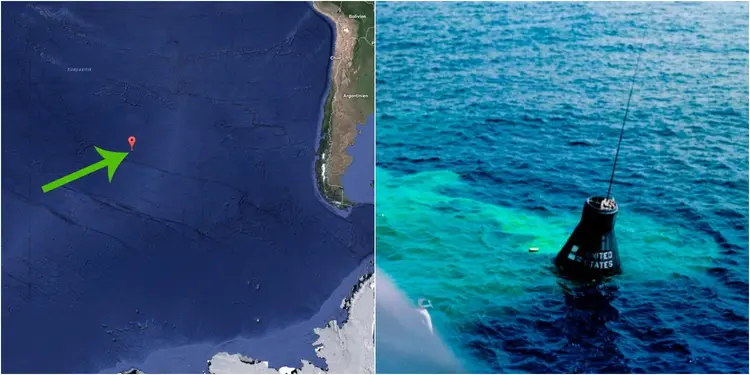
Somewhere in the South Pacific there is a patch of open water so far from everything that the nearest people are often orbiting overhead in a space station. That patch is Point Nemo, the oceanic pole of inaccessibility, and it is the most remote place on Earth. Here are seven things worth knowing about a spot almost nobody will ever see.
1. Point Nemo sits in the middle of the South Pacific

Point Nemo lies at roughly 48°52.6′ S, 123°23.6′ W, about 2,688 km (1,670 miles) from the nearest land. No other point in the ocean is farther from a coastline. The geometry is neat. Three specks of land sit at exactly that same distance: Ducie Island, a tiny atoll in the Pitcairn Islands, to the north; Motu Nui, an islet off Easter Island, to the northeast; and Maher Island, off the coast of Antarctica, to the south. All three are close to deserted, which makes the “nearest neighbors” of the most remote place on Earth remote themselves.
2. Astronauts can be closer to it than anyone on Earth

It sounds like a trick question. It isn’t.
When the International Space Station passes overhead, it can be about 415 km (258 miles) from Point Nemo, give or take. No regular shipping or air routes come within roughly 400 km of the spot, so at those moments the crew on board is the closest group of humans around.
3. It is the “pole of inaccessibility” of the oceans

Geographers call it the oceanic pole of inaccessibility: the point in the sea that is hardest to reach from any shore. As technical labels go, this one is refreshingly literal. Find the spot on a map and there is nothing there to mark it, just open blue in every direction.
4. A Croatian engineer found it in 1992 without leaving his desk

Hrvoje Lukatela, a Croatian survey engineer, identified the point in 1992. No ships or logbooks were involved. He started from the idea that such a point had to exist, fed coastline data from a digital world map into geospatial software, and calculated the coordinates. In 2022 he ran the numbers again with newer map data. A ship captain in the age of exploration would have needed months at sea to get anywhere near the answer; Lukatela needed a computer and a good dataset.
5. The name comes from Jules Verne’s Captain Nemo

Point Nemo is named after Captain Nemo, the submarine commander in Jules Verne’s 1870 novel Twenty Thousand Leagues Under the Seas, a book Lukatela loved as a child. The choice works on two levels. In Latin, “nemo” means “nobody,” which suits both a man who cut himself off from the world and a stretch of ocean where nobody lives.
6. Almost nothing lives there

There is no island or rock anywhere near Point Nemo, so land animals are out of the question. What about sea life?
Not much there either. A common assumption is that the cold and the crushing pressure of the deep keep the area empty. They play a part. The bigger problem is food. Point Nemo lies inside the South Pacific Gyre, a huge system of rotating currents that keeps nutrients from reaching the area, and it is too far from any coast to get runoff from land. Without nutrients, the food chain barely gets started, and scientists describe the waters as one of the most lifeless parts of the ocean. Still, life holds on in a few odd corners. Bacteria and small crabs have been reported around volcanic vents on the seafloor in the wider region.
7. Today it is a cemetery for spacecraft

The most remote place on Earth has become a final resting place for old space hardware. Since 1971, the year the Soviet Salyut 1 station came down over the Pacific, space agencies have steered retired satellites, cargo ships, and stations into this part of the ocean. At least 264 spacecraft were brought down in the area between 1971 and 2016, including six Salyut stations and the Russian Mir station in 2001. The International Space Station is next. It is scheduled to be brought down into the sea near Point Nemo in 2031.
Why here? Remoteness, mostly. With so little shipping and no one living nearby, whatever survives reentry falls where it is unlikely to hurt anyone, which is exactly the quality that made Point Nemo famous in the first place.
Sources: Wikipedia: Pole of inaccessibility, Wikipedia: Spacecraft cemetery, History Defined




Bir yanıt yazın