
8 Giant’s Causeway Facts You Should Know


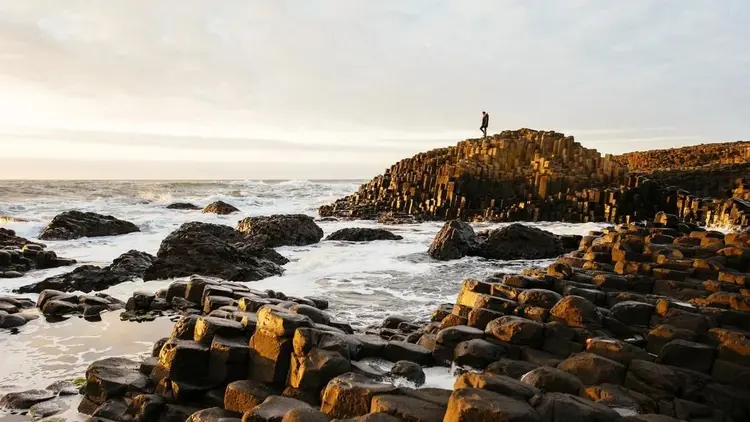
On the north coast of Northern Ireland, in County Antrim, thousands of hexagonal stone columns step out of the North Atlantic and climb toward the foot of the cliffs. The shapes are so regular that it’s easy to see why people once assumed a giant had laid them by hand. These 8 Giant’s Causeway facts cover the geology, the legend and a surprising afterlife in rock music and film.
1. The Giant’s Causeway is made of about 40,000 basalt columns

The columns formed roughly 50 to 60 million years ago, when Europe and North America were still pulling apart. As the land split, molten lava welled up through the cracks and pooled into a lava lake. It cooled slowly. Then it contracted and fractured into columns, most of them six-sided. Despite how they look, nobody carved them, and scientists knew that early on. The exact conditions behind them took much longer to pin down.
In 2008, Lucas Goehring, then a PhD student at the University of Toronto, and his supervisor, Professor Stephen Morris, showed how the pattern works. Slower cooling means wider columns. A decade later, Yan Lavallée, a volcanology professor at the University of Liverpool, calculated that the rock cracked at about 840–890°C.
2. Legend says a giant built it

Geology is one explanation. Irish folklore has a livelier one, and it comes in more than one version.
The Irish giant Fionn mac Cumhaill, better known in English as Finn McCool, was feuding with Benandonner, a Scottish giant. To reach his rival, Finn built a causeway across the sea. Then he got a proper look at Benandonner. The Scot was far bigger. Finn ran home. His wife (Oonagh in many tellings) dressed Finn as a baby and tucked him in. When Benandonner saw the size of the “baby,” he pictured the size of the father, fled back to Scotland and tore up most of the causeway behind him so no one could follow.
3. The wider world first heard of it in 1693

In 1693, Sir Richard Bulkeley, an Irish politician and fellow of Trinity College Dublin, presented a paper on the Giant’s Causeway to the Royal Society in London. In 1739 the Dublin artist Susanna Drury painted watercolors of the site, and the Causeway was well on its way to becoming a tourist attraction.
UNESCO named it a World Heritage Site in 1986, the first in Northern Ireland. The same year, the National Trust, which has cared for the Causeway since the 1960s, opened a visitor center there. That building burned down in 2000. Its replacement only opened in 2012.
4. Tourists could once buy pieces of it

Before the National Trust took over its protection, chipping off the Causeway and selling the pieces was a common trade. Visitors could literally take some home. The Scottish writer Leitch Ritchie, who visited in the 1830s, reported that more than a dozen men and boys trailed after him, offering boxes full of mineral specimens. Today the stones stay put, and that’s exactly how it should be.
5. Other strangely shaped rocks are scattered around the site

The hexagonal columns get the attention, but the shoreline around them holds a string of odd formations, and the legend has a story for most of them. Two stand out: the Camel and the Giant’s Boot. The Camel, lying at the foot of the cliffs, is said to be the only beast strong enough to carry Finn. Then there’s the Boot. Supposedly a size 93.5, it slipped off Finn’s foot as he fled from Benandonner. Why stop at one giant story when the coast offers several?
6. A Led Zeppelin album cover was shot here

The cover of Led Zeppelin’s 1973 album Houses of the Holy was photographed at the Causeway, and it shows naked, fair-haired children climbing over the stones in an eerie, otherworldly landscape. It’s not a single shot. The finished image is a composite of many photos. Its strange coloring did the rest, making it one of the band’s most recognizable covers.
7. The Causeway has appeared in several films

Filmmakers have noticed the scenery too. In Dracula Untold (2014), the Causeway stood in for a mountain in Transylvania. Your Highness (2011) turned it into part of the Minotaur’s labyrinth. And Hellboy II: The Golden Army (2008) simply let it play itself.
Same stones, three very different worlds.
8. Similar formations exist around the world, and even on Mars

The closest relative is just across the sea. On the Scottish island of Staffa, Fingal’s Cave is a sea cave lined with hexagonal columns formed by the same lava flow as the Giant’s Causeway, which fits neatly with the legend of a road between Ireland and Scotland.
Other examples include Devils Tower in Wyoming, whose columns rise about 265 m (867 ft), and the High Island Reservoir in Hong Kong, where the columns are volcanic rock as well.
Mars, too. In 2007, similar lava columns were photographed there.
Sources: Mental Floss, Wikipedia: Giant’s Causeway, National Trust: Giant’s Causeway







Bir yanıt yazın