
7 Historic Bridges in Turkey That Link Towns and Legends


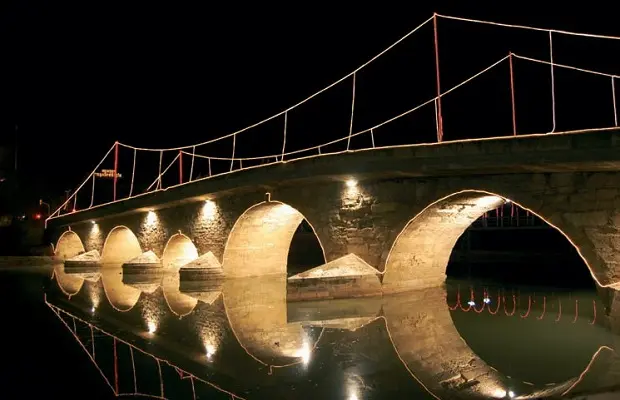
Across Türkiye’s Black Sea valleys and Anatolian river towns, old bridges still carry footpaths, village roads and more than a few legends. These historic bridges in Turkey span Roman foundations, Seljuk-era arches, Ottoman stonework and one tile-roofed timber oddity. Several sit right on roads visitors already travel, from Amasya to the climb toward Uzungöl.
1. Çifte Köprü: twin bridges near Arhavi, Artvin

Photo: Muhammet Bilgin
On the eastern Black Sea coast, steep slopes force a different way of living.
A cable system called varagel hauls loads up to scattered houses, wooden granaries called serender keep crops dry, and stone bridges get people across rushing streams.
Çifte Köprü (“Twin Bridge”) is a pair of single-arch bridges set at right angles to each other near Ortacalar, in the Arhavi district of Artvin province. Their exact date is unknown. The usual estimate is the 1850s. Each span is said to be about 35.5 meters long but only 2.8 meters wide, so both are pedestrian-only.
In classic Black Sea style, the cut-stone pointed arches sit on the route to Mençuna Waterfall, and in 2003 Türkiye’s General Directorate of Highways restored the crossing, replacing its paving and parapet stones.
2. Koyunbaba Bridge: a sultan’s promise over the Kızılırmak

Anatolian folklore has a story for almost every old monument, and the one behind Koyunbaba Bridge in Osmancık, Çorum province, is among the best. Legend says Sultan Mehmed II, marching to the Battle of Otlukbeli, stopped to ask Koyun Baba, a Bektashi dervish, for his blessing. The dervish asked for a bridge over the Kızılırmak, Turkey’s longest river, but the sultan died before he could build it. When his son Bayezid II came through, Koyun Baba is said to have carried him across the water and, in the blink of an eye, all the way to Istanbul. The son kept the promise.
The facts are almost as impressive. According to its inscription, the bridge went up between 1484 and 1489, and it’s described as the longest stone arch bridge the Ottomans built in Anatolia: 250 meters long and 7.5 meters wide, with 19 pointed arches. Silt has built up along the bank, so only 15 arches are visible today, and an Arabic inscription faces the castle across the river. After concrete and plaster repairs in the 1960s and 1980s, a restoration that ran from 2014 to 2017 aimed to bring the stonework back to its original state.
3. Mikron Bridge: one stone arch in the Fırtına Valley, Rize

The eastern Black Sea is a landscape of deep valleys, sharp slopes and fast rivers, with villages strung along the banks. Houses high on the slopes are often reached by single-arch stone bridges. Wealthy locals paid for many. Some go back to the 18th century.
The Fırtına Valley of Çamlıhemşin district alone has about ten, and Mikron Bridge, near the village of Aşağışimşirli on the road to Ayder (a highland village known for its summer pastures), is just one of them. The span is about 30 meters long and roughly 12 meters above the water, with a wide opening to let seasonal floods through. Set that against Koyunbaba’s 19 arches spread across the broad Kızılırmak: on a narrow, fast mountain stream, one high arch does the whole job. It’s dated to the first half of the 19th century. Cut stone forms the arch, while the piers are rubble and the parapets concrete block.
Follow the Fırtına stream from Ardeşen, where it meets the sea, up toward Ayder and you’ll pass more single arches: Kale (Hala) Bridge, built by the master mason Ballıoğlu Mehmet Usta; Kadıköy (Özenkit) Bridge, commissioned in the 19th century by Kabaoğlu Ahmet Efendi; and the 18th-century Timisvat Bridge. Mikron itself was repaired by the Highways directorate in 1999 and reopened to walkers.
4. Talazan Bridge: Seljuk-era arches on the Kelkit, Tokat

About 15 km from Niksar in Tokat province, Talazan Bridge crosses the Kelkit River near the village of Buzköy. Its inscription hasn’t survived. So who built it, and when? Nobody can say with certainty.
The Danishmendids, a Turkic dynasty that made Niksar their capital, left lasting buildings across the region, and some see their style in this bridge. Others, judging by its architecture, place it in the first half of the 13th century, which points to Seljuk influence. Built of cut stone, the bridge runs well over 130 meters on a row of pointed arches. One arch collapsed long ago. Steel beams now close the gap, an unlovely but practical fix. Different stone techniques in the walls mark the repairs that followed repeated floods. A restoration by the regional Highways directorate was carried out between 2010 and 2012, and the bridge still links Buzköy with the surrounding villages.
Tokat province has two more notable stone bridges: Leylekli Bridge in central Niksar and Hıdırlık Bridge, near where the Kelkit meets the Yeşilırmak.
5. Alçak Köprü: Amasya’s “Low Bridge”

Amasya, hometown of the ancient geographer Strabo and setting of the legend of Ferhat, who tunneled through a mountain for his beloved Şirin, is a city of bridges. The Yeşilırmak River runs straight through the center and is crossed by around ten old bridges. Alçak Köprü stands out for its odd shape. It’s Amasya’s only Roman-era bridge. Despite the name, it wasn’t built low: over centuries the river filled its bed with silt until the bridge sank almost to water level (the same slow process that hid four of Koyunbaba’s arches), which earned it the name Alçak Köprü, “Low Bridge.” Its rectangular piers rest on arches at the riverbed, a design that sets it apart from other Anatolian bridges.
In 1865, governor Ziya Paşa had the old arches reworked as supports for a new wooden bridge on top. Floods kept damaging it. After the 1950 flood, the structure was reinforced with concrete and steel.
The bridge sits below Amasya Castle, also called Harşena, with the rock-cut tombs of the Pontic kings in the cliffs behind it. It connects the city center with the riverside district of old waterfront houses, and its most recent restoration took place in 2009.
6. Taşköprü: the bridge that named a town, Kastamonu

The Taşköprü district of Kastamonu shows up in tourism brochures for two things: garlic and its bridge.
Taşköprü means “stone bridge,” and in early morning light, when the arches reflect in the water, it’s easy to see why the town took its name.
The bridge crosses the Gökırmak River on an old Roman route that ran through Paphlagonia, the ancient name for this region, and the district is rich in archaeological finds. The first bridge here was probably Roman. The current one dates to 1366 and was built in the name of Celaleddin Bayezid, known as Kötürüm Bayezid, a ruler of the Candar (Jandarid) dynasty based in Kastamonu.
About 68 meters long, it originally had seven arches, six of which are open today. Repairs have changed a lot, and it shows. Look at the piers, where round and triangular cutwaters sit side by side. Highways engineers widened it in 1968 and repaired it again in 1970, and it later carried both vehicles and pedestrians. It has more recently been reported closed to traffic for restoration. Check its status before planning a crossing.
7. Kiremitli Köprü (Hapsiyaş Bridge): a tile-roofed timber span, Of, Trabzon

Among the single-arch bridges over the fierce streams of the eastern Black Sea, Hapsiyaş Bridge looks nothing like the rest. It rests on cut-stone piers set on rock, with a wooden body and a red tiled roof typical of the area. Timber came first. Long before stone masonry took hold, it was the go-to building material, and this bridge keeps those old techniques alive.
Built in 1935 from large timber beams, it stands on the Of, Dernekpazarı and Çaykara route in Trabzon province, where an arch-like geometric frame lets it span the wide streambed. Registered as a protected monument in 1996, it was restored to its original form by the Trabzon governor’s office in 2002.
It isn’t quite one of a kind, though: a 2018 study in Sanat Tarihi Dergisi describes another roofed wooden “Kiremitli Bridge” in the village of Eğridere near Çaykara.
On the road to Uzungöl, a popular lake resort, Hapsiyaş Bridge’s red roof among the green earned it the nickname Kiremitli Köprü, “Tiled Bridge.” The old route continues past Uzungöl through the Soğanlı and Haldizen valleys to Bayburt, and tour groups often pause there. Truth is, photos are the usual reason.
Sources: Wikipedia, Koyunbaba Bridge, Wikipedia, Candar dynasty, Wikipedia (Turkish), Talazan Köprüsü, Mehmet Bayraktar, Sanat Tarihi Dergisi (2018)



Bir yanıt yazın