
15 Istanbul Landmarks and the Stories Behind Them


Few cities stack Byzantine domes, Ottoman palaces and Renzo Piano glass within a few kilometers of each other the way Istanbul does. These 15 Istanbul landmarks have turned into symbols of the city, not only for how they look but for what has happened inside them. Each one comes with a story that most visitors walk straight past.
1. Hagia Sophia, where any list of Istanbul landmarks starts

The building you see today is the third church on the same spot. The first, dedicated in 360 under Emperor Constantius II, burned down in a riot; a second, built under Theodosius II and dedicated in 415, was destroyed by rebels in the Nika riots of 532. Emperor Justinian I then aimed far higher. His Hagia Sophia, the one still standing, was dedicated in 537. After the Ottoman conquest of 1453 it became a mosque, and centuries later the architect Mimar Sinan reinforced it with heavy buttresses. It served as a museum from the 1930s and has been a working mosque again since 2020.
The dome is the real headliner. It was built for a congregation of thousands, and even a quiet word inside seems to hang in the air. Visitors should dress modestly, women cover their hair, and access can pause around prayer times.
2. Galata Tower: the Genoese lookout

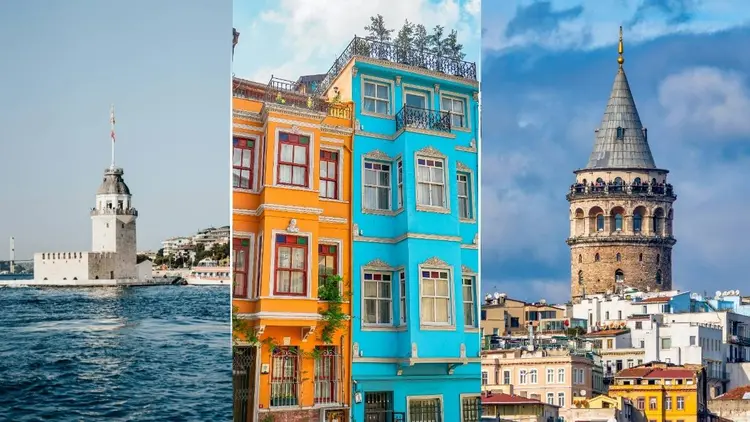
Genoese merchants built the tower in the mid-14th century as part of their fortified colony across the Golden Horn, and they called it the Tower of the Holy Cross. Since then it has been a prison, a fire lookout and, briefly, a coffeehouse. Today it stands about 62.6 meters tall and operates as a museum, reopened in 2020 after restoration.
It has a romantic side, too. Couples who climb it together, popular belief says, end up married.
The panoramic gallery near the top looks out over the Bosphorus, the old city and the Golden Horn in one sweep.
3. Topkapı Palace: four centuries of sultans

Sultan Mehmed II began building Topkapı Palace in 1459, a few years after conquering the city. Set on the tip of the Historic Peninsula, it served as the empire’s seat of government, its school for palace officials and the sultans’ home for nearly four centuries.
The layout works like nested boxes. The First Courtyard was the public outer zone and holds the Byzantine church of Hagia Irene and the old Imperial Mint. State ceremonies and council meetings took place in the Second, known as Divan Square. Beyond it lay the Third Courtyard, the Enderûn or Inner Palace, where the palace school and the sultan’s private service lived and worked. And the Fourth? The sultans’ private retreat, with kiosks such as the Baghdad Kiosk and terraced gardens above the water.
4. Maiden’s Tower: legend versus paperwork

The famous legend says a sultan locked his daughter in this tower to protect her from a prophecy. History is less poetic. The tiny islet off Üsküdar was a lookout point for controlling ships in the Bosphorus, and the Athenian general Alcibiades probably set up a station on the rock as early as 408 BC. Byzantine Emperor Alexios Komnenos built a tower here in 1110, the Ottomans used it as a watchtower, and after a fire in 1721 it was rebuilt and used as a lighthouse. Next came a spell as a quarantine station. Much later, a café and restaurant. Restoration began in 2021, and the tower reopened to visitors in May 2023.
5. Balat’s colorful houses

Balat, on the Golden Horn, was home to Greek, Armenian and Jewish communities for centuries, and that mix still shows in its churches and synagogues. Its online fame comes from something else: rows of old houses with projecting bay windows (cumba), each painted a different color.
Many are still lived in. Photographers love the steep streets; residents mostly just want to hang their laundry in peace, so a little discretion goes a long way.
6. Haydarpaşa Station: a terminal on wooden piles

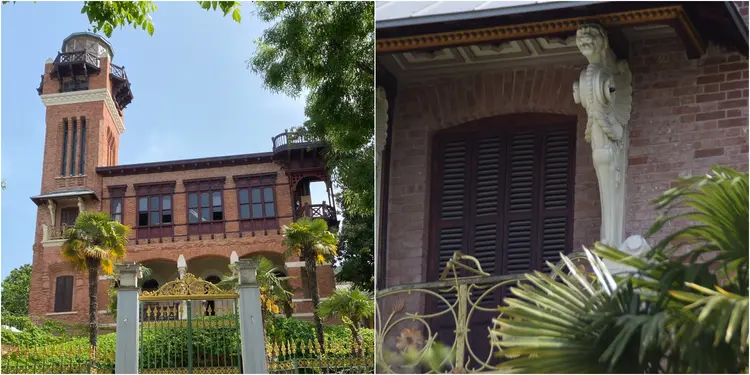
Trains have left from this spot on the Asian shore since 1872, but the castle-like terminal came later. German architects Otto Ritter and Helmuth Cuno designed it in a German neoclassical style, construction began in 1906, and the building was inaugurated in 1909. It stands on reclaimed land. About 1,100 wooden piles, driven into the soft shore, hold it up. An explosion in 1917-1918 cut the height of its towers, and a fire during restoration work in 2010 destroyed the roof and the top floor. Long-distance trains stopped running from here in the early 2010s. The building has been under restoration ever since, and what it will become once the scaffolding comes down is still hard to say.
7. Dolmabahçe Palace: the Ottomans go European

The name means “filled-in garden.” The site was once a bay where the Ottoman fleet anchored, later reclaimed and turned into an imperial garden lined with wooden waterfront pavilions known as the Beşiktaş Waterfront Palace.
Sultan Abdülmecid I replaced them with a stone palace built by the Balyan family of architects, with work starting in 1843. The court moved in from 1856. Compare that with Topkapı, which had housed the sultans since the 15th century: in one move, the dynasty traded courtyards and kiosks for a single European-style palace facing the water. According to the Directorate of National Palaces, six sultans and the last caliph, Abdülmecid II, lived here, and Mustafa Kemal Atatürk, founder of the Republic of Türkiye, stayed here from 1927 and died in the palace in 1938.
With 285 rooms, 44 halls, 68 toilets and 6 Turkish baths, it is often described as the largest palace in the country.
8. Istanbul Modern

Opened in 2004 in a converted customs warehouse, Istanbul Modern was Türkiye’s first museum dedicated to modern and contemporary art. Its new building by Renzo Piano opened in May 2023 near the original site in Karaköy. As locations go, it is hard to beat: the building sits right on the Bosphorus. The museum changed how the city shows contemporary art, and the building gave the shoreline a light, modern counterpoint to the domes across the water.
9. Beyazıt Tower: a weather report in colored lights

Fire was the old city’s great fear. So the Ottomans built watchtowers, and the current stone one, about 85 meters tall, dates to 1828, replacing earlier wooden towers that had themselves burned. By day, watchers signaled the location of fires with baskets; at night, with colored lamps.
The lamps still work. Now they forecast the weather: blue for clear skies, green for rain, yellow for fog and red for snow.
The tower sits on the grounds of Istanbul University and is not generally open to visitors.
10. Atatürk Cultural Center (AKM)

The AKM on Taksim Square has been at the center of Istanbul’s performing arts scene, and its politics, since it first opened in 1969. A fire gutted it in 1970, during a performance of Arthur Miller’s The Crucible. It closed for renovation in 2008. In 2018, amid heavy criticism, the original building was demolished.
The new AKM, designed by Murat Tabanlıoğlu, son of the original architect, opened in October 2021 with an opera house, theater, concert halls, a library and exhibition spaces.
11. Çırağan Palace: from ruin to hotel

Sultan Abdülaziz had Çırağan Palace built in the 1860s on the European shore of the Bosphorus. Its later history is darker than its marble suggests. Sultan Murad V, deposed after just 93 days on the throne, lived here under house arrest until his death in 1904.
In 1909 the Ottoman Parliament moved in, and in January 1910 a fire left little more than the outer walls. The shell stood empty for decades.
A Japanese company bought it in the late 1980s and restored it, and the palace reopened in the early 1990s as part of a luxury hotel. Today its waterfront gardens are among the city’s most sought-after settings for weddings and events.
12. Rumeli Fortress (Rumelihisarı)

Mehmed II built this fortress at the narrowest point of the Bosphorus in 1452, a year before the conquest, in only a few months. Its job was simple: choke off shipping and cut the Byzantine capital from help by sea. Each of the three main towers is named after the vizier who supervised its construction. It has been a museum since the 1960s. In summer it also hosts open-air concerts and festivals.
13. Basilica Cistern: the underground forest of columns

Built under Emperor Justinian I in the 6th century, the cistern is known in Turkish as Yerebatan Sarayı, the “Sunken Palace.” It measures about 138 by 65 meters, roughly 9,800 square meters, and its 336 marble columns stand in 12 rows of 28. It held about 80,000 cubic meters of water. Per Wikipedia, it is the largest of the several hundred ancient cisterns under the city.
Its most photographed residents are two Medusa heads used as column bases, one tilted on its side and one upside down. They came to light when silt was cleared during the 1985-1987 restoration. Their origin is another matter entirely. Nobody knows for sure which earlier building they were taken from, and legends have filled the gap, most of them borrowing from the Greek myth of Perseus and the Gorgon.
The Istanbul Metropolitan Municipality opened the cistern as a museum in 1987, and it now also hosts exhibitions and events.
14. Ortaköy Mosque (Büyük Mecidiye Mosque)

Sitting right on the water at Ortaköy pier, this small mosque looks made for postcards. Its builders are familiar. The same Balyan father and son behind Dolmabahçe completed it for Sultan Abdülmecid I in the mid-1850s, working in an eclectic style that blends neoclassical lines with Ottoman Baroque detail.
15. Grand Bazaar: a city under one roof

Mehmed II again, the sultan behind Rumeli Fortress and Topkapı. He started the Grand Bazaar (Kapalıçarşı) in the 1450s, and it grew around its original core until it became one of the largest covered markets in the world. Its 61 covered streets hold more than 4,000 shops, along with inner courtyards (hans) where traders and workshops once gathered, and gates such as Beyazıt and Nuruosmaniye lead in from every side. Spices, gold, leather, carpets, textiles, traditional crafts, cafés and small restaurants: almost everything ends up here. Prices are often negotiable, and paying the first number quoted is the classic first-timer mistake. A polite counteroffer is normal in most shops.
Sources: Wikipedia: Basilica Cistern, Directorate of National Palaces: Dolmabahçe Palace, Wikipedia: Galata Tower


Bir yanıt yazın