
Harbin Ice Festival: 5 Things to Know Before You Go


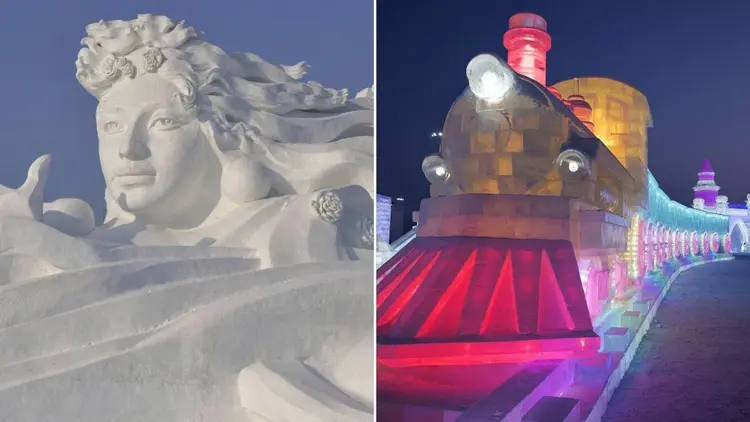
Picture a city under snow, castles built from blocks of ice, and sculptures lit from inside in every color of the spectrum. That’s the Harbin Ice Festival, held each winter in northeast China and billed as the largest ice and snow festival in the world. Here’s what to know before you pack your warmest coat.
1. What is the Harbin Ice Festival?

Its full name is the Harbin International Ice and Snow Sculpture Festival, and it takes place every year in Harbin, a city in northeast China. It began in 1963 as a modest ice-lantern show and garden party, was interrupted for several years during the Cultural Revolution, and returned as an annual event in 1985. Today it draws millions. The 2025 edition alone counted about 3.56 million visitors. The ice is strictly local: workers cut huge blocks from the frozen surface of the Songhua River, and sculptors turn them into towers, temples and whole streets of ice.
The air is brutally cold, yet the mood is anything but.
2. A snow sculpture in the record books

In 2007, Harbin’s snow carvers produced a work titled “Romantic Feelings,” which Guinness World Records lists as the largest snow sculpture. Accounts of its exact size differ. All of them, though, describe something on a scale that is hard to picture, a sculpture hundreds of meters long and built from thousands of cubic meters of packed snow.
Where do you find that much snow? In Harbin, winter takes care of the supply.
3. Where it happens, and what to do there

Harbin is the capital of Heilongjiang province, China’s northernmost, and its winters are among the coldest of any major city in the country. Average winter temperatures sit around -17°C (1°F), and lows of -25°C (-13°F) are not unusual. That cold is the point. It keeps the sculptures standing for months.
The festival is spread across several sites, including Ice and Snow World, Sun Island on the far bank of the Songhua, and the ice lanterns of Zhaolin Park. Highlights include:
- Long ice slides, popular with kids and adults alike.
- Winter sports, from alpine skiing at nearby Yabuli to winter swimming in the Songhua River for the truly brave.
- Walk-through ice castles and palaces.
- Light shows after dark, when colored lamps inside the ice turn the grounds into something closer to a dream than a park.
4. When to go and how to get there

Exhibits usually open in late December and run until late February, though in some years parts stay open into early March; the official opening ceremony, by tradition, is held on January 5.
Don’t rely on last year’s dates: they change every season. Check the current program before booking.
Entry to the main sites is ticketed. Harbin has an international airport and is linked by train to China’s other major cities. Packing is the part not to improvise. For cold this serious, a heavy down coat, waterproof boots, a scarf, a hat and insulated gloves are the minimum.
5. More than just big

It’s easy to assume the appeal is pure scale. It isn’t. The sculptures impress with craft, too, and the two materials ask for different skills: the ice arrives as blocks cut from the Songhua and glows when lit from inside, while snow pieces like “Romantic Feelings” are shaped from packed snow, more like carving a hillside. Themes range from Chinese cultural heritage to modern architecture, and the festival hosts an international ice sculpture competition; in 2019, artists from 12 countries took part. One year might bring ice replicas of famous world landmarks, another a futuristic city of glowing towers. Variety is part of the draw. For a first winter trip to China, few sights are as hard to forget.
Sources: Wikipedia, Harbin International Ice and Snow Sculpture Festival, Guinness World Records, Largest snow sculpture



Bir yanıt yazın