
12 Things to Know About Mizzi Mansion on Büyükada


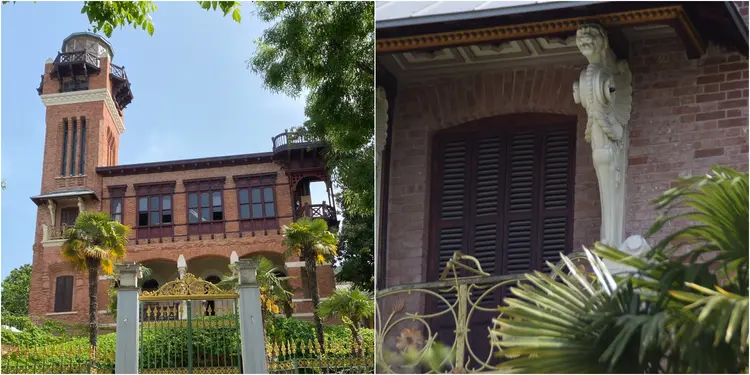
Most of Büyükada, the largest of Istanbul’s Princes’ Islands, is a parade of pale wooden summer villas. Then a red brick tower shows up on Çankaya Caddesi and breaks the pattern completely. That tower belongs to Mizzi Mansion, one of the most unusual houses in Istanbul, Türkiye, and its story runs from a lawyer’s newspaper empire to an earthquake, a hotel and an amateur astronomer.
1. A red landmark on Çankaya Caddesi

Çankaya Caddesi is the island’s grand street of 19th-century mansions, and Mizzi Mansion stands at number 31. Cars are banned on most of Büyükada, so the usual way to reach it is on foot or by bike from the ferry pier. Why go? Few houses in Istanbul look anything like it.
2. Brick and a tower on a wooden island

Brick, not timber.
With its red pressed-brick front and a monumental corner tower, the house seems almost detached from the architecture around it, since most of its neighbors are painted wood, as island summer homes of the era usually were. The contrast is the whole point.
3. A 19th-century house that became an island symbol

The mansion is believed to date from the second half of the 19th century, and for well over a hundred years it has been one of Büyükada’s signature buildings. Ferry passengers, cyclists and anyone walking up Çankaya Caddesi tend to stop and look twice. That alone says a lot.
4. Once known as the Red Palace

Its color earned it nicknames. Over the years locals called it Kırmızı Kuleli Köşk, “the mansion with the red tower,” and Al Palas, roughly “the Red Palace,” and the second name still turns up today. Both fit.
5. First built in masonry around 1860

The first house on the site is thought to have been a masonry building from around 1860. No one has pinned down an exact year.
Academic research, including a 2020 study in Istanbul University’s Journal of Art History, describes what came next: the 1894 earthquake badly damaged the house, and the Italian architect Raimondo D’Aronco repaired and reconstructed it.
6. Named after Lewis Mizzi, a Maltese lawyer

The name comes from Lewis Mizzi, a lawyer born in Malta, which was then a British colony. He was one of the house’s best-known owners, yet whether he was also the first is far from settled. Some sources say he commissioned it. Others say it first belonged to a Greek family and passed to Mizzi, the lawyer handling a foreclosure case over the property, and the Istanbul Biennial’s venue page even credits a George Mizzi. What research does show is that in the 1890s, when the earthquake struck, the mansion was in Lewis Mizzi’s hands.
7. A big name among Istanbul’s Levantines

Levantines were the European families, many of them Italian, French, British or Maltese, who settled in Ottoman port cities. Mizzi studied law at the University of Malta, set up a practice in Istanbul in the second half of the 1800s and, according to Levantine Heritage, was one of the city’s leading European lawyers for nearly half a century. He also owned The Levant Herald, an English-language newspaper in Pera, and its weekly overseas edition, the Eastern Express. He later retired to Malta. He died there in 1935.
8. The 1894 earthquake changed everything

The 1894 Istanbul earthquake hit the house hard. Accounts describe it as one of the most badly damaged homes on the island, and yet, without that disaster and the rebuild that followed, the mansion visitors see today would probably not exist.
9. Raimondo D’Aronco and the observatory tower

D’Aronco didn’t design the house from scratch. He arrived in Istanbul in 1893, repaired the earthquake-damaged building, and that repair is what gave it its distinctive character. The iconic tower and its observatory are said to have been added at Mizzi’s request, around 1893-1894. Then, in 1894-1895, D’Aronco renovated the whole house, focusing on the front facade. According to an Istanbul University study, the project and its photographs were shown at the 1896 Turin Art Triennial, where Italian architects praised them. The tower had a scientific afterlife, too. It later became an amateur astronomical observatory used by the Greek astronomer Eugenios Antoniadi.
10. Many owners over the decades

An observatory tower, a large garden and red brick: that combination made it a Büyükada symbol. The building has three floors, including a basement, and over the decades it changed hands many times through sales and inheritance. Each owner used it differently.
11. A hotel in the 1930s

From about 1930 to 1940 the mansion ran as a hotel called the San Remo, with a further restoration in 1934. It then reportedly stood empty from 1940 until 1952. In more recent years it has hosted art events, including a venue role in the Istanbul Biennial, but it remains private property, so check what is on before planning to go inside.
12. Mizzi Mansion’s mix of styles

The front facade carries the clearest trace of Late Victorian English architecture. Look closer and more styles appear: Neo-Greek, Neo-Gothic, Italian and French Renaissance, and Tudor, all on one house. It is the brick-versus-wood contrast of Çankaya Caddesi, replayed on a single facade.
Eclectic is an understatement.
Sources: Adıgüzel, Reconstruction of the Mizzi Mansion by Raimondo D’Aronco (Journal of Art History, 2020), Levantine Heritage, the Mizzi family, İKSV Istanbul Biennial, Mizzi Mansion






Bir yanıt yazın