
Grand Prismatic Spring: 10 Facts About Its Rainbow Colors


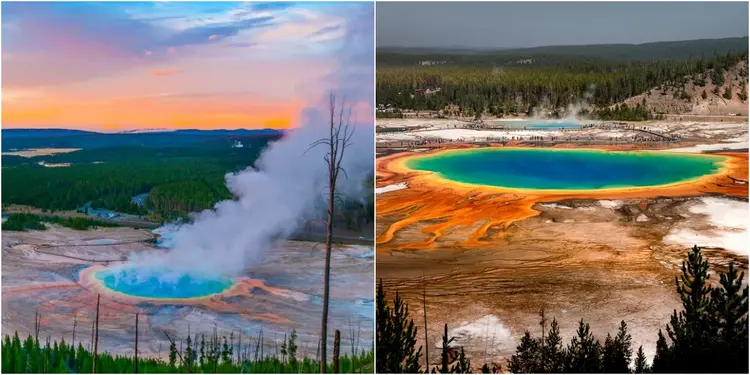
Some places look as if someone pushed the saturation slider all the way to the right. Grand Prismatic Spring, in Yellowstone National Park in the United States, is one of them: a steaming pool ringed in orange, yellow and green around a deep blue center. The colors are not a camera trick, and the biology behind them is stranger than the photos.
1. A Spring Straight Out of a Fairy Tale

Plenty of natural sites get called “otherworldly.”
This one earns it.
Seen from above, the spring looks like a giant eye, or a painter’s palette left out in the sun, with bands of color spreading outward from a blue core. If you’re after a place where the real thing matches the postcard, this is a strong candidate.
2. Inside the World’s First National Park

Yellowstone National Park was established on March 1, 1872. The US National Park Service calls it the world’s first. Grand Prismatic Spring sits in the park’s Midway Geyser Basin, one of several thermal areas scattered across a volcanic plateau.
3. One Park, Three States

Yellowstone spreads across the corner where three US states meet: Wyoming, Montana and Idaho. The split is lopsided, though. About 96% of the park lies in Wyoming, 3% in Montana and just 1% in Idaho.
The park covers roughly 8,991 km² by the Park Service’s own count, which adds the honest footnote that no area figure has been scientifically verified. Forests, canyons, lakes and rivers fill that space, and the thermal basins are only a fraction of it. Still, they’re what most first-time visitors come for. Wildlife is the other big draw, and the two often overlap, with bison grazing a short walk from steaming ground. Give yourself more than a day if you can. Distances inside the park are long, and the roads are slow.
4. More Than 10,000 Hydrothermal Features

Yellowstone holds more than 10,000 hydrothermal features: hot springs, geysers, mud pots and steam vents. Over 500 of them are active geysers, which the Park Service puts at more than half of all the geysers on Earth, and once you add about 290 waterfalls, the park starts to feel like a geology textbook with the pages wide open. Hot springs are the most common type of feature here. The biggest of them all: Grand Prismatic Spring.
5. Grand Prismatic Spring Ranks Third on Earth

Beyond the park, it’s often described as the largest hot spring in the United States. Worldwide, the list of bigger ones is short. Just two: Frying Pan Lake in New Zealand and Boiling Lake on the Caribbean island of Dominica.
6. Wider Than a Football Field Is Long

The spring measures about 110 m across and about 50 m deep. For scale, an American football field runs 100 yards (about 91 m) between the goal lines, so the pool would overshoot it end to end.
The depth is just as hard to picture.
Stand a 10-story building in the middle, and its roof would still sit well below the surface.
7. Water at Around 70 °C

The spring discharges an estimated 2,100 liters of water per minute, at around 70 °C. That’s far too hot for skin, full stop. It’s one reason visitors stay on the boardwalks around the basin.
From the edge, the rainbow effect is easy to miss. Steam drifts across the surface, especially on cool mornings, and the color bands are wide enough that you only see one or two at a time, never the full set of rings stacked together. Up close, it looks less like a painting and more like a hot, breathing lake. Most of the famous images are taken from higher ground, where the whole pattern fits into one frame.
8. Microbial Mats Paint the Colors

So where do the colors come from? The answer surprises a lot of people: living things. The bright bands are microbial mats, multilayered sheets of heat-loving microorganisms, mostly bacteria and archaea.
9. Different Temperatures, Different Colors

The water is hottest at the center and cools toward the edges. Different microbes thrive at different temperatures, so each species settles into its own ring, and the rings stack up into a rainbow. The blue center is the exception. Too hot for the mats, the water there stays sterile and clear, and since deep, clean water shows its own natural blue, the effect here is especially strong.
The mats also shift with the seasons. They tend to be orange and red in summer and usually turn dark green in winter, so the spring you see in July and the one you see in January are not quite the same picture.
10. What Makes It Look So Vivid

Here’s the part most photos leave out: colorful microbial mats aren’t unique to this spring. Smaller hot springs elsewhere in Yellowstone show similar bands.
Size and setting seem to make the difference. The spring sits in an open basin with no trees around it, so it catches full daylight, and that light is what makes the colors pop in photos.
For the best view, skip the boardwalk and climb. The Grand Prismatic Overlook Trail starts at the Fairy Falls Trailhead, about 1.6 km (1 mile) south of Midway Geyser Basin, and climbs about 32 m over roughly 1 km (0.6 miles) to a viewpoint looking down on the spring. The boardwalk puts you next to the heat; the overlook shows you the whole pattern. Parking at the trailhead is very limited. The trail can also close for snow, so check the Park Service alerts before you go.
Sources: Wikipedia: Grand Prismatic Spring, National Park Service: Yellowstone Park Facts, National Park Service: Hydrothermal Features, National Park Service: Grand Prismatic Overlook Trail




Bir yanıt yazın