
21 Things to Do in Mersin, Türkiye’s Tantuni Capital


Mersin sits on the Mediterranean coast of southern Türkiye, with Adana to the east and Antalya to the west, and the province splits that stretch of coast neatly in two. The list of things to do in Mersin runs from sinkholes and sea castles to Roman roads, waterfalls and a canyon. Twenty-one made the cut here, though the province could easily fill fifty.
1. Cennet and Cehennem sinkholes (Heaven and Hell)

Two collapsed caverns near Silifke, given names that sound like a sermon. Cennet (Heaven) is a vast pit about 250 m long and 70 m deep on average, and a 300-step staircase leads down to the ruins of a 5th-century monastery dedicated to the Virgin Mary at the bottom. Cehennem (Hell) is smaller but deeper, at 128 m, and its overhanging rim means nobody walks in. Hence the name.
2. Asthma Cave (Wish Cave)

A short walk from the sinkholes, Astım Mağarası (Asthma Cave) takes its name from a local belief that its air helps people with asthma. That is folk tradition, not medical advice. Visitors tie small wishes to the trees around the entrance, which is why it also goes by Dilek Mağarası, the Wish Cave.
3. Yumuktepe Mound

Once on the edge of town and now surrounded by the Toroslar district, Yumuktepe is a höyük (settlement mound) built up layer by layer from the Neolithic period to Byzantine times. Excavations began in the 1930s and revealed some of the earliest village life on this coast. It is a site for imagination more than spectacle.
4. Adamkayalar (the Rock Men)

About 7 km from the beach town of Kızkalesi, in the Erdemli district, figures stare out from a cliff above a gorge. Nine niches hold eleven men, four women, two children and an ibex, with Roman eagles on the pediment, probably carved in the 2nd century AD.
Who were they? Nobody knows for certain.
5. St. Paul’s Church and Well, Tarsus

Tarsus is the hometown of the Apostle Paul, and this church stands on what tradition calls his birthplace. Don’t expect an ancient church, though: the present building dates from 1862. Today the Ministry of Culture runs it as a monument museum, with ceremonies held for visiting pilgrim groups, and St. Paul’s Well, a short walk away in the old town, is the other stop on the pilgrim route.
6. Roman Road and Cilician Arch near Tarsus

Legend has a long guest list for this road: Paul, Cicero, Julius Caesar, Cleopatra, Mark Antony, Augustus and Hadrian. A preserved stretch about 3 m wide lies near the village of Sağlıklı, roughly 15 km from Tarsus, and is thought to have been in use until the 4th century AD.
Walk it slowly.
7. Old houses of Tarsus

Mudbrick, timber and stone houses line the old streets of Tarsus, many from the late Ottoman and early Republican years. They aren’t grouped into a neat open-air museum. That’s the charm: you find them by wandering.
8. Kırkkaşık Bedesten

İbrahim Bey of the Ramazanoğlu family, the local Turkmen rulers, built this covered market in 1579, and its rents once paid for the upkeep of the Tarsus Grand Mosque next door. The name means “forty spoons,” after the lotus carvings on the pediment that people took for spoons.
Repaired in 1960-61, its 18 rooms are still shops today.
9. Hagia Thecla (Aya Tekla)

About 4 km south of Silifke, this site honors Thecla, an early Christian saint from Ikonion (today’s Konya) who, according to the Acts of Paul and Thecla, followed Paul and lived and died here. A church was built into the cave linked to her. On the hilltop above, Emperor Zeno added a large church around 460-470. Part of its apse still stands.
10. Göksu Delta

Where the Göksu River meets the sea near Silifke, the delta has recorded 332 bird species and has been a Ramsar wetland of international importance since 1994, one of the most important bird areas in the country.
Bring binoculars, because the birds won’t come to you.
11. Mamure Castle

Right on the beach about 6 km east of Anamur, Mamure is one of the best-preserved castles on the Turkish coast, with 39 towers and bastions and a moat. Armenian, Seljuk, Karamanid and Ottoman rulers all rebuilt it in turn. The name Mamure, “prosperous,” came from the Karamanids. Inside, a small mosque and a ruined bathhouse survive.
12. Gilindire Cave (Aynalıgöl)

Remarkably, this cave in the Aydıncık district went unnoticed until 1999, when a shepherd stumbled on it. Stalactites, stalagmites and drapery-like dripstones divide it into chambers, and at the back lies a lake about 140 m long, brackish near the surface and salty further down. Its other name, Aynalıgöl, means “mirror lake.” The still water earns it.
13. Kızkalesi (Maiden’s Castle)

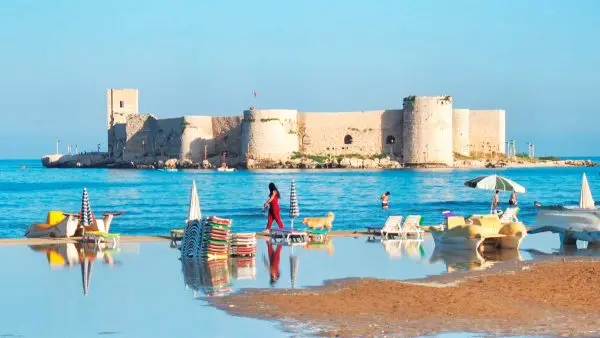
A castle sitting about 300 m out to sea, off the beach town of the same name in the Erdemli district. Boats take visitors across. The story behind the name: a fortune teller warned a king that a snake would kill his daughter, so he shut her away on the island, where no snakes lived. One day a basket of grapes arrived from the mainland. A snake was hiding inside.
14. Soli Pompeiopolis

Around 700 BC, colonists from Rhodes and mainland Greece settled this harbor about 11 km west of central Mersin, in what is now the Mezitli district. Then came Pompey. In 67 BC the Roman general resettled defeated pirates here and renamed the city Pompeiopolis. Excavations are ongoing, and the columns of the old main street still stand.
15. Atatürk House Museum

Mustafa Kemal Atatürk, the founder of the Turkish Republic, stayed in this house with his wife Latife Hanım for about eleven days during a visit to Mersin in early 1925. It sits on Atatürk Avenue (Atatürk Caddesi), one of the city’s busiest streets. The museum opened on 12 October 1992.
Expect period furniture and personal belongings.
16. Anamur River (Dragon River)

Midsummer heat on this coast is serious, and the cold, clear Anamur River, also called the Dragon River, is a local answer to it. Picnic areas around Dibek sit along the water, and some people fish. A cool spot for a long, slow lunch.
17. Ilısu Waterfall

In Gülnar, Ilısu is where people go when the coast gets too hot. Shade, falling water, quiet. Not much more is needed.
18. Yerköprü Waterfall

In the Mut district, Yerköprü looks almost too tidy to be natural, like a waterfall painted by someone who had only heard of them. The name means “earth bridge.”
Photographers love it.
19. Uzuncaburç (Olba)

About 30 km north of Silifke, at around 1,200 m in the Taurus Mountains, the village of Uzuncaburç sits beside the ruins of ancient Olba, known in Roman times as Diocaesarea. The name means “tall tower,” after the ruins. The Temple of Zeus and the Temple of Tyche are the headliners, and the cooler mountain air is a welcome bonus after the coast.
20. Tarsus Waterfall

On the Berdan River, the ancient Cydnus, right in Tarsus, this waterfall is a weekend picnic spot packed with families. Locals say remains of a Roman-era cemetery show around it when the water drops.
Go on a weekday for a quieter visit.
21. Lamos Canyon

In the Erdemli district, near the town of Limonlu, this canyon is also known as the Kayacı Valley and is about 50 km from central Mersin. Its name is the river’s: Lamos, the ancient name of the stream that cut it. A short canyon walk is a good counterweight to all the ruins elsewhere in the province.

And then there is lunch. Mersin is the home of tantuni, finely chopped beef cooked on a wide, shallow griddle and rolled in thin lavash bread, and anyone in town will say it never tastes as good anywhere else. After a day of sinkholes, castles and canyons, that argument is worth testing on the spot.
Sources: Cennet and Cehennem (Wikipedia), Kızkalesi castle (Wikipedia), Göksu Delta (Wikipedia), Mersin Atatürk House Museum (Republic of Türkiye Ministry of Culture and Tourism)

Bir yanıt yazın