
Lake Natron: 7 Facts About the Lake That Petrifies


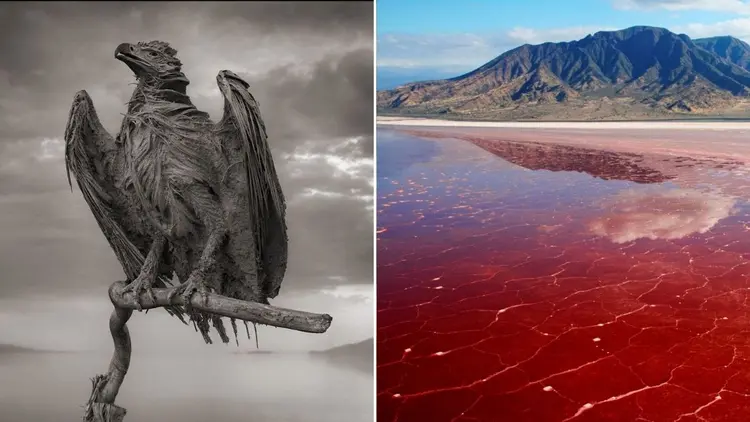
Lake Natron, in northern Tanzania, looks like something from a science fiction set: blood-red water, crusts of salt and birds that seem carved from stone. The stone birds are real, though the story behind them is stranger and more scientific than the legend. Here is what makes this lake so hostile, and why some animals thrive in it anyway.
1. Where Lake Natron is

Lake Natron lies in the Arusha Region of northern Tanzania, and its northern tip reaches across the border into Kenya. It is long and shallow. Up to 57 km long and 22 km wide, the lake is less than 3 meters deep.
The lake takes its name from natron, a naturally occurring mix of sodium carbonate compounds that crystallizes as the water evaporates. That chemistry makes the water extremely alkaline, with a pH that can exceed 12. For comparison, household ammonia sits at around 11. Then there is the color.
Cyanobacteria carrying a red pigment tint the open water deep red and the shallow edges orange, while salt-loving microorganisms stain the salt crust red or pink. From the air, the lake can look less like water and more like a painter’s palette left out in the sun.
2. A lake shaped by the Great Rift Valley

Lake Natron sits in the Gregory Rift, the eastern branch of the East African Rift, where the continent’s crust is slowly pulling apart.
Volcanic activity comes with the territory. About 16 km south of the lake rises Ol Doinyo Lengai, a 2,962-meter volcano whose name means “Mountain of God” in the language of the local Maasai. Its lava is the oddity. Ol Doinyo Lengai is the only volcano on Earth known to erupt natrocarbonatite, an unusually cool and runny lava rich in sodium carbonate, and while exactly how much each source contributes is hard to pin down, the sodium-rich volcanic landscape around the basin is a big part of why the lake is so salty and caustic.
3. Why dead animals here look like stone

The lake became famous in 2013, when photographer Nick Brandt published eerie images of birds and bats that looked like stone statues, and the pictures spread online with a simple caption: touch the water and turn to stone.
That caption gets it wrong. The reality is slower. Animals that die in or near the lake, often birds that crash into its mirror-like surface, are gradually coated and preserved by its salts. The carbonate-rich water dries out and calcifies their bodies. The result: rock-hard remains. Brandt found the dead animals washed up on the shore and posed them on branches and rocks for his photographs. No creature freezes into a statue on contact.
4. Deadly for many, home for some

Not everything dies here. A small fish, a tilapia species adapted to the warm, salty water, lives in the hot springs along the lake’s edges. The lake’s best-known residents are pink. Flamingos, by the million, use this hostile shoreline as a nursery.
5. How flamingos thrive in a caustic lake

Lake Natron is the only regular breeding site in East Africa for some 2.5 million lesser flamingos, and around three-quarters of the world’s lesser flamingos are born here. How does a bird raise its young in water this caustic? Adaptation, mostly. Tough skin on their legs and feet copes with the alkaline water, and their filter-feeding bills strain out Spirulina, a cyanobacterium that blooms in the lake. The same pigments in that food help give the birds their pink color.
The lake also works as a moat. Flamingos build cone-shaped mud nests on seasonal islands that form as the water evaporates, and the caustic water keeps most predators away. It is the same water that slowly calcifies a bird that crashes into it, here working in the flamingos’ favor. Water level is a delicate balance: low enough not to flood the nests, high enough to keep hungry visitors out.
Outside these specialists, life is scarce. For most animals the lake is a trap, not a refuge.
6. What makes the water so dangerous

The danger comes from a combination: very high pH, high salt content and heat.
The heat alone is extreme. Water temperatures frequently top 40°C (104°F) and can reach 60°C (140°F). Strongly alkaline water like this can irritate human skin and eyes. Look, don’t wade. Add the hot, dry climate of the rift floor, and it is easy to see why only a few hardy species survive here.
Compare it with a freshwater lake a few hours’ drive away in the same rift and the contrast is striking: one supports fish, hippos and lush shores, while Natron supports a handful of microbes, one small fish and a flamingo colony.
7. A window into life at the extremes

Places this extreme interest scientists who study how far life can be pushed, and Lake Natron is one of the planet’s clearest examples. Its basin was designated a Ramsar wetland of international importance in 2001.
Frightening and beautiful at once, Lake Natron is a reminder of how thin the line between life and death can be in nature. Pink flamingos, calcified birds, red water. All come from the same chemistry. The lake is also the usual base for climbing Ol Doinyo Lengai, with campgrounds nearby, so travelers in northern Tanzania can see it for themselves. Just keep your hands out of the water.
Sources: Wikipedia: Lake Natron, Wikipedia: Ol Doinyo Lengai, National Geographic







Bir yanıt yazın