
11 Best Beaches in the Balkans, From Montenegro to Croatia


Three seas wash the Balkan Peninsula: the Adriatic, the Ionian and, on the far eastern side, the Black Sea. That gives the best beaches in the Balkans an unusual range, from white-pebble spits and cliff-backed coves to sand strips you can walk for an hour without reaching the end. Here are 11 of them, in Albania, Montenegro, Croatia, Greece, Bulgaria and Slovenia.
1. Dhërmi Beach, Albania

Dhërmi sits on the Albanian Riviera, where the Ceraunian Mountains drop straight into the Ionian Sea. The beach runs for about 5 km below the village, ending at a hill topped by the Monastery of Saint Theodore, and on a clear day Corfu shows up on the horizon to the south. Clear turquoise water, pine-covered slopes behind you, kayaks and snorkels for rent: that’s the appeal.
After dark, the beach clubs take over.
2. Jaz Beach, Montenegro

About 2.5 km west of central Budva, Jaz is one of the longer beaches on the Montenegrin coast, with a main stretch of roughly 850 m and a second, quieter section beyond it. It’s a pebble beach, not a sandy one, framed by rocky headlands and green hills. Big enough for a crowd? The Rolling Stones played here in 2007 to about 40,000 people, so yes. On an ordinary summer day it’s simply a roomy, easygoing beach that families with small children like.
3. Zlatni Rat, Croatia

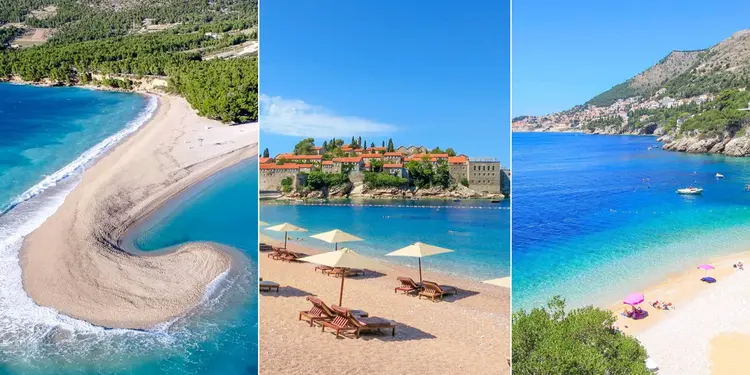
Zlatni Rat, the “Golden Horn,” is probably the most photographed beach in Croatia. It’s a spit of fine white pebbles about 2 km west of the town of Bol on the island of Brač, poking south into the Hvar Channel with a pine grove along its spine. Its tip moves. The afternoon Maestral wind usually nudges it slightly east in summer, while a strong southeasterly Jugo can swing it the other way, sometimes within hours. That same reliable Maestral is why windsurfers come here every summer, and kiteboarders have staged competitions off the point. No two aerial photos of it look quite the same.
4. Navagio Beach, Greece

Navagio, or Shipwreck Beach, is a cove on the coast of Zakynthos in Greece’s Ionian Islands, hemmed in by sheer cliffs and usually reached by boat. The rusting hull on the sand is the MV Panagiotis, a small cargo ship that ran aground in a storm on October 5, 1980. Getting close is less simple. Rockfalls in 2018 and 2022 led to closures and restrictions on swimming and anchoring, so check the current rules before booking a boat trip. Even seen only from the water or from the clifftop above, the bright blue water makes it one of the most recognizable beaches in Europe.
5. Velika Plaža, Montenegro

Velika Plaža means “Great Beach,” and the name is honest. Running about 12 km (7.5 miles) from Port Milena in Ulcinj to the mouth of the Bojana River, it’s the longest beach in Montenegro and one of the longest in Europe, a strip of sand backed by dunes and alluvial forest. Finding a quiet spot is rarely hard.
Steady onshore winds on summer afternoons have made it the Adriatic’s best-known kiteboarding spot, with several schools along the shore.
6. Sunny Beach, Bulgaria

This is the only Black Sea entry on the list, and it comes with a bonus next door. Nesebar, sometimes called the “Pearl of the Black Sea,” began as a Thracian settlement, became a Greek colony in the 6th century BC, and passed through Roman, Byzantine, Bulgarian and Ottoman hands before UNESCO added its old town to the World Heritage List in 1983. Its narrow lanes and old churches make it a rewarding place to wander.
Sunny Beach lies immediately north of Nesebar, the two now practically merged, and it’s Bulgaria’s biggest resort. A wide band of golden sand runs for several kilometers in front of the hotel strip, and the area was once known for its natural dunes. Restaurants, beach bars, water sports and loud nightclubs fill the rest of the picture. Anyone after silence should stay in Nesebar and walk over for the day.
7. Portorož Beach, Slovenia

Slovenia has less than 50 km of coast, and Portorož is where most of its beach life happens. The town grew up in the late 19th century as a spa resort using salt-water and salt-pan mud treatments, and by the early 20th century it was one of the grandest resorts on the Adriatic. Today the seafront is lined with hotels, restaurants, shops, a marina and casinos.
Lively rather than secluded.
8. Mirror Beach, Albania

Of the beaches around Saranda on Albania’s Ionian coast, this small cove ringed by huge white rocks is a standout. Locals call it Plazhi i Pasqyrave, the “beach of mirrors,” after the glare the afternoon sun throws off the water. The sea is genuinely, almost absurdly clear. What sets it apart from Saranda’s busier beaches is how little has been built around it, which leaves mostly the rocks, the waves and the sound of both.
9. Sveti Jakov Beach, Croatia

Dubrovnik’s old-town beaches get packed in July and August, which is exactly why this one, about 2 km east of the Ploče Gate, is worth the effort. The effort is real: after a walk of 20 to 30 minutes along the coast road, past the little church of Sveti Jakov, around 150 steps lead down the cliff to the water. Climbing back up is the hard part.
Down below, the beach is pebbly (water shoes help), there’s a bar for drinks and snacks, and pine trees creep toward the shore for some shade. The payoff, though, is the view west across the water to the Old Town walls, best at sunset.
Not keen on stairs? Local buses and taxis run up to the top, and in summer small boats from the Old Port often stop at the beach.
10. Sveti Stefan, Montenegro

Sveti Stefan is a tiny walled island joined to the mainland by a narrow tombolo, a sandbar just wide enough for a path, and it’s one of the most photographed sights on the Adriatic. The old village on the islet was turned into a luxury hotel, Aman Sveti Stefan, but the resort has been closed since early 2020 amid disputes with the government, with no announced reopening date. So the islet itself is off limits for now. The reddish-pink beaches on either side of the tombolo are still there, and the coastal path toward Miločer gives the best angles on the island.
Compare it with Velika Plaža farther south: one is 12 km of open sand, the other a postcard you mostly admire from the shore. Both belong on a Montenegro coast itinerary.
11. Queen’s Beach, Croatia

Croatia is mostly pebbles, which makes Queen’s Beach (Kraljičina plaža) near Nin a rarity: more than 3 km of sand stretching north of the town, with a gentle, shallow entry that suits families. Nin sits in a lagoon in northern Dalmatia, a short drive from Zadar and easy to reach by car or bus. The lagoon is also known for its mineral-rich mud, which visitors smear on in the belief that it eases joint and muscle aches. Legend says a medieval Croatian queen bathed here, hence the name. For a quiet beach day, it’s hard to beat.
Sources: Wikipedia: Zlatni Rat, Wikipedia: Sveti Stefan, Lonely Planet: The best beaches in Dubrovnik, Total Croatia News: Queen’s Beach and the Nin healing mud




Bir yanıt yazın