
The 5 Cinque Terre Villages: A First-Timer’s Guide


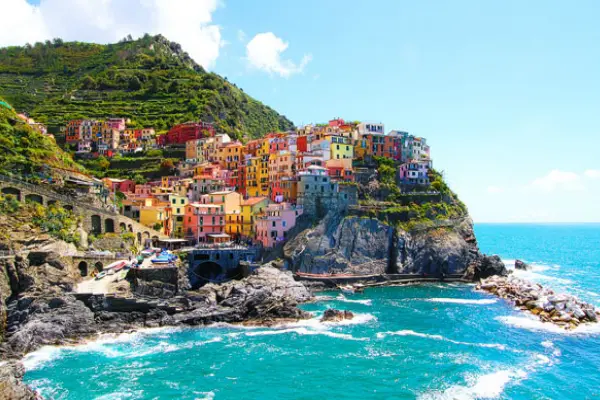
Five old fishing villages cling to the cliffs of Liguria, on Italy’s northwest coast, and together they make up the Cinque Terre, literally the “Five Lands.” UNESCO added the area to its World Heritage List in 1997, and the hills around the Cinque Terre villages have been a national park since 1999. Here they are from north to south, with what to see, where to eat and how to get there.

1. Monterosso al Mare, the Beach Village

Monterosso is the most developed of the five, and it has the only long sandy beach on this stretch of coast. That explains the wine shops, the restaurants and the wide choice of hotels. First-time visitors find life easy here.
The catch: summer brings crowds.
Want the best photo of the village? Climb to the Capuchin convent, a building from around 1600 that looks down over the rooftops, then wander the narrow lanes, rest under one of the striped beach umbrellas and try a glass of local Cinque Terre white wine. L’Ancora della Tortuga, a restaurant on the waterfront rocks, has long been a local recommendation. Espresso is taken seriously here.
2. Vernazza, the Postcard Harbor

Pastel houses, green shutters and seafront cafés set Vernazza apart. The classic postcard shot of the whole village takes a little effort, since you need to climb a short way up the hiking path toward Monterosso and then turn around to look back.
Late afternoon, the cafés fill up. That is when the village is at its most sociable. Seafood is excellent here, as it is everywhere in the Cinque Terre, and Ristorante Belforte is known for its presentation as much as its cooking. Vernazza is also famous for gelato. Start with lemon, sold around the main square.
3. Corniglia, the Village on the Hill

In four of the Cinque Terre villages, you step off the train and you’re already in town. Corniglia is the exception. It is the only one of the five not right on the sea, and from the station by the shore you reach it by the Lardarina, a staircase of 33 flights and 383 steps. A small shuttle bus sometimes runs up the road from the station for anyone who would rather not climb. Honestly, the stairs are worth it. With every flight, the view over the coast opens up a little more.
4. Manarola, the Colorful One

Manarola is the second-smallest of the five. Many visitors call it the prettiest, though that is one argument nobody ever settles. At its center stands the church of San Lorenzo, whose cornerstone is dated 1338. Between April and September, the clear water below the village is good for swimming, and small fishing boats are pulled up even in the side streets.
From here, the Via dell’Amore (Path of Love) runs just over 1 km (0.6 mi) along the cliffs to Riomaggiore. A rockslide closed it in 2012. More than a decade later, in July 2024, the path fully reopened. Despite the romantic name, it is no longer a free stroll. Entry now goes through the Cinque Terre Card with a booked half-hour slot, and in high season it runs one way, from Riomaggiore to Manarola.
For dinner, Trattoria dal Billy has a reputation for homemade seafood spaghetti and panna cotta, and Cantina dello Zio Bramante is the place for live music afterward.
5. Riomaggiore, the Southern Gateway

Riomaggiore is the southernmost village and the first train stop from La Spezia. Turn right just outside the station. A path there leads up to a viewpoint over the whole village before you even reach the center. Handmade crafts and souvenirs are easy to find in its lanes, and at the top of the village the church of San Giovanni Battista (St. John the Baptist) is worth the climb for the carved marble doorways on its facade. Fried seafood and gelato are local favorites here too, and Il Grottino is one of the better-known restaurants.
Compare it with Corniglia. One village sits right on the water and is reached straight from the train, while the other rewards you only after 383 steps.
Where to stay
From April to September, the Cinque Terre can be very busy, so book early. Monterosso, with the widest choice of hotels, is the easiest base for a first visit. Leave it late and both the room supply and the prices work against you. Winter bookings tend to be noticeably cheaper.
Walking between the villages
The Sentiero Azzurro (Blue Path) links all five villages along the coast. Some sections are steep. Landslides on the unstable slopes also close parts of it at times, and how long a closure lasts is hard to predict, so check which stretches are open before you set out. When a section is closed, the local train covers the same ground in a few minutes.
How to get to the Cinque Terre
The villages sit on the Genoa-Pisa railway line. Most visitors arrive by train at La Spezia, which has connections from Genoa, Milan, Florence, Pisa and Rome, then switch to the regional trains that stop in all five villages. The Cinque Terre Card, sold at National Park info points from La Spezia to Levanto, covers trains and park access, and it is the same card that books a Via dell’Amore slot, so a day card is the easiest way to hop between villages. Many long-distance trains don’t stop at every village, so check the timetable.
Sources: Cinque Terre (Wikipedia), Corniglia (Wikipedia), Via dell’Amore visit information (official site)




Bir yanıt yazın