
Istanbul’s Historic Peninsula: 10 Must-See Places


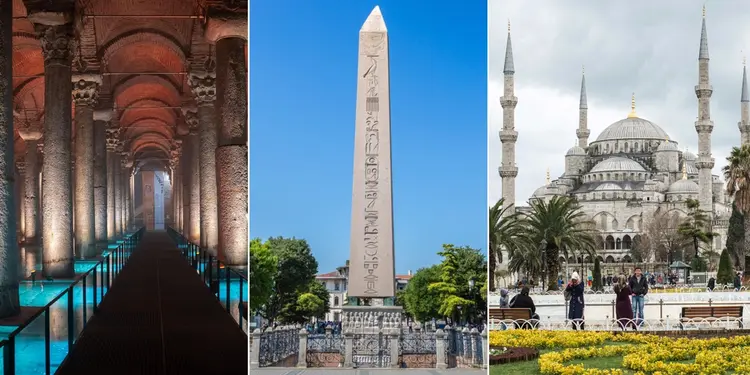
Water on three sides and Byzantine land walls on the fourth: the Historic Peninsula is where Istanbul began. Known in Turkish as Suriçi (“within the walls”) and now part of the Fatih district, this wedge of land between the Golden Horn, the Bosphorus and the Sea of Marmara served as the capital of the Byzantine Empire and then of the Ottoman Empire. These 10 places are the ones a first-time visitor to Türkiye’s largest city shouldn’t leave without seeing.
1. Sultanahmet, Heart of the Historic Peninsula

Start here.
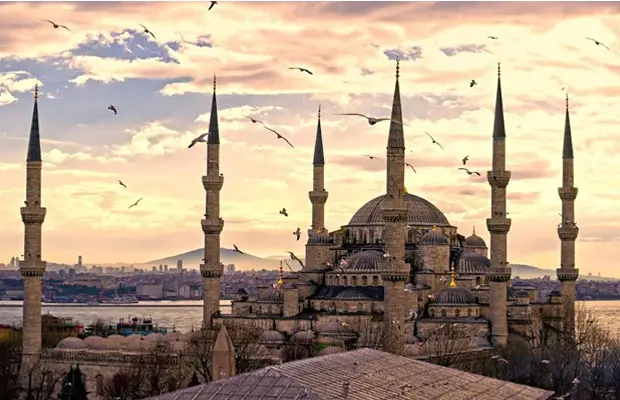
The Sultanahmet Mosque, better known as the Blue Mosque, and the square in front of it draw more visitors than almost anywhere else in the city.
Built in the 17th century for Sultan Ahmed I, the mosque takes its English nickname from the İznik tiles inside, mostly blue with touches of white and green. It was never meant to stand alone, though. Around it grew a whole complex: shops, a bathhouse, a soup kitchen, madrasas (religious schools), an arasta (a covered row of shops whose rents supported the mosque), fountains, a tomb, a hospital, a royal pavilion and a primary school, which together make it one of the largest and most significant building complexes in Istanbul. It is still a working mosque. Cover shoulders and knees, women should cover their hair, shoes come off at the door, and it’s best to time a visit outside prayer hours.
2. Topkapı Palace

For nearly four centuries, from Mehmed II (Mehmed the Conqueror) in the 15th century to Abdülmecid I in the 19th, Topkapı Palace was where the Ottoman Empire was run, its pages educated and much of its art commissioned. A government decree of 3 April 1924, months after the Republic of Türkiye was proclaimed, turned it into a museum. The grounds are enormous: roughly 600,000 to 700,000 square meters by most estimates, making it one of the largest palace museums in the world.
What’s inside? Chinese porcelain, portraits of the sultans, an arms collection, the Holy Relics (among them a cloak attributed to the Prophet Muhammad), the Enderun Library and the Imperial Treasury.
Give it half a day.
3. The Obelisk of Theodosius

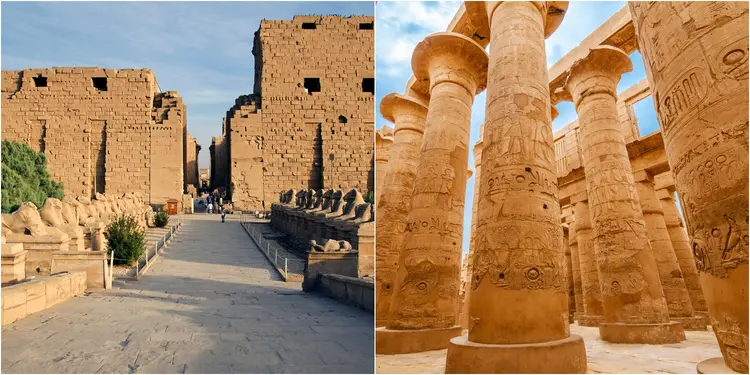
The open square beside the Blue Mosque was once the Hippodrome, where Roman and Byzantine crowds came to watch chariot races. At its center stands something far older than either empire. Pharaoh Thutmose III raised this obelisk at the temple of Karnak in Egypt around 1450 BC, which makes it about 3,500 years old and more than twice the age of Hagia Sophia. In 357 AD Emperor Constantius II had it and a second obelisk shipped down the Nile; the twin went to Rome, where it’s now known as the Lateran Obelisk, while this one waited in Alexandria until Theodosius I set it up on the Hippodrome’s central barrier in 390, on a marble pedestal carved in the city.
It reached its current home a little over 1,600 years ago. Karnak had it for some 1,800 years.
4. Spice Bazaar

One of Istanbul’s oldest markets, the Spice Bazaar sits in Eminönü, right by the Golden Horn ferry piers. It belongs to the New Mosque complex next door. That complex took its time. Safiye Sultan, mother of Sultan Mehmed III, started the mosque in 1597; the project stalled after Mehmed III died in 1603, and it was Turhan Hatice Sultan, mother of Mehmed IV, who finally completed it in the 1660s, adding the bazaar after the Great Fire of 1660.
The Turkish name, Mısır Çarşısı, means “Egyptian Bazaar.” Revenue from Ottoman Egypt paid for the building.
Today its 80-odd shops sell spices, dried fruit and nuts, herbs, Turkish delight and souvenirs.
5. Basilica Cistern

Locals call it Yerebatan Sarayı, the “Sunken Palace,” and one look at the forest of marble columns rising from the water explains why. Built in the 6th century under Byzantine Emperor Justinian I to store water for the city, the cistern lies about 150 meters southwest of Hagia Sophia and holds 336 columns, each around 9 meters tall. It reopened in 2022 after a restoration and earthquake-proofing project.
Two spots are worth hunting for. One column is carved with teardrop patterns, and popular lore says it honors the laborers who died building the cistern; the historical record only says that thousands of enslaved people worked on it. In the far northwest corner, two column bases rest on carved heads of Medusa, the figure from Greek mythology whose gaze turned people to stone, and one of them is upside down. Why? Nobody knows for certain. The favorite story says it keeps her stare from doing any harm.
6. Hagia Sophia

Justinian I, the same emperor behind the cistern, ordered Hagia Sophia built, and it went up between 532 and 537 as the cathedral of the Patriarchate of Constantinople. It was the largest church in the world for more than 500 years. After the Ottoman conquest of 1453, Mehmed II converted it into a mosque; the Republic opened it as a museum in 1935, following a 1934 decision, and in 2020 that decision was annulled and the building became a mosque again. Few buildings anywhere have changed roles this often.
Architecturally, it’s a domed basilica. It was also one of the first large buildings to use a fully pendentive dome, the solution for setting a round dome on a square base that changed the history of architecture. For many Christians it remains a place of deep symbolic and spiritual meaning, and today it is also a working mosque. The Blue Mosque dress code applies.
7. Grand Bazaar

Mehmed II commissioned its core, a domed hall for trading textiles and jewels, soon after the conquest; work started in 1455/56 and was finished around 1461. Nearly six centuries and a long list of fires later (1515, 1701 and 1954 among them), the Grand Bazaar is still one of the city’s busiest trading hubs, with an estimated 3,000 to 4,000 shops along 61 covered streets and dozens of hans, the old courtyard inns where merchants once lodged and traded. Every gate seems to open onto a different world.
Bargaining is part of the experience at many shops: start below the asking price and keep it friendly.
Then there’s the legend. Tunnels supposedly run beneath the bazaar to the Basilica Cistern and on, under the sea, all the way to Kınalıada, the nearest of the Princes’ Islands, and the few who knew the route were made to swear on the Quran never to reveal it. It remains just that: a legend.
8. Beyazıt Square

Istanbul University’s monumental gate, a Neo-Renaissance arch, dominates one side of Beyazıt Square. The ground is far older. This was the site of the Byzantine Forum of Theodosius, and over the centuries the square has been rebuilt and rearranged many times, most recently in a redesign that opened in 2022. The Bayezid II Mosque, built for Sultan Bayezid II in the first years of the 1500s, stands on the square and gives it its name. Book lovers, take note. Right beside the mosque is the Sahaflar Çarşısı, an old book market, and the Nuruosmaniye Mosque is a short walk east, next to one of the Grand Bazaar’s gates.
9. Istanbul Archaeology Museums

Founded in 1869 as the Imperial Museum (Müze-i Hümayun), the institution opened its main building to visitors on 13 June 1891. The Classical facade sets the tone. Inside, according to Türkiye’s official museums portal, the collection runs to nearly one million objects, much of it from lands once within the Ottoman Empire: Anatolia and the Balkans, Mesopotamia, Syria, Egypt and the Arabian Peninsula, from the ancient Orient to the Hellenistic, Roman and Ottoman eras. Three buildings share the site. One of them, the Tiled Kiosk, holds Islamic art. History buff or not, it leaves a mark.
10. Süleymaniye Mosque

Mimar Sinan, the most celebrated Ottoman architect, built the Süleymaniye Mosque for Sultan Süleyman the Magnificent. An inscription gives 1550 for the foundation and 1557 for the inauguration. The mosque is the centerpiece of a full complex with madrasas, a primary school, a hospital and medical school, a public kitchen, a hamam (Turkish bath), shops and the tombs of Süleyman and his wife Hürrem Sultan.
Sinan is said to have claimed the mosque would stand until the end of the world. It has proven remarkably tough. Not untouched, though: the Great Fire of 1660, the same blaze that preceded the Spice Bazaar, damaged it, and the 1766 earthquake brought down part of the dome.
Sinan himself lies in a tomb just outside the complex.
Sources: Wikipedia, Obelisk of Theodosius, Wikipedia, Hagia Sophia, Türkiye Museums, Istanbul Archaeological Museums, Go Türkiye, Istanbul.

Bir yanıt yazın