
Sultanahmet Square: 15 Historic Sights, Step by Step


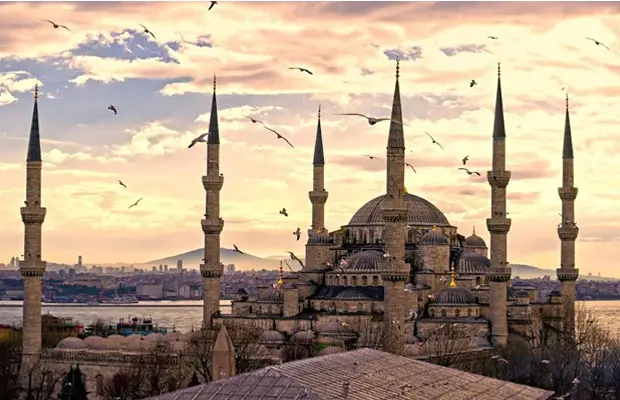
Sultanahmet Square sits at the heart of Istanbul’s Historic Peninsula, and almost every first trip to the city in Türkiye passes through it. Under the paving lies a Roman racetrack, and around its edges stand some of the most famous buildings on Earth. Here are 15 stops for exploring the square and its neighborhood on foot, one step at a time.
1. The Hippodrome, or “Horse Square”

The square’s story begins with the Romans. Under the Roman and then the Byzantine Empire it was the Hippodrome, the city’s stage for chariot races, musicians, dancers, acrobats and fights with wild animals, and later Ottoman Turks simply called it Atmeydanı, the Horse Square. The emperor’s Great Palace once spread from the edge of the track down the slope toward the sea. Truth be told, almost nothing of it survives above ground. A large floor mosaic from the palace, though, can still be seen nearby.
2. A square for festivals and revolts

In Ottoman times the square kept its role as the city’s public stage. Lavish circumcision celebrations for the sultans’ sons, said to last forty days and nights, were held here. So were Janissary revolts. During a 17th-century military uprising known as the Vaka-i Vakvakiye, rebels hanged their victims from the branches of a huge plane tree on the square.
Centuries later, on May 23, 1919, the writer Halide Edib gave a famous speech here to a vast crowd protesting the Allied occupation of Istanbul.
3. Sultanahmet Square’s famous trio

The first things to catch the eye are three tall monuments standing in a row. Their original job: marking the central barrier that split the racetrack in two. Chariots raced around them lap after lap, by most accounts seven times, and the first team back to the starting line won.
The track is long gone, but the monuments the racers circled are still standing.
4. Three monuments, three stories

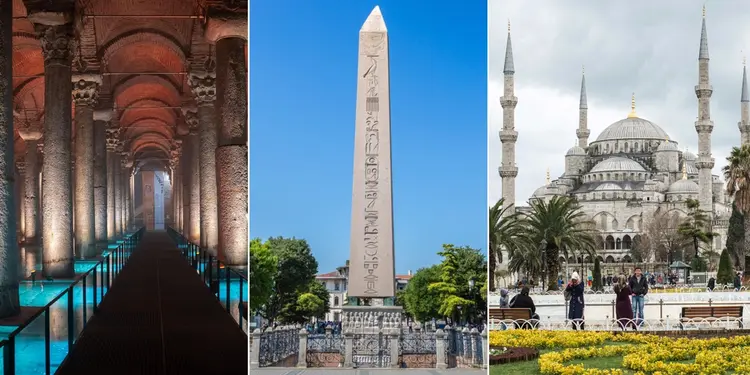
The most famous of the three is the Obelisk of Theodosius, made for Pharaoh Thutmose III around 1450 BC and brought from Egypt to stand here in 390. Raising it again took about a month: the Latin inscription on its base says 30 days, the Greek one says 32. Even the base can’t agree with itself. Next to it, the bronze Serpent Column came from the sanctuary of Apollo at Delphi, and legend later turned its three twisted snakes, headless today, into a talisman against vermin. Then comes the 32-meter Walled Obelisk. Rougher than its Egyptian neighbor, it still towers over the square.
5. İbrahim Pasha Palace

On the west side of the square stands the palace of Pargalı İbrahim Pasha, Grand Vizier and close confidant of Sultan Süleyman the Magnificent. Built around 1524, it saw weddings, festivals and stormy times, and kept İbrahim’s name even after he was executed in 1536. Since 1983 it has housed the Museum of Turkish and Islamic Arts, founded in 1914 as the first museum in Turkey to bring Islamic art together in one place.
The carpet collection alone is worth the visit.
6. The German Fountain, a gift to Istanbul

At the northern end of the square, an octagonal domed fountain stands out for its elegant lines. It was a gift from Germany. The occasion: Kaiser Wilhelm II’s 1898 visit to Istanbul, the second of his three trips to the Ottoman capital. Built in Germany and assembled here around 1900, it is neo-Byzantine in style, and the inside of its dome glitters with gold mosaics.
7. The Blue Mosque

With its slender minarets rising like the raised arms of a dervish in prayer, the Sultanahmet Mosque, better known as the Blue Mosque, defines Istanbul’s skyline. Sultan Ahmed I had it built between 1609 and 1617 by the architect Sedefkâr Mehmed Ağa. More than 20,000 İznik tiles and blue-dominated painted decoration inside the domes earned it the name Europeans gave it. Count the minarets: six. Only a handful of mosques in Turkey share that number. It is a working mosque, so visitors enter outside prayer times, with shoulders and knees covered and a headscarf for women.
8. Hagia Sophia, a world masterpiece

Hagia Sophia rises at the far end of the square in all its weight and grace. The building standing today is the third church on the site, built for Emperor Justinian I between 532 and 537, and for more than 500 years it was the largest church in the world. The reason is the dome. Its sheer size made Hagia Sophia the defining symbol of Byzantine architecture. After centuries as a mosque, it became a museum in 1935 and was reclassified as a mosque again in 2020, so the same prayer-time and dress rules apply as next door.
9. Istanbul Archaeology Museums

A short walk down from Hagia Sophia, the Istanbul Archaeology Museums hold around a million objects from cultures across the old Ottoman lands, from the Balkans and North Africa to Anatolia, Mesopotamia and Arabia. The painter and archaeologist Osman Hamdi Bey founded them as the Imperial Museum, which opened on June 13, 1891, and it is often called Turkey’s first museum. Whether it truly was the first is harder to say, since Hagia Irene’s 1846 collection of military antiques, a few minutes away, has a claim too. The complex comes in three parts. There is the main Archaeological Museum, the Museum of the Ancient Orient and the Tiled Kiosk, one of the oldest Ottoman buildings in the city.
10. Topkapı Palace

Behind Hagia Sophia, the Imperial Gate (Bab-ı Hümayun) leads into the gardens of Topkapı Palace, seat of government, school and home of the Ottoman sultans. The palace was split in two. An outer section handled services and administration, while the inner one held the sultan’s private world. It sits on Sarayburnu, the tip of the peninsula where the Sea of Marmara, the Bosphorus and the Golden Horn meet, on top of the old Byzantine acropolis. On the land side, a wall built by Sultan Mehmed II sealed it off from the city. On the sea side, the Byzantine walls did the job.
11. Hagia Irene

Its name means “Holy Peace,” and it stands in the first courtyard of Topkapı Palace, right beside Hagia Sophia. Tradition credits the first church here to Constantine I in the 4th century. What stands today is mostly Justinian’s 6th-century rebuild. Hagia Irene is one of only two Byzantine churches in Istanbul never turned into a mosque. After serving as an Ottoman arsenal, it became a collection of military antiques in 1846, one of the first steps toward museums in Turkey, and today it doubles as a museum and a concert hall for the Istanbul Music Festival.
12. The former Carpet Museum

Back beside Hagia Sophia, two lesser-known spots deserve a mention. The first is the old imaret, the 18th-century soup kitchen of the Hagia Sophia complex, northeast of the great building. For several years it displayed the Carpet Museum’s collection: carpets and prayer rugs donated to mosques and tombs in the Seljuk and Ottoman tradition, rare Anatolian weavings from the 14th to the 20th century, and Persian and Caucasian pieces. After Hagia Sophia became a mosque again, the carpets were moved out in 2020 and the building was set to return to its original purpose. Any guide that still sends visitors here for carpets is out of date. For carpets, head back to İbrahim Pasha Palace on the square.
13. Soğukçeşme Street

The second is Soğukçeşme Street, a small open-air museum squeezed between Hagia Sophia and Topkapı Palace, leaning against the palace wall. Its row of wooden houses with overhanging bay windows was restored and reopened in 1986, partly as a guesthouse-style hotel, and an old Byzantine-era cistern on the street now holds a restaurant. The marble fountain from 1800 that gave the street its name (“cold fountain”) is still there. So is the house where Fahri Korutürk, Turkey’s sixth president, was born.
14. Little Hagia Sophia

Walk past Topkapı Palace toward the shore at Cankurtaran and another “Hagia Sophia” appears in a quiet, tree-lined garden. It was built as the Church of Saints Sergius and Bacchus under Justinian I and Empress Theodora, finished in 536. A scaled-down copy of the famous one, then? Not at all: it was finished a year before Hagia Sophia itself. Between 1506 and 1513, under Sultan Bayezid II, the Chief Black Eunuch Hüseyin Ağa converted it into a mosque, and a madrasa and his own tomb were added later. Compared with its giant namesake, it is small, calm and almost empty of crowds. That is exactly its charm. A few little shops line the courtyard.
15. Dede Efendi House

Before leaving Cankurtaran, look for a wooden house on a narrow street off the main tourist path. It belonged to Hamamizade İsmail Dede Efendi (1778-1846), one of the greatest composers of Ottoman classical music, and tradition says it was a gift from the sultan. After years of neglect it was restored as a small house museum. Few visitors find it. Check whether it is open before making the detour.
Like the rest of this neighborhood, these lanes reward anyone who slows down and wanders.
Sources: Wikipedia, Hippodrome of Constantinople, Wikipedia, Hagia Sophia, GoTürkiye, Historic Peninsula Istanbul Guide



Bir yanıt yazın