
The Boiling River of the Amazon: 5 Things to Know


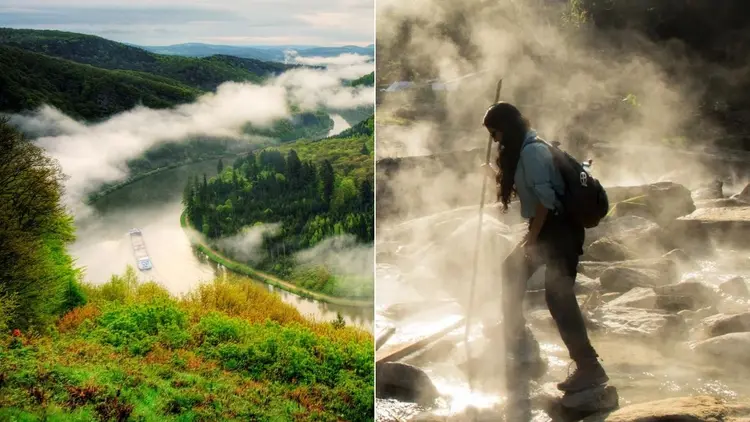
For years, the Boiling River of the Amazon sounded like a campfire story: a river in the Peruvian rainforest so hot it could cook anything that fell in. Geoscientist Andrés Ruzo, who grew up in Peru hearing the tale, went looking for it and found that the legend was real. Here is what you should know about the river, the science behind its heat, and the forest that surrounds it.
1. A childhood legend that a Peruvian geoscientist never forgot

Ruzo first heard about the river as a boy, from his grandfather. The story stuck, the way stories heard at that age often do. By 2011 he was working on a thermal map of Peru, and he decided to find out whether the myth held up.
The trip took him deep into the Amazon, to a remote area where jaguars roam and indigenous shamanic traditions are still alive, and getting there was a journey in stages: first by car, then by motorized canoe, and finally on foot. It was a long way in.
2. The river turned out to be real, and far from any volcano

What Ruzo found was no trickle. In places the river is about as wide as a two-lane road, roughly 25 meters (about 80 feet) at its widest, and close to 5 meters (16 feet) deep. National Geographic puts its average temperature at around 86 °C (186 °F), hot enough to scald an animal that slips in. Here is the strange part, though: the location. The nearest active volcanic center is about 700 km (435 miles) away. Hot springs are common next to volcanoes; a hot river this far from one is not, and that raised a big question for geologists.
So where does the heat come from?
3. The heat comes from deep underground, not from a volcano

Ruzo’s answer is the geothermal gradient, the steady rise in temperature the deeper you go into the Earth’s crust. Rainwater seeps down through deep faults, picks up heat far below the surface, and then rises again through hot springs that feed the river, holding on to much of that heat on the way up.
Think of a natural radiator loop.
The contrast is striking. At its headwaters the river runs at about 27 °C (81 °F), roughly the temperature of the surrounding rainforest, yet downstream, where the hot springs pour in, it gets close to boiling. The exact depth is hard to pin down, but the water has to travel a long way into the crust to get that hot, then come back up fast enough not to cool off. Because there is no magma chamber nearby, the Boiling River works as a showcase for how much heat the planet holds beneath an ordinary landscape.
4. Locals call it Shanay-timpishka, home of the serpent spirit Yacumama

The local name, Shanay-timpishka, is usually translated as “boiled with the heat of the sun.” The geology says otherwise. Still, the name has endured. For local shamans, the river’s power comes from Yacumama, a giant serpent spirit known as the “Mother of the Waters,” who is said to give birth to the hot water.
The area matters culturally as much as scientifically. Shamans regard the river as a center of healing and traditional knowledge that goes back generations, and the healing community of Mayantuyacu sits on its banks. Science here had to work with tradition. Ruzo returned to study the river with the permission of the local shaman. As the story is usually told, that permission came with a condition: once his research was done, he would pour the water samples he had taken back into the river, a gesture meant to honor it and keep it in balance.
5. The forest around the Boiling River is disappearing fast

Deforestation is now the biggest threat. Loggers, farmers, and oil companies are all active in the surrounding jungle, and much of the land around the river is open to development rather than protected. For a place this rare, that is a thin shield.
Travel times make it plain. On Ruzo’s first trip in 2011, the journey meant two hours by car, 30 to 45 minutes by motorized canoe, and an hour or more of hiking. By 2014, a road had been cut through, turning it into a direct three-hour drive from the city of Pucallpa, with no canoe and no walking. In three years, an expedition became a drive.
Sources: National Geographic, Wikipedia


Bir yanıt yazın