
8 UNESCO World Heritage Sites in Southeast Asia


Stretching from Myanmar in the west to the Philippines in the east and Indonesia in the south, Southeast Asia holds some of the oldest and most absorbing historic places on Earth. Its UNESCO World Heritage Sites open a window onto the faiths, trade routes and building traditions of the people who have lived here for thousands of years. These eight span jungle temples, river ports and a plain scattered with mysterious stone jars.
1. Temples of Angkor, Cambodia

Angkor is one of the most recognizable ruins in the world, and it’s easy to think of Angkor Wat as the whole site. It isn’t. Inscribed on the UNESCO World Heritage List in 1992, Angkor is an archaeological park of hundreds of temples, with Angkor Wat, the largest religious monument on the planet, at its center. The Khmer Empire built the temples. It ruled from the 9th to the 15th century.
At its peak, Angkor was the largest preindustrial city in the world by area, and estimates suggest it could support somewhere between 750,000 and a million people. Then came 1431. Forces from the Siamese kingdom of Ayutthaya sacked the city, and it slowly gave way to the forest. When the French explorer Henri Mouhot brought it to European attention around 1860, tree roots had split walls and burst through roofs. That tangle of stone and jungle is exactly what draws around 2 million visitors a year today.
2. Sukhothai, Thailand

Sukhothai Historical Park sits in north-central Thailand and preserves the ruins of the capital of the Sukhothai Kingdom, often described as the first Thai kingdom, in the 13th and 14th centuries. UNESCO listed it in 1991. The park covers about 70 km² (27 sq mi), with close to 200 ruins. Highlights include Wat Mahathat, the park’s most important temple, Wat Si Chum with its huge seated Buddha, and Wat Sa Si on its island in a lake.
King Ram Khamhaeng made Theravada Buddhism the state religion and turned Sukhothai into a spiritual and commercial hub.
His successors never matched his reach.
3. Hoi An, Vietnam

Hoi An lies near the mouth of the Thu Bon River on Vietnam’s central coast. From the 15th to the 19th century it was an important trading port, and its Ancient Town earned World Heritage status in 1999. Chinese and Japanese merchants settled here, and European ships called too, leaving a blend of local and foreign styles that is still easy to read in the streets. Since Vietnam’s 2025 administrative reform, the town falls under the city of Da Nang. The old quarter is packed with well-preserved wooden shophouses, narrow lanes and colorful lanterns. Its best-known landmark? The Japanese Bridge, a small wooden bridge from around the start of the 17th century and one of the town’s symbols.
4. Borobudur Temple, Indonesia

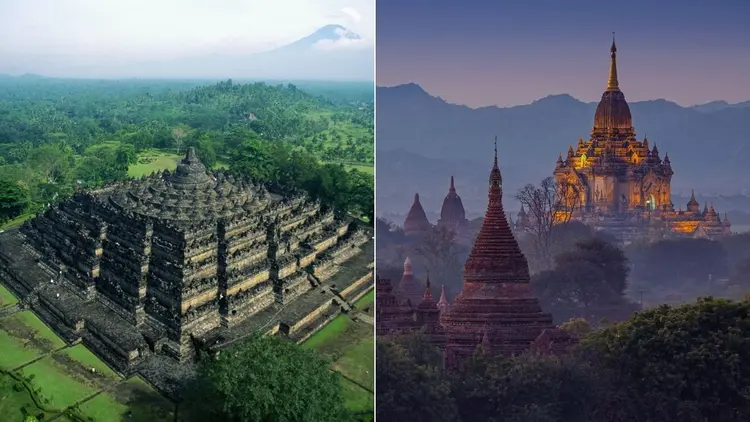
Borobudur, on the Indonesian island of Java, is the largest Buddhist temple in the world. It was raised in the 8th and 9th centuries from around 55,000 m³ of andesite stone and was inscribed by UNESCO in 1991. Its stacked terraces trace the Buddhist path, from the world of desire at the base to the formless realm at the summit, where 72 Buddhas sit inside perforated stupas.
The walls carry 2,672 relief panels, and the temple originally held 504 Buddha statues.
Then it was abandoned for centuries. Angkor, left to the forest after 1431, met the same fate. Help came in 1814, when Thomas Stamford Raffles, then the British lieutenant-governor of Java, heard about the temple and sent a team to clear the overgrowth.
5. George Town and Melaka, Malaysia

Two cities share one listing: “Melaka and George Town, Historic Cities of the Straits of Malacca,” inscribed in 2008. George Town is the cultural heart of Penang Island, off Malaysia’s northwest coast, and it’s widely seen as the country’s food capital, so arrive hungry. Its streets are lined with landmarks like the Cheong Fatt Tze Mansion, known as the Blue Mansion, and Fort Cornwallis from the British colonial era.
Melaka, on the southwest coast of the Malay Peninsula, grew from a 15th-century Malay sultanate into a trading prize that European powers fought over. Portuguese, Dutch and British rulers followed one another. The layers still show. St. Paul’s Church began as a Portuguese chapel in 1521 and is often called the oldest church building in Southeast Asia, while the Dutch Square around the Stadthuys is full of Dutch-era architecture.
6. Bagan, Myanmar

Bagan, formerly known as Pagan, was the capital of the Pagan Kingdom and flourished between the 9th and 13th centuries as a center of religious and cultural learning. In the 11th century, King Anawrahta unified the lands that make up much of today’s Myanmar, and royal support for Theravada Buddhism turned Bagan into a showcase of Buddhist art and architecture.
Anawrahta started the building boom. King Kyansittha took it further, with the Ananda Temple among his best-known works. More than 2,200 temples and pagodas still stand across the plain.
UNESCO added Bagan in 2019. Few places in the region pack this much history into a single view.
7. My Son Sanctuary, Vietnam

My Son Sanctuary is an ancient temple complex of the Champa kingdom, about 36 km (22 miles) south of Hoi An in central Vietnam and part of Da Nang city since 2025. Champa emerged around the 2nd century and united clans across central and southern Vietnam. Building at My Son began in the 4th century, under strong influence from Indian Hinduism, and the first documented shrine honored Shiva. Successive rulers kept adding monuments until the 13th century, earning My Son a place on the UNESCO list in 1999.
The site holds the remains of more than 70 temples and tombs, gathered in groups. Most honor Shiva. Vishnu was venerated here too. French researchers rediscovered the sanctuary in 1898 and restored its main temples between 1937 and 1943. US bombing during the Vietnam War destroyed much of it, a loss that can’t be undone. Still, what remains is widely considered the finest example of Cham architecture.
8. Plain of Jars, Laos

The Plain of Jars, in Laos’s Xiangkhouang Province, is an archaeological landscape dotted with huge carved stone jars. Surveys have identified more than 120 jar sites, each with anywhere from one to about 400 jars of varying sizes. Exactly who made them, and why? That’s still debated, but excavations have found human remains and burial goods, which points to funerary use. Local legend has a livelier answer: giants made the jars to brew and store rice wine after defeating their enemies. UNESCO inscribed the site in 2019.
The plain also bears the scars of a far more recent and tragic chapter.
Relative to its population, Laos is the most heavily bombed country in history, a legacy of US air raids during the Vietnam War era, the same war that wrecked My Son, and this area was among the hardest hit. Bomb craters and shattered jars still show the destruction.
Sources: Wikipedia: Angkor, Wikipedia: Borobudur, TheCollector: 8 Unmissable UNESCO World Heritage Sites in Southeast Asia

Bir yanıt yazın