
Danakil Depression: Ethiopia’s Hottest Place on Earth


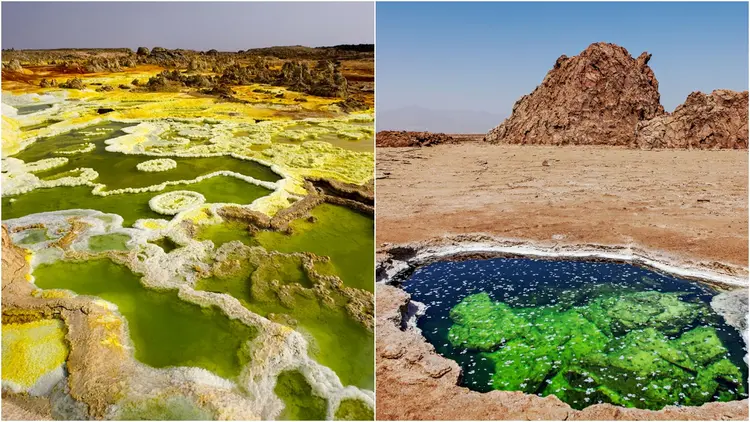
The Danakil Depression, a sunken desert in northeastern Ethiopia near the borders of Eritrea and Djibouti, has long been nicknamed the “land of death.” Parts of it lie more than 100 meters below sea level, rain barely falls for most of the year, and the nearby settlement of Dallol holds the record for the highest average temperature of any inhabited place on Earth. Yet the same harsh conditions have produced lava lakes, acid pools and salt flats that look like they belong on another planet.
Where Is the Danakil Depression and How Did It Form?

The Danakil Depression lies in Ethiopia’s Afar Region and reaches into Eritrea, covering an area roughly 200 km long and 50 km wide. To the west rises the Ethiopian Plateau; to the east, the Danakil Alps separate it from the Red Sea.
It’s a rift. Here the Earth’s crust is being pulled apart, with the Nubian plate and the smaller Danakil microplate drifting away from each other by about 8 mm a year in the north and up to 18 mm a year in the south. That slow stretching began roughly 11 million years ago. The result: a basin with active volcanoes, hot springs and salt deposits more than 500 meters thick in places. Several times the Red Sea flooded it, most recently about 130,000 years ago, and every retreat left another layer of salt behind.
The numbers back up the nickname. Its lowest ground sits around 125 meters below sea level, and the settlement of Dallol recorded an average annual temperature of 34.6°C (94.3°F) between 1960 and 1966, the highest ever measured for an inhabited location. Recognition followed in 2022, when the International Union of Geological Sciences named the depression one of its first 100 geological heritage sites.
The wider Afar Triangle matters to science, too. Lucy, the 3.2-million-year-old skeleton of an early human relative, was found in 1974 at Hadar in the Awash Valley, farther south in the same region. The original is kept at the National Museum of Ethiopia in Addis Ababa, where visitors see a plaster replica.
What to See in the Danakil Depression

The Danakil is the northern end of the Afar Triangle, and its main sights sit a few hours’ drive apart.
Visitors don’t explore on their own: trips run with local Afar guides and armed escorts, usually in convoys of four-wheel-drive vehicles.
Erta Ale Volcano

Erta Ale is a 613-meter shield volcano and the most active volcano in Ethiopia. Its name means “smoking mountain” in the Afar language, and its summit lava lake has been there since at least 1906, the longest-lived lava lake known. The climb looks gentle. It isn’t: the heat and distance turn it into a hike of three to four hours, usually done in the evening. At the crater rim, visitors often cover their faces against the fumes. People with asthma or other breathing conditions should think hard before going and keep their time at the crater short.
Dallol Hydrothermal Field

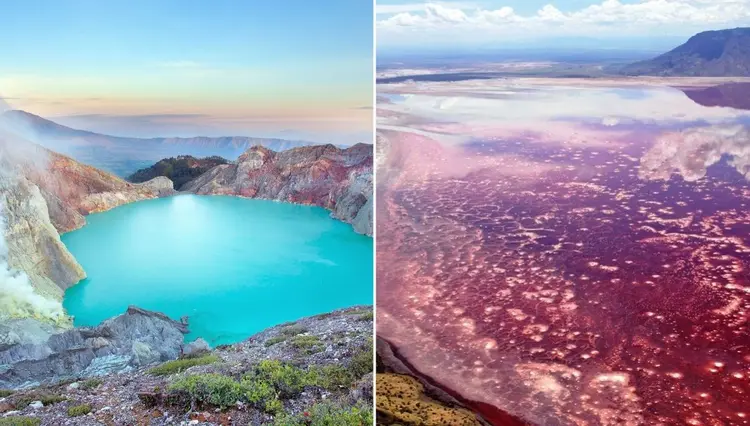
North of the Erta Ale range, Dallol is the image most people have in mind when they book a Danakil trip. Hot, salty water rises through a dome of salt around a small volcanic cone, building terraces, chimneys and pools in white, green, yellow, orange and red. So what paints those colors? Not bacteria, as it’s tempting to assume, but iron minerals reacting with air, and the palette shifts from day to day as springs switch on and off. The water is among the most acidic found anywhere in nature, with pH values below zero. Don’t touch it. Wear sturdy boots for the sharp, unstable crust, and follow your guide’s route exactly.
Salt Lakes

Lake Karum and Lake Afrera (also spelled Afdera) are hypersaline lakes with no outlet to the sea, and most Danakil tours stop at one or both. Karum is the more striking of the two, a mirror of brine framed by white salt. Nearby, Afar workers still cut blocks of salt from the pans, and camel caravans have traditionally carried them to the highlands.
Is the Danakil Depression Safe to Visit?

The Afar people, traditionally herders of goats, camels and cattle, consider the Danakil their land, and visitors pass through with their permission and local guides. Tour companies usually provide armed escorts, and there’s a military post on the rim of Erta Ale.
Those precautions exist for a reason. In January 2012, an attack on a group of European tourists near Erta Ale left five dead, and in December 2017 a German visitor was shot and killed on the volcano. The wider region has also been unsettled since the 2020-2022 conflict in neighboring Tigray. The UK Foreign Office currently advises against all travel within 20 km of the Eritrean border and within 50 km of the Tigray boundary, and against all but essential travel to the rest of Afar. Some tour operators have paused trips, and how long that will last is hard to say.
Check your own government’s travel advice and travel insurance terms before you plan anything.
When to Visit the Danakil Depression

September to May is generally considered the best time to visit, when daytime temperatures are “only” around 35-40°C (95-104°F). The cooler heart of that window, from about November to February, is the most comfortable. Summer is another story. From June to August, temperatures climb well above 40°C (104°F), and the few tours that run in summer tend to be private and pricier.
Whatever the month, expect intense sun. That 34.6°C record from Dallol is a year-round average, after all, with the cooler months already counted in. Shade is scarce, and accommodation is very basic.
Sources: Wikipedia: Danakil Depression, Wikipedia: Erta Ale, Brilliant Ethiopia: Danakil Depression, UK FCDO: Ethiopia travel advice



Bir yanıt yazın