
15 Taj Mahal Facts About India’s Monument to Love


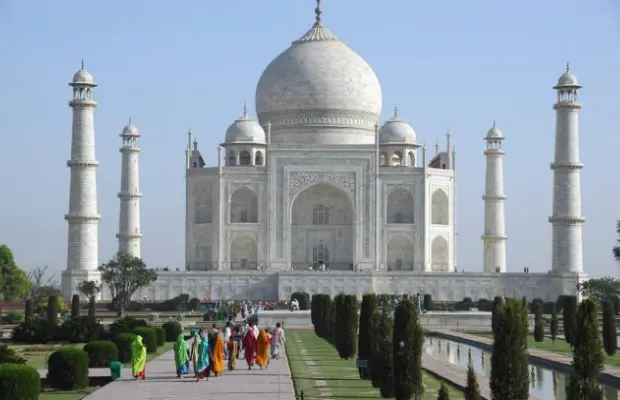
The Mughal Empire, founded by a Timurid prince from Central Asia, ruled much of the Indian subcontinent from 1526 to 1857 and left behind a legacy of poetry, painting and architecture. Its most famous building is a white marble tomb in Agra, named one of the New 7 Wonders of the World in 2007. These 15 Taj Mahal facts trace the love story that started it all, how it was built, and the legends that grew around it.
1. It began as a love story

The Taj Mahal stands on the southern bank of the Yamuna River in Agra, in the Indian state of Uttar Pradesh, and it’s the masterpiece of Mughal architecture: a blend of Persian, Islamic and Indian traditions.
Yet its origins were private: a widower’s tribute to his wife.
2. Mumtaz Mahal, “the exalted one of the palace”

Shah Jahan, the fifth Mughal emperor, was devoted to his wife Arjumand Banu Begum, and he gave her the title Mumtaz Mahal, usually translated as “the exalted one of the palace.” She was more than a royal consort. Mumtaz traveled with him on military campaigns. He consulted her, too, on private and state matters alike.
3. A death on campaign

In 1631, heavily pregnant, Mumtaz was with Shah Jahan on a campaign in the Deccan. It ended in Burhanpur. There, on June 17, she died of hemorrhage after giving birth to their 14th child, a daughter named Gauhar Ara Begum, and in Islamic tradition a woman who dies in childbirth is honored as a martyr.
4. An emperor in mourning

Her death shattered him. Shah Jahan withdrew into secluded mourning for a year, and court chroniclers record that he gave up music and fine clothes for two years. When he reappeared, his hair had reportedly turned white. He found his consolation in building. The tomb was commissioned in 1631, the same year she died.
5. A vision of paradise on earth

Paradise was the model: the whole complex was conceived as an image of it, with the tomb rising at the end of a walled garden divided by water channels. A popular legend adds a contest. Shah Jahan, it says, invited architects to compete and reviewed a vast number of designs before choosing one.
No contemporary record of the contest has surfaced. Treat it as a story, not history.
6. Who designed it is still debated

Most historians name Ustad Ahmad Lahori, Shah Jahan’s court architect, as the chief architect. The project, though, drew on a multinational team, and Turkish tradition puts one of its members, Isa Muhammad Effendi, in the spotlight, claiming he trained under Mimar Sinan, the great Ottoman architect.
Other accounts describe Isa as Persian. The evidence for either version is thin.
7. Two decades in the making

Construction began in 1632. The team included an Ottoman dome designer, Ismail Afandi, and the Persian calligrapher Amanat Khan, whose Quranic inscriptions frame the arches. By 1648 the mausoleum itself was finished. Work on the wider complex went on until about 1653.
8. One of the costliest buildings of its age

More than 20,000 workers and artisans took part. The bill came to about 32 million rupees at the time. The white marble came from Makrana in Rajasthan, while the inlaid stones traveled much farther: jade and crystal from China, turquoise from Tibet, lapis lazuli from Afghanistan, sapphire from Sri Lanka, and carnelian from Arabia. The bulk came from inside the empire; the color came from across Asia.
9. A thousand elephants on the job

Teams of oxen and elephants hauled the marble and other materials on specially built wagons. How many elephants? The French gem merchant Jean-Baptiste Tavernier, who visited India in the 17th century, put the number at 1,000.
A staggering figure. It rests largely on his account, though.
10. Marble set with precious stones

The walls and tombs are decorated with pietra dura, a technique of inlaying cut stones into marble to form flowers, vines and patterns. Twenty-eight kinds of stone were used. On a clear night under a full moon, the polished marble seems to glow, which is why moonlit views of the Taj have inspired poets and painters for centuries.
11. A building that changes color through the day

The marble looks pinkish at dawn, turns milky white in the midday sun and takes on a golden tone by moonlight. Local lore explains it romantically. The shifting colors, it says, mirror Mumtaz Mahal’s changing moods.
The real cause is light on translucent stone. But the legend is the one guides prefer to tell.
12. A dethroned emperor with a view

A famous legend says Shah Jahan planned a second, black marble tomb for himself across the river. It traces back to Tavernier, and it doesn’t hold up: excavations in the 1990s found no trace of it. The record is clearer, and darker. In 1658 his son Aurangzeb seized the throne, killed his three brothers and placed Shah Jahan under house arrest in Agra Fort. The former emperor spent his last years in the Musamman Burj, an octagonal tower with a view across the Yamuna to his wife’s tomb, and he died there in 1666 before being buried beside her.
13. What lies beneath the dome

The dome is crowned by a gilded finial about 9.6 m tall, originally gold and replaced with a gilded bronze copy in the early 19th century. Four white marble minarets, each more than 40 m high, stand at the corners of the platform. Inside, the main chamber holds the cenotaphs of Mumtaz Mahal and Shah Jahan. Here’s the catch: they’re only memorials. Their actual graves lie in a quieter crypt below. The domed chamber is said to carry a long echo, which guides sometimes demonstrate.
14. A scaffold taken down overnight

The builders skipped wood. Around the tomb they raised a colossal scaffold of brick instead, and legend says that when Shah Jahan was told dismantling it would take years, he announced that anyone could keep the bricks they carried away.
By the next morning, the story goes, the scaffold had vanished.
15. A masterpiece of symmetry, with one exception

From whichever side you look, the Taj Mahal is symmetrical. Even the minarets were built leaning slightly outward, so that if one ever collapsed, it would fall away from the tomb. One element breaks the pattern. Shah Jahan’s own cenotaph sits to the west of his wife’s, on a larger base. Hers was placed at the center. His came later, added only after he died in Agra Fort in 1666. Perfect symmetry, it seems, was never planned for two.
Sources: Wikipedia: Taj Mahal, Wikipedia: Mumtaz Mahal, National Geographic: A husband’s love built the Taj Mahal but cost him an empire




Bir yanıt yazın