
Derinkuyu Underground City: 9 Facts to Know


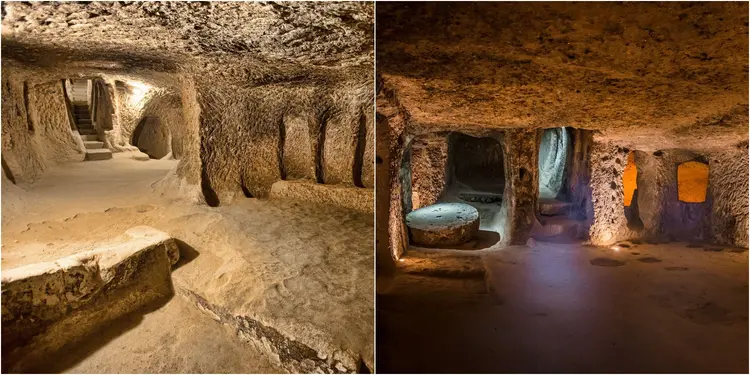
Somewhere under a quiet town in central Türkiye, a city drops roughly 85 meters into the rock. Derinkuyu underground city, in Cappadocia, could shelter as many as 20,000 people along with their animals and food stores, yet its sheer size is not the most impressive thing about it. The engineering is.
1. A home renovation uncovered it in 1963
Derinkuyu lies in the town of the same name, about 30 km (19 miles) south of Nevşehir. In 1963, a resident renovating his house knocked through a basement wall and found a room behind it.
That room led to a passage. The passage led to a city.
Excavations went on to reveal food stores, stables, wine and oil presses, chapels and gathering halls, and many more openings from homes in the town turned out to connect to the same network. Derinkuyu was simply the largest excavated piece of a much wider underground system.

2. Derinkuyu underground city goes about 85 meters deep
The figure for depth is solid: roughly 85 meters (280 feet). Levels are another matter. Popular accounts often say 18, but that number is shaky: more cautious sources describe at least eight, and only part of the city is open to visitors.
Geology made it possible. Cappadocia’s volcanic tuff is soft enough to carve with simple hand tools, yet it hardens on contact with air, a rare combination that let people dig deep without the rooms collapsing behind them.

3. Nobody knows exactly when it was built
No founding date exists. Xenophon, the Greek writer, described people in Anatolia living in houses dug underground in his Anabasis, written around 370 BC, one of the oldest texts on such dwellings.
Who started the digging is still debated, and there is no clean answer.
Some researchers point to the Hittites in the late Bronze Age, around 1200 BC. The most widely cited view credits the Phrygians, an Iron Age people of central Anatolia known for carving monuments into rock, with cutting the first tunnels in the 8th to 7th centuries BC.

4. It started as storage, then became a refuge
Cappadocia sat on a crossroads. Armies kept marching through. Space dug for storing food gradually turned into somewhere to wait out a raid, and every new threat seems to have pushed the digging a little deeper.

5. Its busiest era was Byzantine
Many peoples passed through the region over the centuries. Several left their mark.
The complex reached its full form in the Byzantine era, when Christian communities used it as a refuge during the Arab-Byzantine wars and later the Seljuk incursions of the 11th century. At its peak, it could hold an estimated 20,000 people, plus their livestock, all living below ground.

6. Uninvited guests were not welcome
The narrow, twisting corridors were no accident. Huge round stone doors, shaped like millstones, could be rolled across passages to seal off each level from the inside, so an attacker who found one entrance still faced a maze with locked gates. Each floor could be closed separately. A central hole in the stones is often said to have let defenders strike through, though that use is harder to prove.

7. Each level had its own job
Animals were generally kept on the upper levels, a sensible choice that kept their smell and fumes away from the lower rooms and, by most accounts, added warmth in winter. Farther down came storerooms, wine and oil presses, and chapels.
On the second level sits a spacious room with a barrel-vaulted ceiling. It is thought to have been a religious school.

8. The air shafts and well came first
How do thousands of people breathe and drink 85 meters below ground? Vertical shafts, often put at more than 50, carry fresh air down through the rooms and corridors, while a single shaft about 55 meters (180 feet) deep appears to have served as the well. Both systems seem to belong to the early phases of construction. Put simply, the builders planned ahead from day one.

9. Derinkuyu is not the region’s only underground city
More than 200 underground settlements at least two levels deep have been found between Kayseri and Nevşehir, and around 40 of them reach three levels or more. Derinkuyu even has a direct line to one of them. Some 8 to 9 km (about 5 miles) of tunnels link it to Kaymaklı, another underground city. The count keeps growing. In 2013, construction workers in Nevşehir broke into a vast network beneath the town’s castle, which researchers began mapping in 2014. Derinkuyu is part of the Göreme National Park and the Rock Sites of Cappadocia, a UNESCO World Heritage Site since 1985.

Sources: Wikipedia, Derinkuyu underground city, National Geographic, underground city found in Nevşehir, UNESCO World Heritage Centre, Göreme National Park and the Rock Sites of Cappadocia

Bir yanıt yazın