
18 Facts About Coober Pedy, Australia’s Underground Town


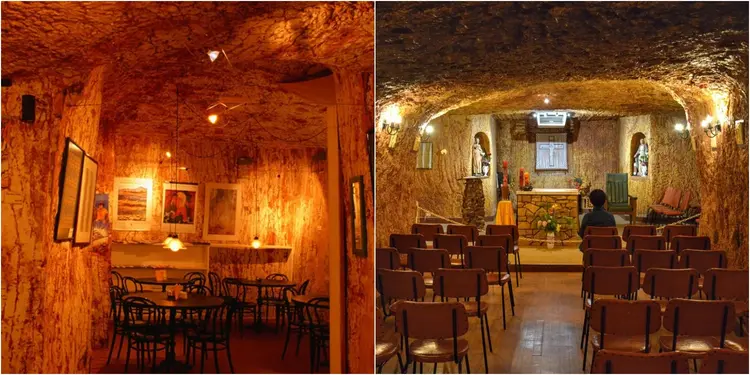
Drive into Coober Pedy for the first time and it can look as if half the town is missing. That’s because a good share of it is underground: in this Coober Pedy underground town in the South Australian outback, people have spent more than a century carving homes, churches and guest rooms into the rock to escape the heat. Here is how an opal rush turned into one of the strangest places to live in Australia.
1. An opal town deep in the outback

Coober Pedy sits about 846 km (526 miles) northwest of Adelaide, the capital of South Australia, along the Stuart Highway. It exists for one reason: opal, and lots of it.
2. The “opal capital of the world” since 1915

The first opal here was found on February 1, 1915, by Willie Hutchison, who had been out prospecting for gold. The town grew up around that find. Because of the sheer amount of precious opal mined since then, Coober Pedy is often called the “opal capital of the world,” according to Wikipedia.
3. The 1920s put it on the map

When a post office opened in 1920, the name Coober Pedy became official. Miners kept coming. Each one was chasing the same thing: a lucky strike.
4. Miners from across Europe

The biggest wave came after World War II. Refugees, veterans and immigrants from Southern and Eastern Europe headed for the opal fields, and at times up to 60% of the miners had Southern or Eastern European roots. That mix still shows in the town’s churches, clubs and surnames.
5. But the mines aren’t the real story

Plenty of towns have mines.
What makes Coober Pedy different is where its people chose to live.
6. One of Australia’s hottest towns

Summer here is brutal. The average January high is 36.7°C (98°F), and days above 40°C (104°F) are common. The record, 48.3°C (119°F), was set in December 2019 and matched in January 2026.
7. Desert life is hard on everything

Heat is only one problem. There’s almost no shade, rain is scarce, and the town’s water is pumped up from the Great Artesian Basin through a council bore and treatment plant. Ageing pipes and heavy water loss have given Coober Pedy the highest consumer water charges in South Australia.
8. The locals found a way to cope

The answer came from the mines themselves.
If digging tunnels was already part of daily work, why not dig a house too?
9. Many residents live in dugouts

Coober Pedy had about 1,400 residents at the 2021 census, and many of them live in “dugouts,” homes cut into the hillsides. Exactly how many is hard to pin down. And contrary to what most people assume, a dugout isn’t a luxury: a standard three-bedroom dugout can be excavated for roughly the price of a house built on the surface.
10. From above, it looks almost deserted

Seen from the road, the town looks thin: a few buildings, a lot of bare ground and the pale mounds left by decades of mining.
It’s easy to mistake it for a place people have mostly left.
11. The real Coober Pedy underground town lies a few meters down

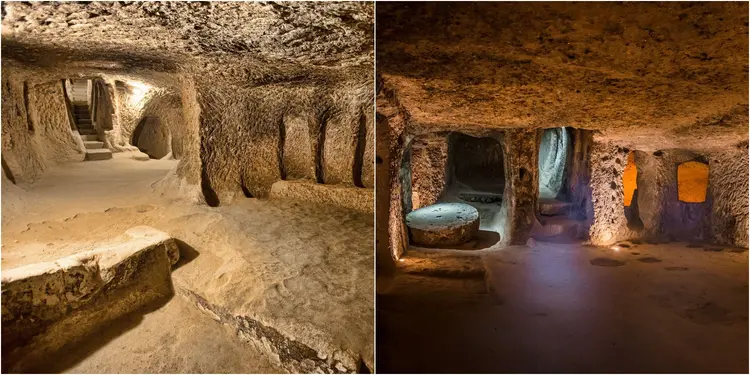
Step through one of the doors set into the hillsides and the picture changes. Kitchens, bedrooms and living rooms run back into the sandstone, with smooth carved walls instead of plaster.
12. Churches, rooms to rent and shops underground

The dugouts go well beyond homes. Both the Serbian Orthodox Church and the Catholic Church hold services underground, several motels rent out rooms set into the rock, and, yes, there’s even an underground jewelry shop. For visitors, a night below ground is one of the town’s main draws.
13. Wind and sun power much of the town

Coober Pedy is off the main grid, and since July 2017 it has run on a hybrid system operated by Energy Developments (EDL). According to ARENA, the Australian Renewable Energy Agency, two wind turbines (4 MW) and 12,000 solar panels (1 MW) work with a battery and the existing diesel generators, with the goal of cutting diesel use by 70%. In September 2017 the town ran on 100% renewables for 35 hours straight, a first for the system.
14. Dugouts need fresh air

Living inside a hill only works if air can move. Dugouts rely on ventilation shafts that reach up to the surface, so the rooms stay fresh rather than stuffy. With that in place, underground life is much easier to live with than it sounds.
15. Quiet and dark on demand

Meters of rock block out most outside noise and all daylight. The result for residents: quiet nights, and real darkness whenever the lights go off.
16. A steady temperature all year

The rock keeps dugouts at a constant temperature, commonly cited as around 23-25°C (73-77°F). Compare that with the surface, where the record hit 48.3°C.
Same town, same day, a gap of more than 20 degrees.
17. More comfortable than it looks

The honest verdict: life in Coober Pedy is far less harsh than the first glance suggests. Cool homes, an underground place of worship and a night’s stay in the rock are exactly what bring visitors from around the world.
18. From mining town to outback attraction

Opal still matters here, but tourism now shares the spotlight. Coober Pedy is a popular stopover on the Stuart Highway, and visitors come for the mines, the underground churches, the cemetery and the Umoona Opal Mine and Museum. Each June, the town also holds its Opal Festival.
Sources: Wikipedia: Coober Pedy, ARENA: Time to ditch the generator? The town where renewables took over










Bir yanıt yazın