
Aya Yorgi Church: 14 Things to Know on Büyükada


High on Büyükada, the largest of Istanbul’s Princes’ Islands in Türkiye, Aya Yorgi Church has been collecting wishes for centuries. On two feast days a year, April 23 and September 24, people of many faiths climb its hill barefoot, unspooling thread and lighting colored candles in the hope of a little help. Even committed skeptics have been known to make a wish once they reach the top.
1. From Saint George of Cappadocia to Aya Yorgi

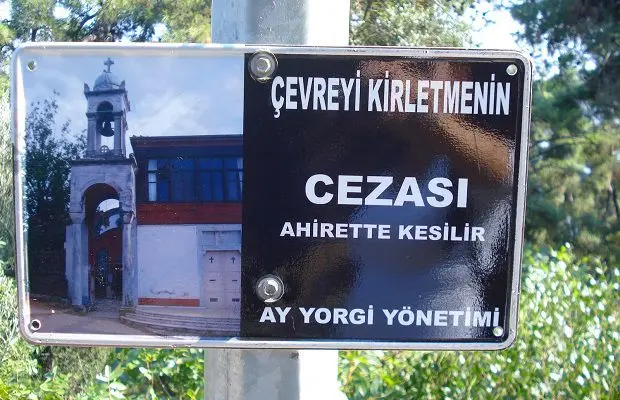
Aya Yorgi sits on Yücetepe, Büyükada’s highest hill, about 200 meters above the Sea of Marmara. The formal name is a mouthful. It is the Greek Orthodox Monastery of Hagios Georgios Koudounas, and the oldest building in the complex, a small two-story church with a tiled roof known simply as the “Old Church,” dates to 1751. Behind it all stands Saint George of Cappadocia, the soldier-saint martyred in the Roman era for his Christian faith. The name is borrowed. “Aya Yorgi” is just the Turkish way of saying the Greek Hagios Georgios.
2. The Monastery of Bells and Its Many Legends

Some claim a thousand-year history. One tradition says it was founded in 963, under Byzantine Emperor Nikephoros Phokas, and a decree issued by Emperor Manuel Komnenos in 1158, listing the islands and their monasteries, mentions a place called “Kodono.” According to Manuel Gedeon, a 19th-century Greek historian, that name points to Aya Yorgi Koudounas on Büyükada: the monastery “of the bells.” Modern references are more cautious. The Wikipedia entry on Büyükada says the monastery was probably founded in the 10th century, while the buildings standing today date from the mid-18th to the 19th century. The honest answer is that nobody knows the exact founding date.
3. One of Türkiye’s Two Great Pilgrimage Sites

Built in 1905 and opened for worship in 1909, the cut-stone building behind the bell tower is the “new” Aya Yorgi Church, and it looks nothing like its modest, tile-roofed older neighbor: this one is solid masonry. And don’t mistake it for a museum. The complex is still an active Greek Orthodox monastery.
Christians regard Aya Yorgi and the House of the Virgin Mary near Ephesus as the two main Christian pilgrimage sites in Türkiye.
Hence the crowds every April 23 and September 24.
4. Barefoot and Silent: Becoming Half a Pilgrim

Two dates matter most. In the Orthodox calendar, April 23 is Saint George’s feast day, the name day of everyone called George (Yorgos in Greek). September 24 honors Saint Thecla. An early follower of the Apostle Paul, she survived several attempts on her life by miracle, or so tradition says.
On those two dates, anyone who walks the path to Aya Yorgi barefoot and without saying a word is believed to become a “half pilgrim.”
5. “At the End of the Path, You’ll Hear Bells”

The ritual starts at the foot of a slope called Azap Yokuşu, roughly “the Slope of Torment.” Shoes come off here. Talking stops. Only then, the belief goes, does a wish stand a chance. According to legend, Saint George appeared to a shepherd in a dream and told him to climb the hill and dig wherever he heard the sound of tiny bells.
The shepherd ignored the dream at first. When it came back three nights in a row, he gave in, and the ritual still echoes his climb: poverty probably explains the bare feet, and being alone probably explains the silence.
6. How the Famous Icon Came to Light

Near the church, the shepherd heard the bells the saint had described. He stopped and dug. Out of the ground came sacred objects that looked as new as the day they were buried. One version says the priests of Prinkipo, the island’s old Greek name, had buried the icon and relics to save them when the island was overrun. That is how the monastery’s best-known image is said to have been found: Saint George spearing a monster that has risen from the sea. Versions differ on the details. Another account dates the burial to 1204, during the Fourth Crusade, and the discovery to the early 17th century. It adds that the original icon is now kept at the Patriarchate church in Fener, on Istanbul’s Golden Horn, with a copy in the monastery itself.
7. Which Came First, the Church or the Icon?

The same story has yet another telling, tied to an icon said to have been a gift from the Büyükada convent founded by Byzantine Empress Irene.
Here the burial comes first. In the 14th century, monks hid the Aya Yorgi icon and its votive offerings from pirate raids, and three centuries later the shepherd from the saint’s dream followed his instructions and dug up the treasure. The monastery rose on the spot.
8. A Toast to the View

You can reach the top on foot or by bicycle (the Princes’ Islands are closed to private cars), and GoTürkiye, the official tourism site, describes the climb to Aya Yorgi as easy. Then catch your breath. Yücetepe Kır Gazinosu, a family-run restaurant at the summit, has sweeping views over the island and the sea.
Got time? Stay for a meal and raise a glass to the view. Wine made by the monastery’s clergy used to be sold here. Worth asking whether any is left.
9. Goodbye Rationality, Hello Superstition

On an ordinary day, this is a peaceful hilltop church. Feast days are different. Turn up on one of them, and chances are you’re here for a wish.
Leave your rationality somewhere easy to find on the way back down. Folk belief and old superstition take over as guides from here, and there are several ways to try to get a wish granted, so pick one. Mind the crowds. April 23 is also Türkiye’s National Sovereignty and Children’s Day, a public holiday, which makes the hill even busier.
10. Careful: Don’t Let the Thread Break

Photo: ezgidizdaroglu.blogspot.com
The first route to a wish is the legend’s own: walk up barefoot and in silence. Then there’s the thread. Some pilgrims tie a thread to a bush at the bottom and unspool a whole reel of it on the way up, which is said to open the way to good fortune. Get the thread all the way to the church without it snapping. The wish comes true.
11. Red Thread for Love, White for Health

Each thread color carries a meaning. Red is for love. White is for anyone seeking health and peace of mind.
One small caveat: with the crowds, keeping a thread intact is hard work, and by the end of a feast day all those well-meant strands tend to end up as litter on the slopes around the monastery. Hardly the blessing anyone climbed up for.
12. Borrow a Bell or a Key

Not every ritual here involves thread. Stalls near the church sell little icons made for specific wishes. If that feels too much like shopping for a miracle, skip the stalls and make your wish inside the church instead, where you leave whatever donation feels right and take a small bell or key in return. There is a catch. Once the wish comes true, you’re expected to come back and return it to the church.
13. A Box of Sweets or a Can of Oil?

You can also light a candle, write your wish on paper and drop it into the wish box. Thanks take different forms. When a wish comes true, some people hand out sweets, while others donate oil. Oil is the older custom: before electricity, giving it for the church’s lamps was a tradition.
Today that custom lives on as gifts of sunflower or olive oil, which the church passes on to people in need.
14. Don’t Forget These Colors

On the two feast days, candle sellers line the route all the way from the ferry pier. Colored votive candles have become especially popular in recent years, and the color code is surprisingly specific. Orange is for success at school, red for finding love and blue for climbing the career ladder a few rungs at a time, while those hoping for healing choose white and those hoping for a baby choose purple.
Sources: Wikipedia, Büyükada; GoTürkiye, Büyükada; Wikipedia, House of the Virgin Mary.




Bir yanıt yazın