
15 Things to Know About Bulgur Palas in Istanbul


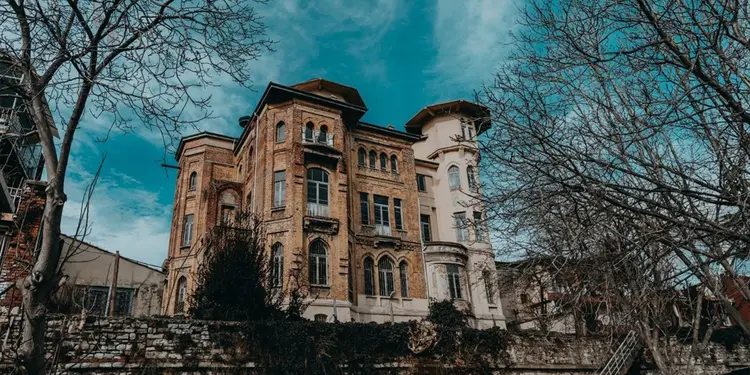
Istanbul was the capital of two empires, the Byzantine and the Ottoman, and centuries of that history still stand in its streets. Few buildings among them have a stranger story than Bulgur Palas. A grand early-20th-century mansion in the old city, it was built on grain money, stalled by exile, lost to debt, left empty for decades and finally opened to the public in 2024.
1. It crowns Istanbul’s seventh hill

Like Rome, Istanbul is traditionally said to stand on seven hills. Bulgur Palas sits on the seventh, Kocamustafapaşa Hill, in the Fatih district of the historic peninsula, and it counts among the most important historic mansions in the city.
The view does a lot of the talking: the old city, the Sea of Marmara, Üsküdar on the Asian shore and, on a clear day, the Princes’ Islands.
2. Beauty is only half the appeal

The facade is the obvious draw. The other half is the backstory.
3. The story behind it is genuinely odd

A wartime fortune, an exile to Malta, a bank that bred canaries in the basement, and a city government that bought the whole thing back a century later. Not many Istanbul buildings have changed owners, and jobs, quite so many times.
4. Work began in 1912, to an Italian design

Construction started in 1912. For decades the design was credited to Giulio Mongeri, an Italian-Levantine architect who held Ottoman citizenship and shaped much of early 20th-century Istanbul. Not everyone agrees anymore. As the Wikipedia entry on Bulgur Palas notes, a recent study links the design to another Levantine architect, Alessandro Valeri, so the attribution is now open to debate.
5. A showcase of the First National Architectural Movement

The First National Architectural Movement, sometimes called the Neoclassical Turkish style, was the dominant look in Istanbul between roughly 1908 and 1930. Revival was the core idea: architects took the traditional features of classical Ottoman buildings, especially their decoration, and put them on new structures with modern plans and materials, which is why so many public buildings from that era look older than they are. Pointed arches, tiles and overhanging eaves all came back into fashion. Mongeri was one of the movement’s leading names, and Bulgur Palas is regularly cited among its most successful examples.
6. The man who built it: Mehmet Habip Bey

Mehmet Habip Bey commissioned the mansion and was its first owner. He was a prominent member of the Committee of Union and Progress, the Young Turk party that dominated late Ottoman politics, and in 1908 he was elected to parliament as deputy for Bolu, a province east of Istanbul.
So the building’s real name is the Habip Bey Mansion. Where “Bulgur” comes from is the better story.
7. Why “Bulgur”? Its owner was the “Bulgur King”

Bulgur is cracked wheat, a staple of Turkish kitchens. During World War I, Habip Bey went into the grain trade (bulgur, barley and wheat) and made a fortune, helped by a privilege for renting railway wagons that was granted to party members. People started calling him the “Bulgur King.” Palas is an old Turkish borrowing of “palace,” so the nickname for his house, Bulgur Palas (sometimes rendered as Bulgur Palace in English), wrote itself.
8. Its construction stalled for years

The foundations went in in 1912, but the house took far longer than planned. Exile was the reason. After World War I, with Istanbul under Allied occupation, Habip Bey was arrested in March 1919 at the request of the Allied powers and, as a Unionist, deported to Malta along with other members of his party. He was released in 1921, came back to Istanbul and restarted the work, even importing some materials from abroad. He never saw it finished.
9. A grand house in an occupied, hungry city

The scale was hard to miss: 81 separate units, 1,750 m² of open space, 3,750 m² of enclosed floor area, 1,000 m² of outbuildings and an ornamental pool. In a city living through shortages and occupation, a mansion like that became the talk of Istanbul. Not in a flattering way. The pool, at 9 m², was ornamental in every sense.
10. Then the money started running out

Habip Bey’s business, meanwhile, went sour. A wartime fortune, it turned out, did not survive the peace: his trade income fell, he took a loan from the Ottoman Bank, and the family ended up facing a heavy debt.
11. In 1926 the mansion went to the Ottoman Bank

Habip Bey died suddenly in 1926, still in his forties, and his widow, Bedia Hanım, had to hand the mansion over to the Ottoman Bank against the family’s debts.
What came next is the oddest chapter. The bank turned the house into an archive center. It also used three of its apartments as staff housing and bred canaries in the basement to supply its branches. Over the decades the archive grew into a store of documents covering a long stretch of the country’s history, with records on banking, law and everyday social life. The house had become an institution. Its story, though, was not over.
12. Garanti Bank took over in 2001

The Ottoman Bank merged into Garanti Bank in 2001, and the mansion changed hands along with it, so one of the finest examples of civil architecture in Istanbul stayed private property, closed to the public.
It was, in effect, left to its fate. The once-famous mansion slid into disuse, empty and a little eerie, until 2021.
13. Istanbul’s city government bought it back in 2021

Istanbul Metropolitan Municipality (known locally as İBB) bought Bulgur Palas in 2021 and set about restoring it to its original look.
On February 28, 2024, the building opened to the public.
14. Today it’s a culture and community center

After three years of restoration, carried out by KİPTAŞ, the municipality’s housing company, the mansion now works as a culture and community complex. According to the İBB Atatürk Library page on Bulgur Palas, it has a library, a terrace with panoramic views, exhibition spaces (including shows run with Magnum Photos), a café and multipurpose event areas.
There is a neat symmetry here. For most of the 20th century the house stored a bank’s paperwork behind closed doors; today it stores books, and anyone can walk in and read them.
15. Where is Bulgur Palas?

The mansion stands on Kocamustafapaşa Hill in the Cerrahpaşa area of Fatih, the district covering Istanbul’s historic peninsula; its official address is Kargı Çıkmazı in the Aksaray neighborhood. Most first-time visitors to the old city stay close to Sultanahmet and never climb this far west, which is part of the appeal. The municipality lists it as open Tuesday to Sunday, 10:00 to 19:00. It closes on Mondays.
Sources: Wikipedia: Bulgur Palas, İBB Atatürk Library: Bulgur Palas, Anadolu Agency (in Turkish)




Bir yanıt yazın