
The 15 Most Beautiful Cathedrals in the World


Strictly speaking, a cathedral is the church that holds a bishop’s seat, but nobody crosses an ocean to look at a job title. The most beautiful cathedrals in the world draw travelers of every faith and none, because they are also some of the boldest buildings humans have ever attempted. Here are 15 of them, from Moscow’s candy-colored domes to a concrete crown in Brazil.
1. St. Basil’s Cathedral, Moscow, Russia

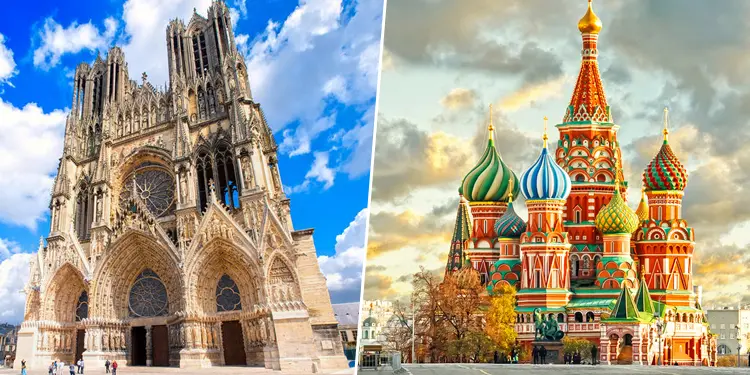
St. Basil’s stands on Red Square, and it is often mistaken for part of the Kremlin next door. Ivan the Terrible ordered it to celebrate the capture of Kazan and Astrakhan, and it went up between 1555 and 1561. Those famous colors came later. The domes were first gilded, over white and red walls, and the bright paintwork you see today was added in stages from the 1680s to 1848.
Who designed it? Nobody knows for sure. Tradition names Barma and Postnik Yakovlev, possibly one and the same man. A popular legend says Ivan had the architect blinded so he could never build anything as beautiful again, but most historians call it a myth. Since 1928 the building has been a museum run by the State Historical Museum, and regular services have returned, including a weekly Sunday liturgy.
If you’re planning a trip to Russia, check your government’s current travel advice first.
2. Reims Cathedral, Reims, France

If French kings had a home church, this was it. Clovis I was baptized in Reims around 496, and from 1027 to 1825 almost every king of France was crowned in the cathedral. The site itself goes back to the early 5th century, when Bishop Nicasius built a church over Gallo-Roman baths. Then a fire. The present Gothic building was begun in 1211 and finished in the 14th century. Since 1905 the French state has owned it, while the Catholic Church has exclusive use of it.
3. Milan Cathedral, Milan, Italy
Known locally as the Duomo di Milano, this is the largest church in Italy, and it took its time getting there. Archbishop Antonio da Saluzzo began it in 1386. The last bronze door was inaugurated in 1965, so construction stretched across nearly six centuries.
The cathedral fills one side of the Piazza del Duomo, a forest of white marble spires. On Easter Sunday, April 12, 2020, with Italy in lockdown, Andrea Bocelli sang a solo concert called Music for Hope inside the empty cathedral.
Millions watched it online.
4. Cathedral of Brasília, Brasília, Brazil

Not every great cathedral is old. Oscar Niemeyer designed this one for Brazil’s new capital, with Joaquim Cardozo as structural engineer, and it rose slowly: the cornerstone was laid in 1958, but the cathedral did not officially open until 1970. Sixteen curved concrete columns form a hyperboloid that looks like hands lifted toward the sky, with glass in between. Inside, three angel sculptures hang from steel cables above the nave. Up to 4,000 people fit beneath them.
5. Notre-Dame de Paris, Paris, France
Notre-Dame is probably the most famous Catholic cathedral anywhere. It stands at the eastern end of the Île de la Cité, an island in the Seine, and its rib vaults and flying buttresses made it an early landmark of Gothic architecture.
By the early 19th century it was so run-down that officials considered pulling it down. Victor Hugo’s 1831 novel The Hunchback of Notre-Dame turned public opinion, and a major restoration followed from 1844 under Eugène Viollet-le-Duc.
Then came April 15, 2019. Fire broke out in the roof that evening, the spire collapsed, and the medieval timber roof was destroyed. About 500 firefighters battled the blaze and brought it under control within a few hours. Donations poured in from around the world, and after five years of restoration, Notre-Dame reopened in December 2024.
Few buildings get saved twice.
6. Seville Cathedral, Seville, Spain

Officially the Cathedral of Saint Mary of the See, Seville Cathedral is the largest Gothic cathedral in the world. Work began in 1402 and was largely complete by 1506. When it was finished, it took over from Hagia Sophia as the world’s largest cathedral, a title the Byzantine church had held for about a thousand years. Together with the Alcázar and the Archivo de Indias, it has been a UNESCO World Heritage Site since 1987.
The cathedral occupies the site of the city’s great Almohad mosque. After Ferdinand III of Castile took Seville in 1248, the mosque was used as a cathedral, then demolished to make way for the new building. One part was spared: the minaret. Today it is the bell tower known as the Giralda.
7. St. Paul’s Cathedral, London, England

The Great Fire of London in 1666 wrecked Old St. Paul’s, a medieval Gothic church, and Sir Christopher Wren got the job of replacing it. The foundation stone was laid in 1675, and Parliament declared the new cathedral complete in 1711. Wren’s restrained English Baroque style blends classical ideas with English church tradition. The dome is the giveaway: it has dominated the London skyline for more than 300 years.
8. Metropolitan Cathedral, Mexico City, Mexico

Mexico City’s cathedral sits on top of the former Aztec sacred precinct, on the north side of the Zócalo, the city’s main square. It was built in sections from 1573 to 1813, which explains the mix of styles. Its two bell towers hold 25 bells between them.
In October 2007, workers found a hollow stone ball at the base of a cross on one of the towers. Inside was a lead box of religious objects, coins and parchments, apparently placed there in the 18th century to protect the building from harm. Call it a spiritual insurance policy.
9. Cathedral-Basilica of Notre-Dame de Québec, Quebec City, Canada

Work on the first church here began in 1647, and it is often called the oldest church in Canada. War reached it in 1759. During the Siege of Quebec, part of the Seven Years’ War, fire destroyed the church; it was rebuilt from earlier plans, and the neoclassical facade was not finished until 1843. In 1874 it became the first minor basilica in Canada. The cathedral lies inside the historic district of Old Québec, a UNESCO World Heritage Site.
Look for the chancel lamp, a gift from King Louis XIV of France.
10. Winchester Cathedral, Winchester, England

At about 170 meters overall, Winchester is the longest medieval cathedral in the world. Bishop Walkelin started the Norman building in 1079. Much of what followed is Gothic. The Great Screen behind the high altar dates from the 15th century, while the wooden choir screen is a Victorian addition by George Gilbert Scott. Jane Austen is buried in the north aisle of the nave. William II lies here too, and mortuary chests hold remains believed to belong to early English and Wessex rulers.
11. Alexander Nevsky Cathedral, Sofia, Bulgaria

This Bulgarian Orthodox cathedral honors the Russian soldiers who died in the Russo-Turkish War of 1877-1878. The foundation stone was laid in 1882, most of the building went up between 1904 and 1912, and it was consecrated in 1924. It is among the largest Eastern Orthodox churches in the world. Capacity: 5,000 worshippers.
It is named after Alexander Nevsky, the medieval Russian prince of Novgorod, and a relic of the saint, donated by the Russian Orthodox Church, is displayed beside the altar. The interior uses Italian marble, Brazilian onyx and alabaster. Downstairs, the crypt holds a museum of Bulgarian icons that belongs to the National Art Gallery.
12. Santiago de Compostela Cathedral, Galicia, Spain

This is where the Camino de Santiago, the Way of St. James, ends. Construction of the Romanesque cathedral began in 1075, over relics believed to be those of the apostle St. James. Later centuries added Gothic and Baroque layers, including the Obradoiro facade completed in 1740. Pilgrims who arrive after weeks on foot line up to climb a narrow passage behind the altar and kiss the saint’s mantle.
The real treasure is inside the main entrance. The Portico of Glory, carved by Master Mateo and his workshop and dated 1188, is one of the great works of Romanesque sculpture.
13. Washington National Cathedral, Washington, D.C., USA

Its official name is a mouthful: the Cathedral Church of Saint Peter and Saint Paul in the City and Episcopal Diocese of Washington. It is the second-largest church building in the United States. Building it took 83 years, from 1907 to 1990, in a neo-Gothic style modeled on 14th-century English Gothic. During World War II it held monthly services for a nation at war. It has hosted the state funerals of five presidents, from Dwight D. Eisenhower to Jimmy Carter, and the funeral of Senator John McCain in 2018.
One date stands out. On March 31, 1968, Martin Luther King Jr. gave his last Sunday sermon here from the Canterbury Pulpit, four days before he was assassinated.
14. Cologne Cathedral, Cologne, Germany

Cologne Cathedral was begun in 1248 and finished in 1880, true to the medieval plan, 632 years later. Its twin spires reach about 157 meters, the tallest of any twin-spired church in the world, and it has been on the UNESCO World Heritage List since 1996. Bombs hit it 14 times during World War II. It stayed standing in a flattened city, and it is still a working Catholic church. Its most famous treasure is the golden Shrine of the Three Kings, begun in 1190 and believed to hold the remains of the Three Wise Men. Around 6 million people visit each year.
15. St. Peter’s Basilica, Vatican City

Technically, St. Peter’s doesn’t belong on this list. It isn’t a bishop’s seat, so it isn’t a cathedral; the cathedral of Rome is the Archbasilica of St. John Lateran. So why is it here? A list of the world’s great churches without it would feel incomplete. By interior area, about 15,160 square meters, it is the largest church in the world.
Michelangelo took charge of the project in 1547, when he was already in his seventies. He died in 1564, and Giacomo della Porta and Domenico Fontana completed his dome in 1590. Gian Lorenzo Bernini added the bronze canopy over the papal altar and designed St. Peter’s Square, with its sweeping colonnades.
Compare it with Cologne: one is the slow work of six centuries of masons following a single medieval plan, the other the result of a series of star architects each leaving a mark.
Sources: Wikipedia: Seville Cathedral, Wikipedia: Cologne Cathedral, Wikipedia: Washington National Cathedral, Classic FM: Andrea Bocelli’s Music for Hope







Bir yanıt yazın