
Alberobello: 12 Reasons to Visit Italy’s Trulli Town


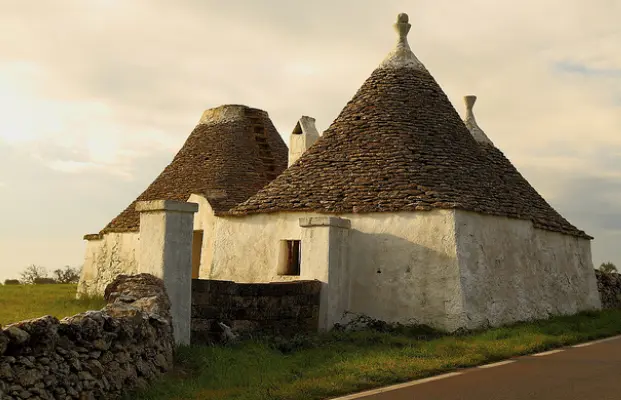
Rome, Florence and Venice get the crowds, but some of Italy’s most memorable sights sit in towns few people can name. Alberobello, in the southern region of Apulia, is one of them: a town of whitewashed houses capped with gray stone cones, listed by UNESCO as a World Heritage Site in 1996. Here are 12 reasons to make room for it on a trip to southern Italy.
1. A town in Apulia with 16th-century roots

Alberobello belongs to the Metropolitan City of Bari, in Apulia (Puglia in Italian), the heel of the Italian boot. Its story begins in the early 16th century, when Count Andrea Matteo III Acquaviva d’Aragona let about forty peasant families from nearby Noci farm the land in exchange for a tenth of their harvest. It stayed an Acquaviva fief until 1797. Then King Ferdinand IV made it a royal town, and Alberobello elected its first mayor.
2. An open-air museum from end to end
The trulli aren’t a single showpiece street. Whole neighborhoods are built from them, and according to Wikipedia, Alberobello is the only inhabited town with an entire district of trulli. Most visitors arrive expecting one picturesque lane. What they find is a hillside of cones.
3. Cone-roofed houses straight out of a Smurf village

Nothing else looks quite like them.
Round at the base, crowned with a gray stone cone and often a small decorative pinnacle, the trulli bring one comparison to mind almost instantly: the mushroom houses of the Smurfs.
The pinnacles had a job, too. They are said to have served as the signature of the master builder, the trullaro.
4. Built without mortar, possibly to dodge taxes

Each trullo is a dry-stone building: limestone stacked without any mortar, topped by a roof with two layers, an inner vault and an outer skin of slabs tilted outward to shed rain. Why skip the mortar? A popular explanation points to a 15th-century edict of the Kingdom of Naples that charged tribute on new settlements, since a house that could be taken apart quickly was hard to tax. The counts who ruled Alberobello reportedly encouraged the method for the same reason. Nobody can prove it either way. It remains a theory rather than settled history, but a persistent one.
5. Symbols painted on the roofs

Many cones carry symbols painted in white, mostly Christian ones such as a simple cross or a cross over a heart. Not all of them are old, though: on some streets, a good share were painted in the late 20th and early 21st centuries.
Spotting the next one becomes a small game on any walk through town.
6. A church built in trullo style

The Church of Saint Anthony of Padua (Chiesa di Sant’Antonio) stands at the top of the Rione Monti district and applies trullo architecture to an entire church. Here’s the surprise: it is far younger than it looks. Construction ran from March 1926 to May 1927, which makes it one of the newest landmarks in the old town, built some four centuries after the first families settled here.
7. Olive groves all around

Olive trees cover much of the countryside around the town. In the center, shops sell local olives and olive oil, so the landscape on the drive in and the shelves in town tell the same story.
8. Museums inside the trulli

Some trulli now hold museums about the town’s rural past. The Museo del Territorio occupies Casa Pezzolla, a complex of fifteen connected 18th-century trulli, the largest group of linked trulli open to visitors in Alberobello. The Trullo Sovrano goes the other way. It is a single trullo, unusual for having two floors, and has worked as a house museum since 1994. One shows how many trulli could be joined into a compound, the other how far a single trullo could be stretched upward.
9. Handmade pasta, olives, soap and wine

Shops around Alberobello sell goods tied to the region and to Italian food culture: handmade pasta, olives, olive oil, soaps and local wines. Many of the best souvenirs here are edible, which at least makes them easy to share.
10. Easy to reach from Bari or Brindisi

The nearest airports are in Bari and Brindisi, the two big cities of Apulia. Alberobello has its own railway station on the Bari–Taranto line, run by FS Sud Est, and buses also serve the town. Journey times depend on the connection, so check current timetables before setting out. Driving is the other common option.
11. A night inside a trullo

Sleeping in a trullo is the detail that turns a stop into a story. Many have been restored as holiday rentals and small guesthouses, and some hotels offer trullo-style rooms. Expect thick stone walls. In some trulli they run well over two meters, and overhead the ceiling rises into the cone.
12. Worth one extra day in Italy

Seeing a town this unusual doesn’t take much planning.
Adding a single day to a trip through southern Italy is enough to walk the lanes of Rione Monti, step inside a trullo and watch the cones change color as the light fades.
Sources: Wikipedia: Alberobello, Wikipedia (Italian): Alberobello, Alberobello.com: Saint Anthony Church



Bir yanıt yazın