
10 Amsterdam Facts, From Wooden Piles to Funeral Poets


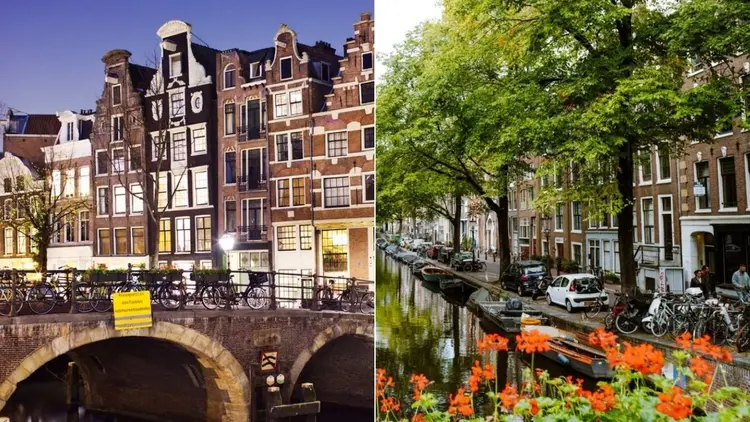
Canals, bicycles and tall brick houses are what most people picture first. The Dutch capital also hides some stranger stories, from the forest of timber under its streets to the poets who speak at funerals no one else attends. These 10 Amsterdam facts go beyond the postcard view.
1. The city stands on wooden piles
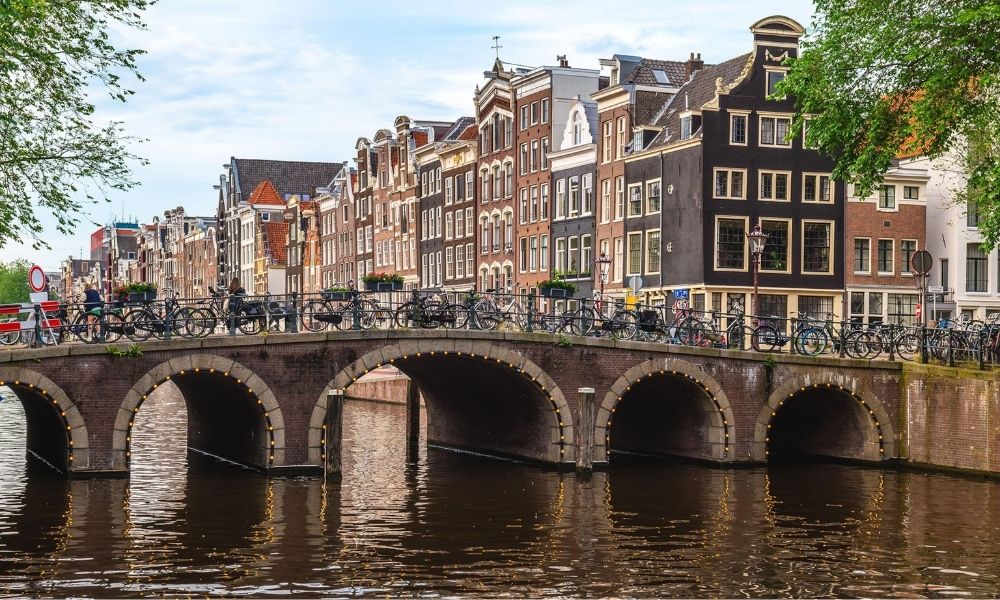
Amsterdam was built on marshland and layers of soft clay, ground that can’t carry a heavy building on its own. So builders drove long wooden piles down through the soft layers until they reached firmer sand, and the houses went up on top of them. An ordinary house typically rests on around 10 piles. Big public buildings need thousands. The Royal Palace on Dam Square stands on 13,659 wooden piles. Amsterdam Centraal, the main train station: 8,687.
Along the older canals, many facades lean a little, forward, sideways, or against a neighbor, a tilt that mostly comes from foundations that have shifted and settled over the centuries.
2. Its capital status rests on a single line in the constitution
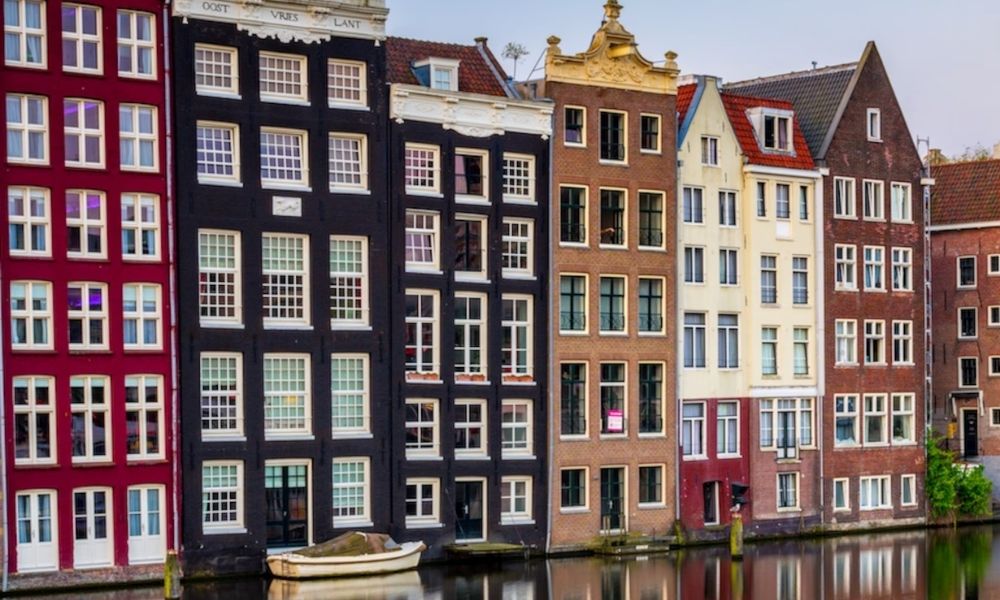
Amsterdam has been recognized as the capital of the Netherlands since 1814, when the country’s new sovereign prince was inaugurated in the city’s Nieuwe Kerk. Its legal footing, surprisingly, is much more recent. The 1983 constitution says the monarch is sworn in “in the capital city, Amsterdam,” and that is the only place the document names a capital at all.
The government, meanwhile, sits somewhere else. Parliament, the ministries and most foreign embassies are in The Hague, which has been the seat of government since 1588.
One city holds the title; the other runs the country.
3. Poets write for funerals nobody attends

When someone in Amsterdam dies alone and no relative or friend comes forward, the city arranges the funeral.
Since 2002, a poet has been part of it.
Through a project known in Dutch as de Eenzame Uitvaart (“the lonely funeral”), a poet gathers whatever can be found about the person’s life, sometimes by talking to neighbors or walking the streets where they lived. Then the poet writes a poem for that one person and reads it at the service.
It doesn’t matter where the person came from. Anyone who dies in Amsterdam unclaimed can receive a poem, and the idea has since spread to other Dutch and Belgian cities.
4. The houses are skinny because of old taxes
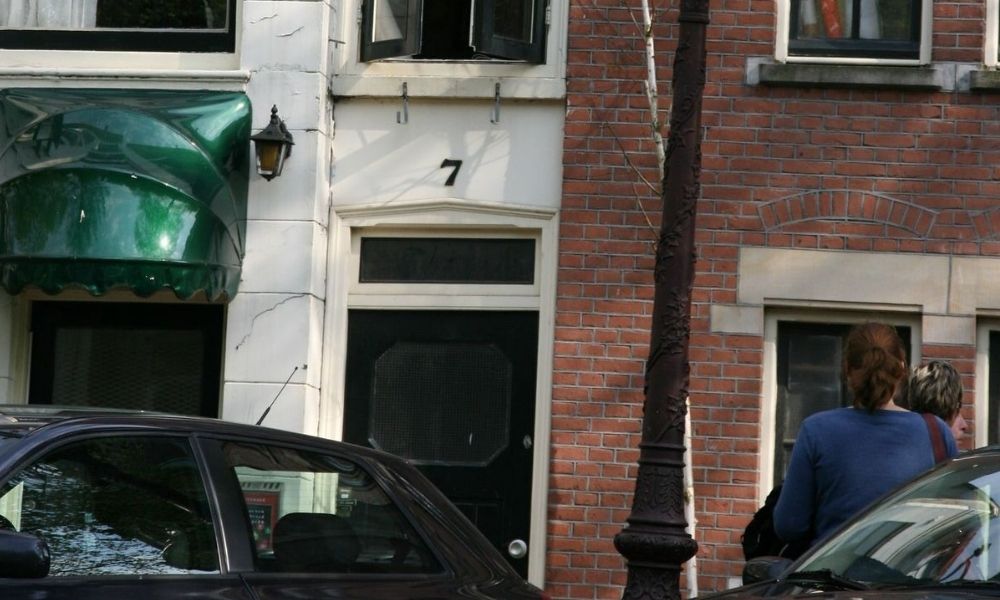
The classic Amsterdam canal house is narrow, tall and squeezed against its neighbors. Why? The usual explanation goes back to the 17th century, when property was taxed by the width of its facade. A wider front meant a bigger bill. So owners built narrow at the street and deep toward the back. The extreme case is Singel 7, often described as the narrowest house facade in the world: at about 1 m (3.5 ft), it’s barely wider than its front door, while the house behind it stretches back much further.
Look up at the gables and you’ll see a hook or beam sticking out near the top. Staircases in these houses are steep and tight, so furniture was hoisted up on a rope and brought in through the windows. Many movers still do it that way.
5. The three X’s have nothing to do with adult content

Visitors often read the city’s “XXX” as a red-light-district joke. They’re wrong: the symbol is far older than that. The three diagonal crosses are St. Andrew’s crosses, named for the apostle who, according to tradition, was executed on an X-shaped cross in the 1st century AD.
They appear on Amsterdam’s flag and coat of arms, on bollards along the streets, and on countless buildings. Where they came from is less certain. Historians think the crosses probably came from the shield of the Persijn family, who were lords of Amsterdam in the late 13th century. The city’s motto is much newer: “Heldhaftig, Vastberaden, Barmhartig” (Valiant, Steadfast, Compassionate), granted by Queen Wilhelmina in 1947 to honor how Amsterdammers behaved during World War II.
6. More than 1,200 bridges link about 90 islands
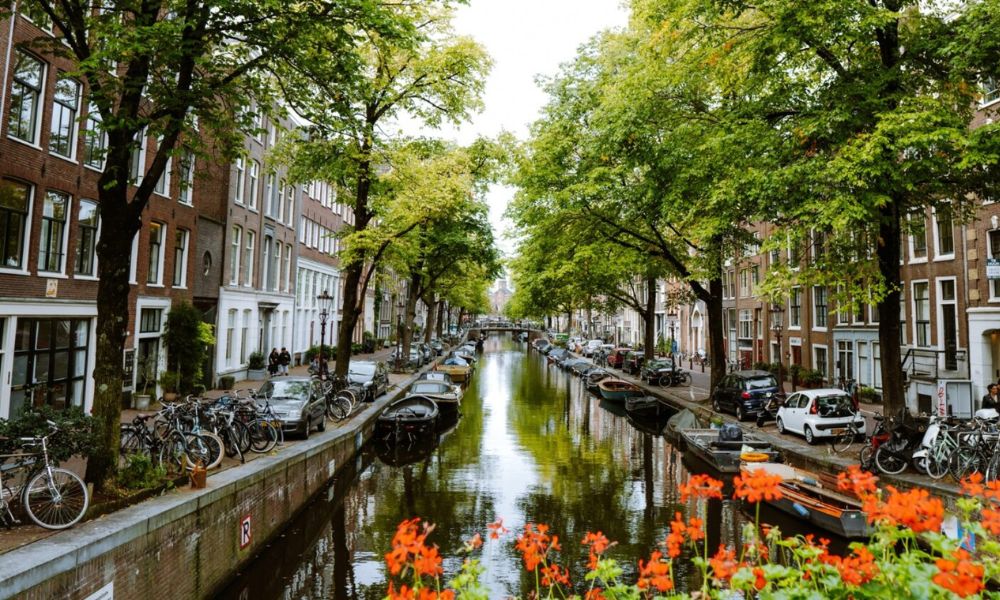
Short walks in central Amsterdam almost always cross a bridge. The city is often credited with 165 canals and 1,281 bridges, about 80 of them along the historic canal ring, the source of a popular, if hard-to-prove, boast that Amsterdam outdoes Venice for canals and Paris for bridges.
It started small. The settlement grew up around a dam on the Amstel River and appears in a document from 1275 as Amestelledamme. As it expanded, canals were dug for trade, transport and drainage, until the city was cut into roughly 90 islands.
For a photo, find the spot where the Reguliersgracht meets the Herengracht. From there, you can count 15 bridges at once.
7. Few cities pack in more museums
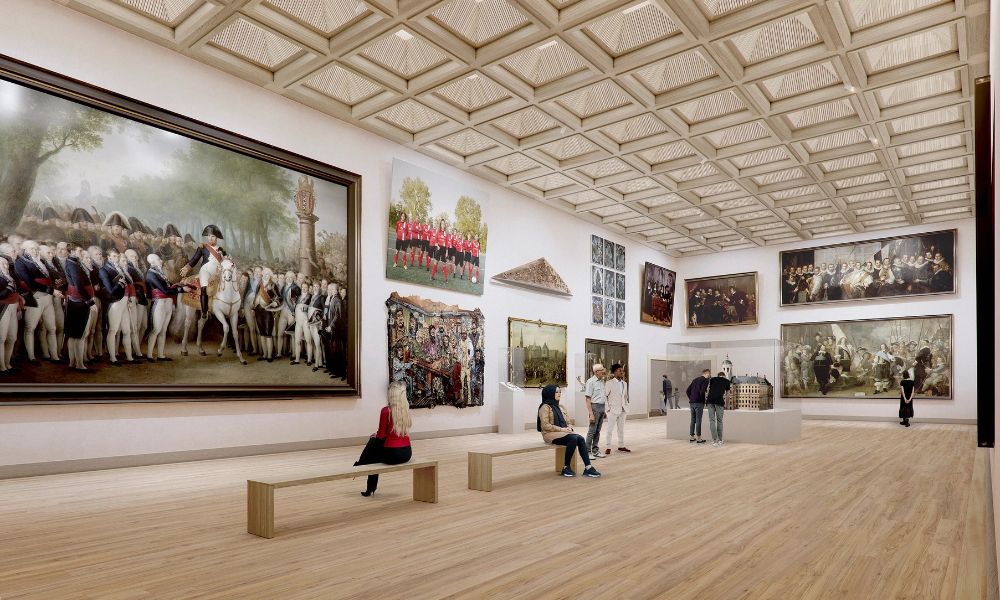
Amsterdam has more than 75 museums and is said to have more museums per square meter than any other city. For a compact city, that’s a lot of culture per street.
The two big names are the Van Gogh Museum, with the world’s largest collection of the painter’s work, and the Rijksmuseum, home to Rembrandt’s The Night Watch.
The museum habit even reaches the airport. Rijksmuseum Schiphol, a small branch of the national museum, sits on Holland Boulevard behind passport control at Amsterdam Airport Schiphol. It opened in 2002 as the first museum inside an airport, and passengers can see a few Dutch masters there before boarding. Entry is free.
8. Bikes almost match the number of people
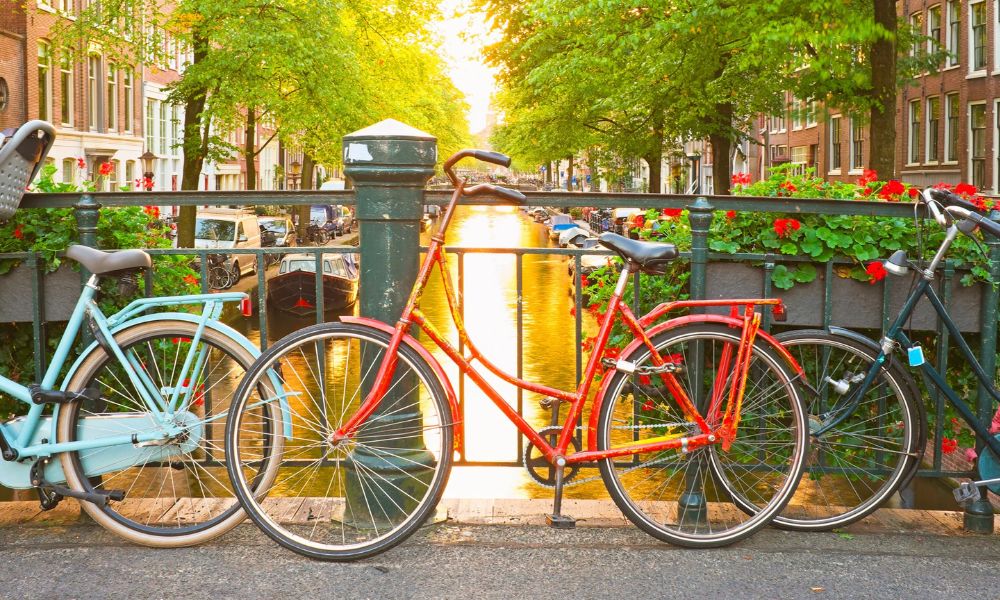
The first thing many visitors notice is the bikes: on bridges, against railings, stacked in multi-level parking garages. Cycling here is less a hobby than the default way to get around. A 2015 count put the number of bicycles in Amsterdam at 847,000, at a time when the city had about 850,000 residents. The city has around 400 km of bike paths, which makes it easy to cross town without touching a car lane.
Not every bike stays on the road.
Between 12,000 and 15,000 are fished out of the canals every year. Theft is the other problem, and not a small one. About 54,000 bikes were reported stolen in 2005 alone, so if you rent one, lock it to something solid.
9. More than 40 parks offer a break from the canals
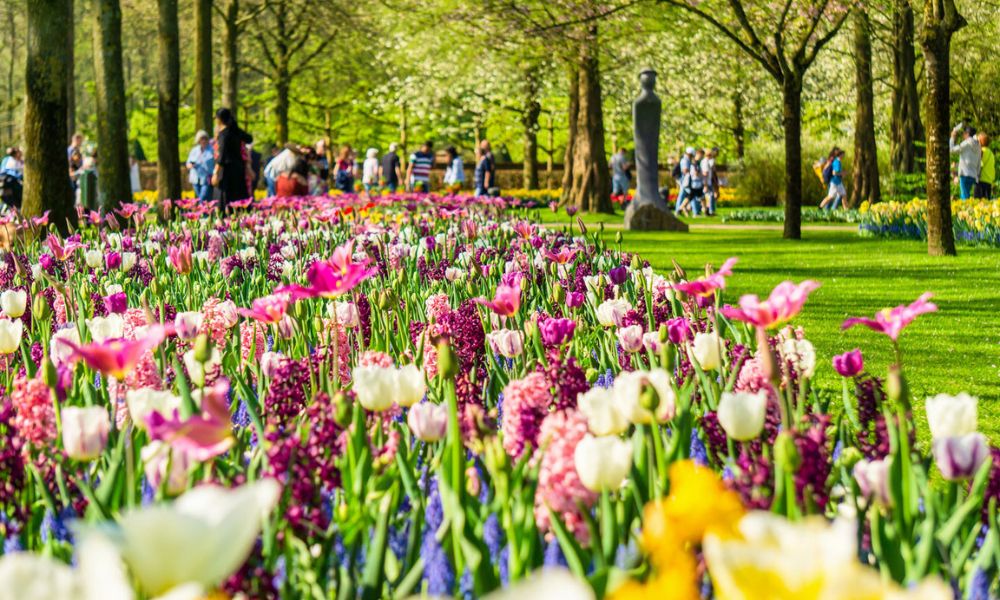
Amsterdam is famous for water, but it has plenty of green space too, with more than 40 parks around the city.
The best known is the Vondelpark, which covers 47 hectares (120 acres) near the Museum Quarter. Locals use it for walks, picnics and running, and in a city with nearly as many bikes as residents, plenty of people simply ride through. Check the treetops, too. Something unexpected may be up there: bright green parrots. Since the 1970s the park has had a growing population of feral rose-ringed parakeets, a species native to Africa and South Asia that most likely took hold here after pet birds escaped. If the Vondelpark feels too busy on a sunny day, the city’s smaller parks are usually calmer.
10. The main shopping street dates back to the Middle Ages
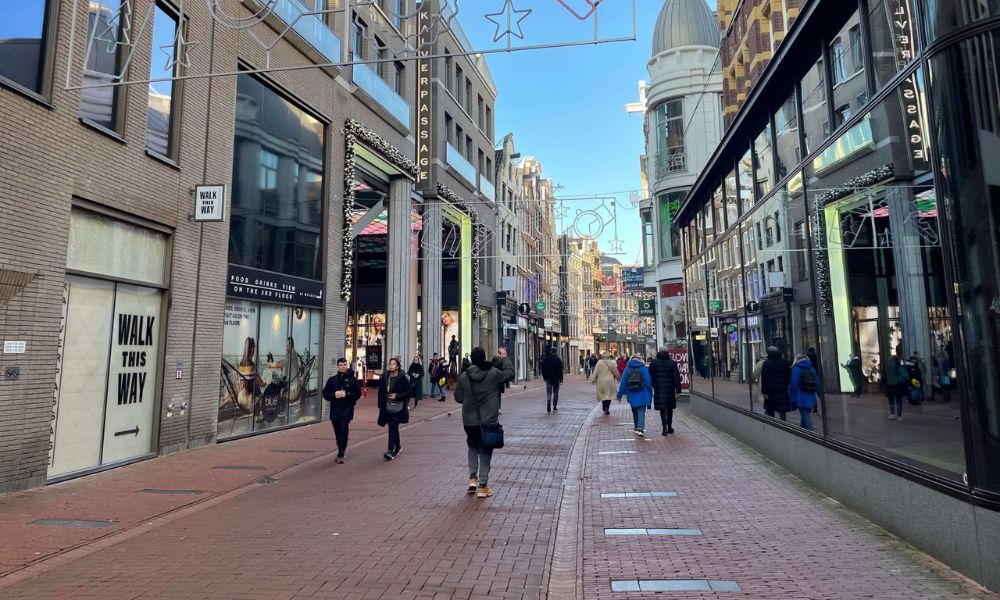
Kalverstraat, Amsterdam’s best-known shopping street, has been a busy commercial route for centuries. After the medieval city walls went up, the stretch between the Munttoren tower and the Spui square was known as Byndewyck. Its current name means “calf street.” From 1486 to 1629, a cattle market was held here, and the name stuck long after the cows were gone.
Today it’s a very different kind of market. In 2016, rents reached up to €3,000 per square meter (approx. $3,300 at the time), making Kalverstraat the most expensive shopping street in the Netherlands. The street is still a mix of old and new: centuries-old building lines framing chain stores and department stores.
A calf market that turned into the country’s priciest retail strip is about as Amsterdam as it gets.
Sources: Wikipedia, Amsterdam, Wikipedia, Capital of the Netherlands, Wikipedia, Kalverstraat, The Fact Site, Amsterdam Facts, Schiphol, Rijksmuseum Schiphol






Bir yanıt yazın