
9 Things to Do in Ayvalık: Stone Houses and Aegean Beaches


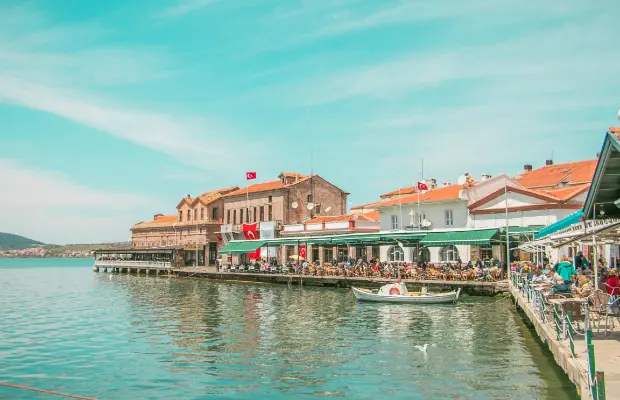
Ayvalık, a colorful Aegean town of old olive-oil factories, stone houses and a coastline strung with islands, sits in Balıkesir province within reach of both Istanbul and İzmir, so a long weekend works. The things to do in Ayvalık run from the old town to the beaches and nearby villages.
1. The old houses: things to do in Ayvalık start here

Start with the historic center. Houses of local “garlic stone” line its streets, built with great care by Greek craftsmen, and Ayvalık is known for having one of the largest collections of historic houses in Türkiye.
Honestly, walking the lanes without a map is half the point.
2. Cunda Island (Alibey Island)

Cunda stands out among Ayvalık’s islands, partly because it’s the only one with a settlement. Its Greek name: Moschonisi. Road signs often say Alibey Island, a name given in honor of Ali Çetinkaya, a commander in the War of Independence. Highlights include the market, the harbor, the Taksiyarhis Church (now the Cunda Rahmi M. Koç Museum), Aşıklar Tepesi (Lovers’ Hill), the Sevim and Necdet Kent Library, the Ayışığı Monastery, Despot’s House, Ada Cove, Tımarhane Island and Taşlı Kahve.
3. Taksiyarhis Memorial Museum

Ayvalık has two churches named Taksiyarhis. One stands in town, the other on Cunda, and the two are easy to mix up. The town church, built of garlic stone, served as a tobacco-monopoly depot from 1927 and was later abandoned, until the Ministry of Culture and Tourism restored it in 2012 and opened it in 2013 as the Taksiyarhis Memorial Museum, attached to the Balıkesir Kuva-yi Milliye Museum.
4. Sarımsaklı Beach

Sarımsaklı is the region’s best-known beach, popular with Turkish and international visitors alike. Set along the road from Ayvalık toward İzmir, it stretches for about 7 km. That’s plenty of room to spread out.
5. Badavut Beach, an alternative to Sarımsaklı

Badavut Beach, a few kilometers before Sarımsaklı, tends to get treated as the runner-up. It shouldn’t be.
The water is colder, admittedly, but clean, and some stretches are calmer. Sarımsaklı wins on sheer length; Badavut wins on calmer water.
6. Şeytan Sofrası, where the devil left a footprint

Şeytan Sofrası (“Devil’s Table”) is a volcanic hill with sweeping views of the Aegean and its islands, about 8 km from Ayvalık and 4 km from Sarımsaklı. The name? A footprint said to be the devil’s, now fenced in and surrounded by coins and red ribbons that visitors leave for luck.
Enterprising vendors sell the ribbons right there, so the superstition comes with its own small business.
7. Ayazma Church, built after a dream

Ayazma Church, also called Faneromeni, takes its name from the “holy water” (“ayazma”) beneath it. Local legend tells of a little girl who dreamed night after night of the Virgin Mary drinking from a spring and pointing to a spot; she told the town council, diggers found water at the place, and a church of garlic stone went up there. It has since served as an olive-oil factory and a museum. What it is today is harder to say for certain, so check before visiting.
8. Saatli Camii, a church turned mosque

Many Anatolian churches became mosques over the centuries. Saatli Camii (Clock Mosque) is one. Finished in the 1850s as the Agios Yannis church, it was converted in 1928, its icons painted over and its bell replaced with a clock.
The surprising part: the mosque keeps much of the church’s architecture.
9. Küçükköy, a village turning into an art and design hub

Küçükköy sits about 5 km from Ayvalık. A project that restored its houses and colored its narrow lanes has made it popular, with the aim of turning it into Türkiye’s new art and design village. Think of it as the old town’s garlic-stone appeal on a village scale. Whether it fully gets there is still an open question.
Sources: Wikivoyage, Daily Sabah, Rahmi M. Koç Museum (Cunda Taksiyarhis, in Turkish)

Bir yanıt yazın