
Side Turkey: 14 Facts About the Ancient Port City


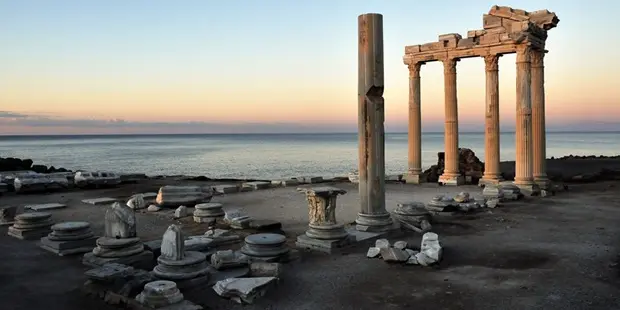
Side Turkey is a small peninsula on the Mediterranean coast near Manavgat, Antalya, about 1 km long and 400 meters wide, where a ruined ancient port sits beside beach hotels. A Greek colony, a pirate-era slave market and a Roman showpiece all stood on this tongue of land. These 14 facts explain how it got here.
1. The name probably means “pomegranate”
Side is commonly said to mean “pomegranate,” a word that traces to one of Anatolia’s old languages. The fruit has stuck around.
It turns up on local menus and souvenirs, while mandarins and bougainvillea add the rest of the town’s color.

2. Greek settlers founded it from Cyme
According to Greek tradition and the geographer Strabo, settlers from Cyme, near today’s İzmir, founded Side, most likely in the 7th century BC. It became one of the main cities of Pamphylia, a region whose name means “land of all tribes.”
Its roots may go deeper. Some sources trace them back to the Hittite era.

3. Side had its own undeciphered language
Inscriptions from the 3rd and 2nd centuries BC show that Side had a local language and script. It remains only partly decoded, and nobody can say for certain what much of it means. That makes it a rare reminder that Greek was not the only voice on this coast, even in a city founded by Greek settlers.

4. Alexander arrived without a fight
Side passed from Lydian to Persian control in the 6th century BC. Then, around 333 BC, it welcomed Alexander the Great.
After his death the city changed hands among his successors, yet its harbor and fleet kept it prosperous, and the 2nd century BC is usually described as its high point.

5. Pirates and slave markets built the fortune
After the Treaty of Apamea in 188 BC, Side kept its independence. So where did the money come from? Somewhere less noble than the marble suggests: pirates used the port as a base, and the agora later turned into a slave-trading center. Roman rule brought more expansion. By the 2nd and 3rd centuries AD, it was the main trading city of its region.

6. It became a bishopric
Residents worshipped Athena, Apollo and many other gods until Christianity spread in the 4th century. The new faith took hold. By the 5th century, Side was a bishopric of eastern Pamphylia and later a metropolitan see.
Churches and basilicas rose among the pagan temples.

7. Raids and earthquakes emptied the city
Arab fleets raided and burned Side in the 7th century. Earthquakes and fire damaged it further, and by roughly the 10th century the city was abandoned, its residents having moved to nearby Antalya. The 12th-century geographer al-Idrisi called it a dead city.

8. It stayed empty for centuries
After the Seljuk and beylik periods, the site saw no settlement. Then came 1895, when immigrants from Crete founded the village of Selimiye on the ruins and reused ancient walls and floors in some of their buildings.
Put simply, this is the origin of today’s Side.

9. Two Sides share one peninsula
Visitors meet both the old city and the modern resort town in the same walk, because the ruins begin right at the entrance and simply carry on into the streets. History is part of daily life here, a habit that goes back to the Cretan villagers of 1895 and their houses built onto ancient walls.
Ancient columns stand among the beach restaurants.

10. Start at the Great Gate and the museum
The Hellenistic main gate, called the Great Gate, was the city’s entrance. A fountain stands just inside. According to the Ministry of Culture and Tourism’s museum page, the Side Museum occupies a restored 2nd-century Roman bath and displays finds from Hellenistic, Roman and Byzantine times excavated in the ancient city.

11. The theater sits on arches, not a hillside
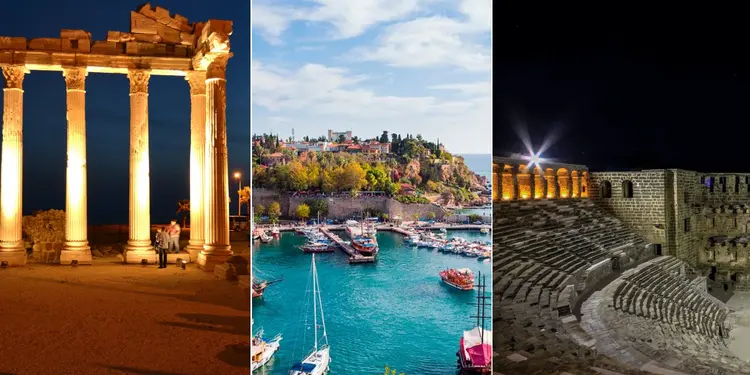
The usual picture of a Roman theater is a bowl carved into a hillside. Not here: Side’s was built on two stories of vaulted galleries close to the sea. It held around 15,000 to 20,000 spectators, echoes Rome’s Colosseum in its engineering and was used for gladiator and animal shows. In the 5th and 6th centuries it also served as an open-air church; today it hosts concerts and festivals.

12. The modern town starts beyond the theater
Past the theater, the main street fills with souvenir shops, while the harbor holds restaurants serving regional dishes, plus bars and cafés. It is busy and commercial, no way around that. The quiet ruins are never far, though: a path left of the theater leads through them down to the sea.

13. Sunset at the Temple of Apollo
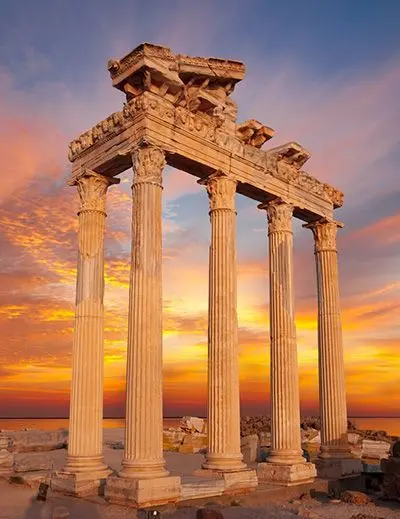
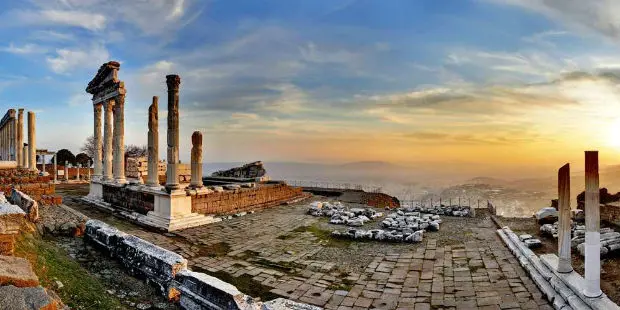
Near the harbor stand two temples, one for Athena and one for Apollo, and a few columns of Apollo’s temple have been raised again, so that at sunset they frame the sea.
It is the most photographed spot in Side.
14. A long sandy coast and a sunken museum
Side has a long beach with clear, shallow water, and visitors also go paragliding and scuba diving. The Side Underwater Museum, Türkiye’s first, opened in October 2015 about 1.5 nautical miles offshore and is reached by diving, with roughly 117 sculptures at depths of 11, 18 and 22 meters. One caveat: a 2022 report described the museum as deteriorating from lack of upkeep, so check current conditions before booking a dive.


Sources: Wikipedia, Side, Turkey, Hürriyet Daily News on the Side Underwater Museum, Türkiye Ministry of Culture and Tourism, Side Museum

Bir yanıt yazın