
Topkapı Palace Treasures and Collections to See


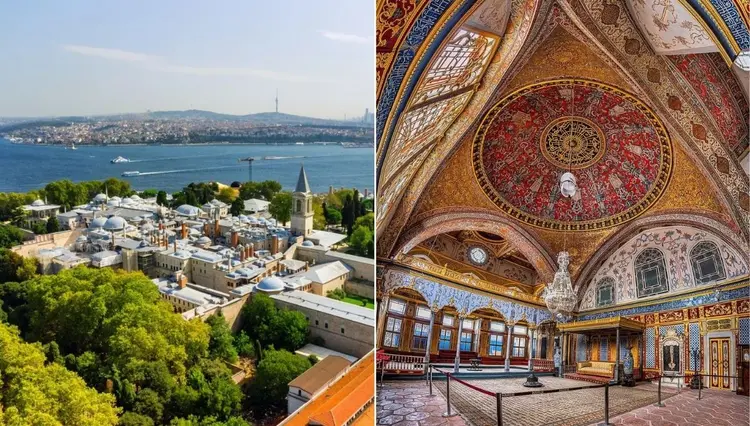
Topkapı Palace treasures read like a short course in Ottoman history: holy relics, jewels the size of eggs, thrones and imperial wardrobes, all inside the palace that ran an empire. Eight stops give the best sense of what is inside, from the Sacred Trusts to the Harem.
1. Topkapı Palace treasures begin with the building itself
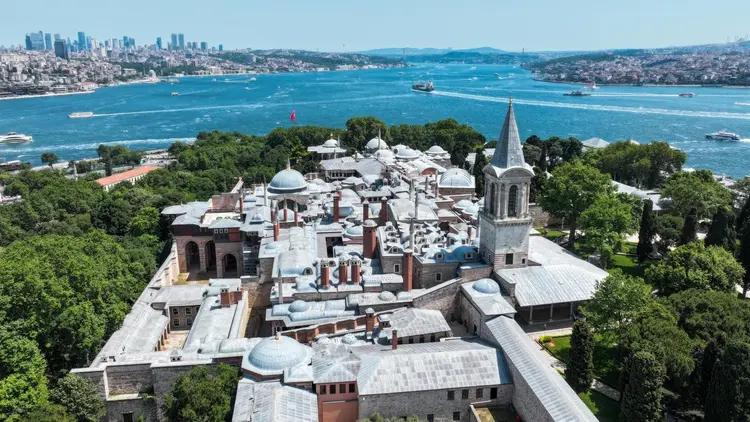
Mehmed II ordered the palace built in 1459, six years after the conquest of Constantinople, and the core was largely finished by the mid-1460s. For roughly four centuries it served as the administrative center of the Ottoman Empire, a run that ended only when the court moved to Dolmabahçe Palace in the 19th century. Home, government office, school, stage for diplomacy: it was all of these at once. The layout is the clue. Four main courtyards, each more private than the last, lead inward—so the deeper you walk, the closer you get to the sultan. The UNESCO listing came in 1985, and the palace is part of the Historic Areas of Istanbul, a UNESCO World Heritage site.
2. The terrace with the view
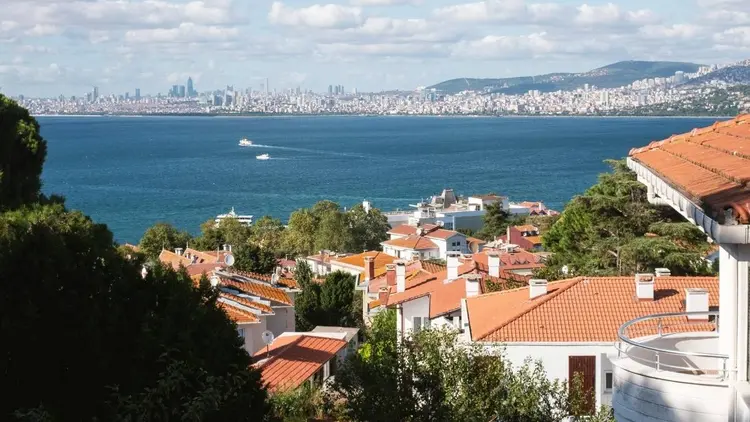
Some treasures aren’t objects. From the palace terraces the city opens up—the Golden Horn, the Bosphorus and the Sea of Marmara in one sweep, the same panorama sultans took in while they decided the affairs of an empire. Then comes the practical part. After a few hours of rooms and display cases, it is a good place to catch your breath.
3. The Sacred Trusts
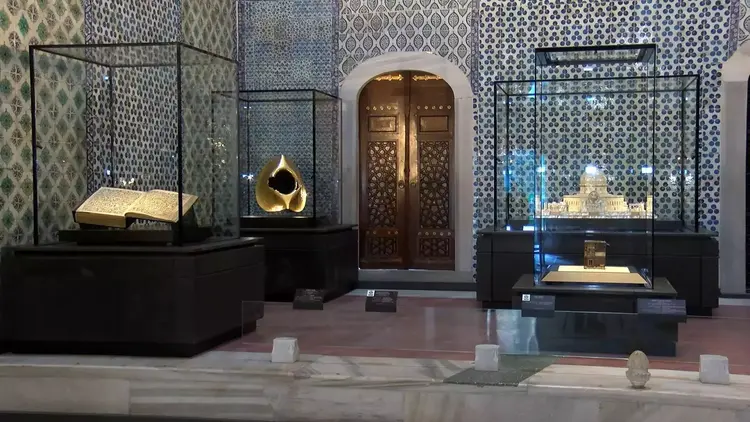
The Sacred Trusts are the museum’s holiest relics. They were gathered after the Ottoman conquest of Egypt in the early 16th century. Among them are the cloak of the Prophet Muhammad, swords, a bow, a tooth, a hair from his beard and an autographed letter, along with the Staff of Moses and the turban of Joseph. The hall is dim and hushed. The recitation of the Quran has long been linked to this space.
Visitors are asked to be quiet and respectful, and to dress modestly.
4. Sultans’ costumes
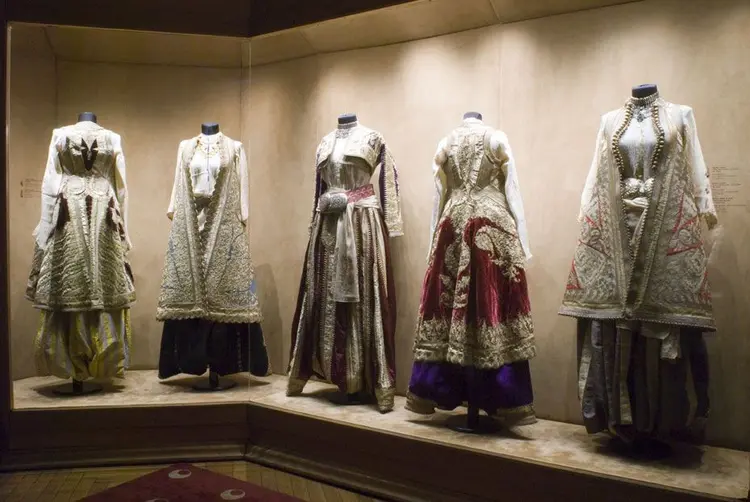
In the Ottoman court, clothes were politics. The costume collection shows silk caftans with gold thread, simpler garments for princes, children’s outfits and court dress; some pieces also carry the sultan’s monogram, the tughra, which marks them as both fashion and imperial seal.
Fabric was how the court spoke before words.
5. The Harem
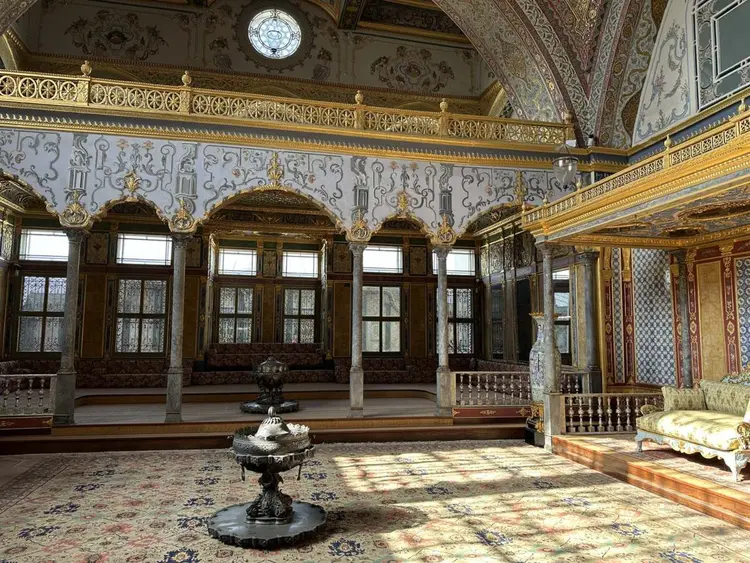
The Harem was the private quarters of the sultan’s household, home to the Valide Sultan (the sultan’s mother), consorts, children and the staff who served them. It is a maze, and sources disagree on exactly how big. Of its several hundred rooms only a small part is open to the public, so it pays to look closely at the tiled walls, the carved wooden doors, the bathrooms and the painted ceilings. Contrary to the popular image, privacy was not the whole story. The Harem was also a place of education and political influence, particularly for the Valide Sultan, who often held real power.
6. The gold-plated throne
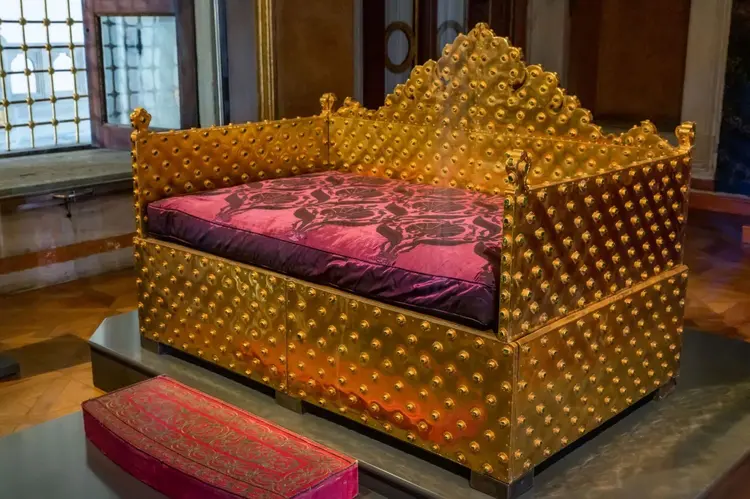
Made for Sultan Murad III in 1585, the gold-plated Bayram Throne is covered in precious stones. Ceremonies and envoys were its business.
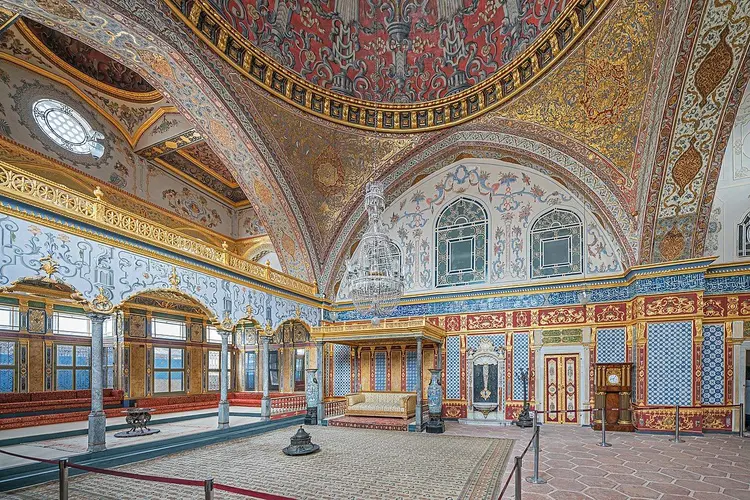
A throne is a statement, the same lesson the caftans teach in silk. Where the Sacred Trusts ask for silence, this piece was made for an audience. Its language needs no translation—every visitor, whatever their native tongue, can read it at a glance, and nearby in the Treasury a walnut throne of Ahmed I shows a very different style.
7. The halberdiers’ quarters and the palace kitchens
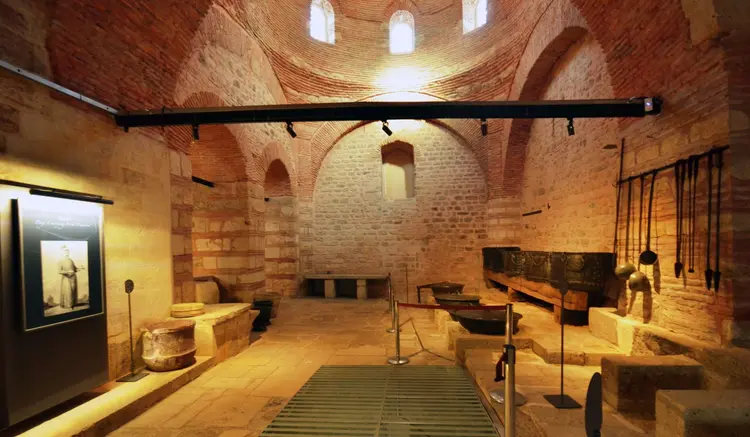
The halberdiers with tresses, known in Turkish as zülüflü baltacılar, were palace guards named for the long locks they wore as a sign of rank; they carried firewood to the royal quarters, and their dormitory is part of the Harem complex. The kitchens are close by and easy to rush past on the way to the jewels, which is a mistake, because their numbers are startling. Ten domed buildings fed around 4,000 people, backed by more than 800 staff. The porcelain collection today holds about 10,700 pieces. Many are Chinese.
8. The Spoonmaker’s Diamond
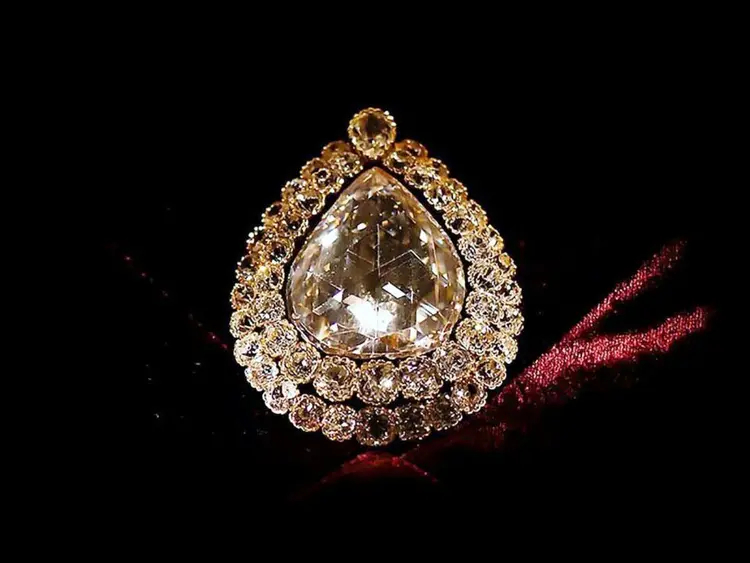
About 86 carats, set in silver and ringed by 49 cut diamonds: the Spoonmaker’s Diamond is among the world’s largest. Legend says a poor man found it on a rubbish heap and traded it for three spoons, hence the name. Is any of that true? Nobody can say for sure; its real history is murkier, and that is part of the charm.
It sits in the Treasury, so plan to spend a good half hour there, and remember that the palace is closed on Tuesdays and the ticket office closes before the doors do.
Sources: Müze İstanbul: Topkapı Palace Museum, Wikipedia: Topkapı Palace, UNESCO World Heritage Centre: Historic Areas of Istanbul







Bir yanıt yazın