
Pamukkale Travertines: The Story Behind the White Terraces


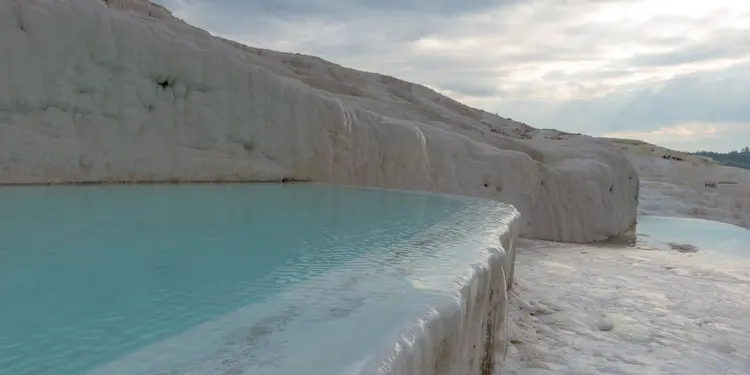
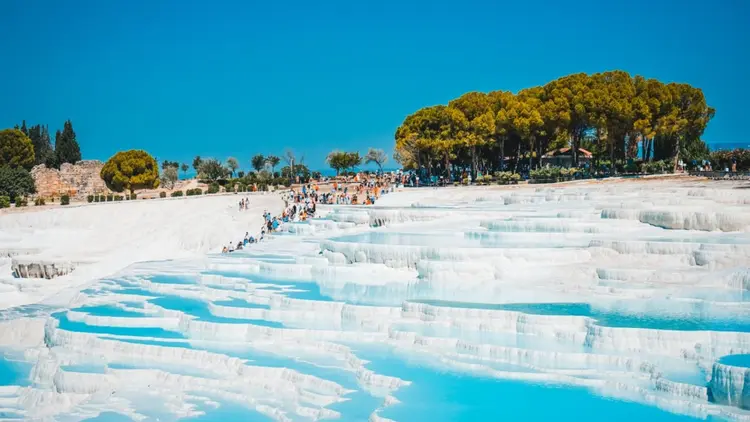
From a distance, the Pamukkale travertines look like a snow-covered hillside in the middle of a warm, dry landscape. Up close, they turn out to be rock that water built, one thin film at a time. Set in the Denizli region of southwestern Türkiye, the terraces sit right beside the ancient city of Hierapolis, and the two together form a UNESCO World Heritage Site.
1. How the Pamukkale travertines formed
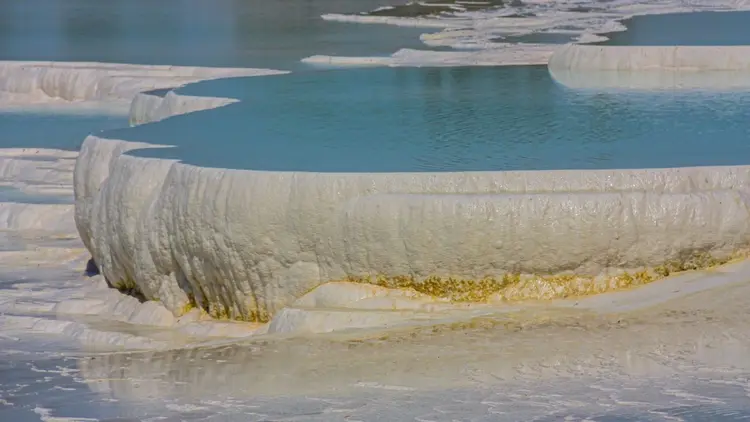
The white comes from spring water. Hot water rises from deep underground carrying dissolved calcium carbonate, and as it flows down the slope and loses carbon dioxide into the air, the mineral settles out and hardens on the rock. Türkiye’s official tourism portal, Go Türkiye, describes it the same way: water supersaturated with calcium carbonate meeting the open air. Layer after layer. That deposit built the stepped basins visible today. The hillside is not a single frozen moment but a slow construction project that never clocked out. The springs still flow.
2. Why it is called “Cotton Castle”
Pamukkale means “cotton castle” in Turkish. For once, the name is refreshingly literal. From the valley below, the bright terraces do resemble a heap of raw cotton piled up on a ridge, and the nickname stuck not just to the slope but to the whole surrounding area. Late in the day, the white takes on warmer shades. The comparison gets even easier.
3. Hierapolis sits right on top of the terraces
Above the travertines lie the ruins of Hierapolis. It began as a Hellenistic city and grew into a thriving spa town under Rome. The draw? Hot springs. People came for the water, and over time the city built everything a resort of that era needed—baths, temples, a large theater and, outside the walls, a vast necropolis of roughly 1,200 tombs.
Getting from a natural wonder to a Roman city takes a few minutes on foot. One was built by water, the other by the people that water drew in, which is the real reason the two are protected as one site.
4. Cleopatra’s Pool: swimming among ancient columns
The best-known place to swim is the thermal pool called Cleopatra’s Pool, also known as the Antique Pool. Local legend says the Egyptian queen bathed here. It’s a nice story, but no firm evidence backs it. What is solid is the scenery: marble columns from a collapsed portico, toppled by an earthquake centuries ago, lie on the bottom, so a swim here means floating over fragments of an ancient building. Entry costs extra, so check the current rate at the gate.
5. The color of the terraces keeps changing
Contrary to the postcards, Pamukkale is not only white. Depending on the angle of the sun, the amount of water on the surface and the time of day, the terraces can look bright white, pale blue or gold. That’s what keeps photographers busy. They return at different hours, because the same slope can look like three different places between morning and sunset.
6. Walking rules that protect the terraces
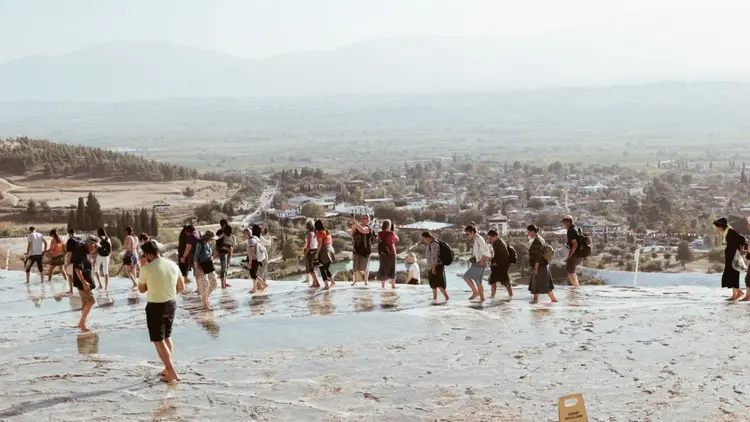
The travertine crust is fragile. The rules follow from that, plain and simple. Visitors are generally asked to stay on marked routes, and walking on the terraces is done barefoot so that shoes do not scuff the surface, while some sections are closed for periods to let the mineral deposits recover.
Following those signs is not optional politeness, because the white surface is exactly what disappears first when too many feet wear it down.
7. When to go to Pamukkale
Spring and autumn are the most comfortable seasons. Milder temperatures, walkable paths. Summer is another matter: heat and heavier crowds arrive together, so getting there early in the morning or close to sunset, rather than in the middle of the day, works much better. Winter feels different. Cold air meets warm, steaming water, and the terraces are far quieter.
8. More than a natural wonder
Pamukkale earned its place on lists of must-see sights in Türkiye. Looks are only part of it. Plenty of visitors spend so long on the white slope that the ruins above become an afterthought, which misses half the point. Mineral springs, geology and the remains of a Roman spa city all meet on one ridge, and a single walk across them connects nature and history in a way few destinations manage.
The result is a story. Thousands of years of water and people wrote it together.
Sources: Wikipedia: Pamukkale, Wikipedia: Hierapolis, Go Türkiye: Pamukkale


Bir yanıt yazın