
Towers of Istanbul: Maiden’s Tower to Galata Tower


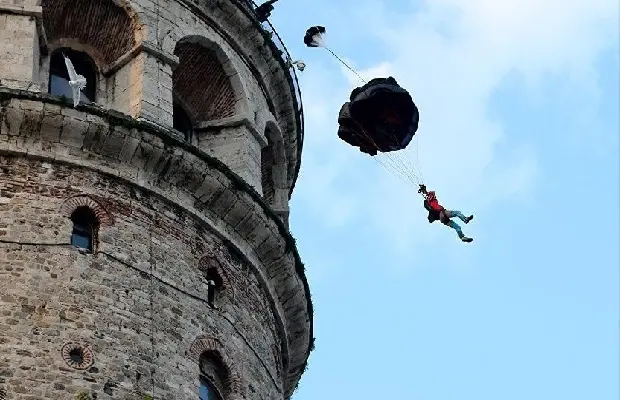
Some of Istanbul’s towers warned the city of fire; others set the time, forecast the weather, or hid a princess from a prophecy. A surprising number of them inspired poems, legends, and at least one Hollywood ending. These seven towers of Istanbul still carry their stories, tragic, romantic, or just strange, in their stones.
1. Beyazıt Tower: the fire-watcher of the city

Today it greets students on Istanbul University’s Beyazıt campus. In 1749, though, Beyazıt Tower had one job: spotting the fires that regularly tore through the city’s wooden mansions.
The original wooden structure was damaged in the 1756 Cibali fire and the 1826 janissary revolt, and Sultan Mahmud II had it rebuilt in stone two years later under architect Senekerim Balyan. The signals were simple and effective. By day, watchers lowered baskets from the tower; by night, they lit lanterns. Either way, the city knew a fire had broken out before most residents could smell the smoke.
A quieter tradition passed between Beyazıt Tower and its counterpart on the Asian side, İcadiye Tower. When a watcher spotted smoke, legend has it he’d send word with a coded phrase: “the Ağa has had a child.” The reply, “a girl, or a boy?”, wasn’t idle curiosity. Fires on the Asian shore, in Beyoğlu, or along the Bosphorus’s European (Rumeli) shore were coded “girl”; fires inside the old city walls were “boy.” Once İcadiye had the news, it fired seven cannon rounds to spread the alarm across the city.
Climb the tower’s 256 steps today (85 meters up) and you’re standing on more than a fire station. Through the Republican era, the tower doubled as a weather signal: green for rain, red for snow, yellow for fog, blue for clear skies, a system retired in 1995 and revived in 2010. In 1968, student protesters occupied it after the death of fellow student Vedat Demircioğlu, raising a flag that paired a hammer and sickle with his name. In 2013, it became a museum.
2. Galata Tower: Byzantine lighthouse, Ottoman prison, revolutionary flight path

Nobody can pin down exactly when Galata Tower went up, which hasn’t stopped historians from arguing about it for centuries. One account credits Emperor Justinian in 507; another points to Anastasius in 528, both building it as a lighthouse. The Byzantines simply called it the Great Tower. The Fourth Crusade flattened it in 1204, and Genoese builders raised it again in 1348 using rubble masonry, under the more dramatic name Christ’s Tower.
Ottoman rule brought new uses. An earthquake in 1509 damaged the structure, and the era’s leading architect, Hayreddin, repaired it. Under Süleyman the Magnificent, it held Christian prisoners put to work in the Kasımpaşa shipyards, a grim stretch that ended when Sultan Murad III let the astronomer Takiyüddin set up an observatory inside.
The observatory closed in 1579, but Galata had already had its brush with science.

Its best-known legend belongs to the 17th century. During the reign of Murad IV, the aviator Hezârfen Ahmed Çelebi had spent time testing wind patterns at Okmeydanı before setting his sights on Galata. In 1638, strapped into wooden eagle wings, he reportedly jumped from the tower and glided across the Bosphorus to Doğancılar in Üsküdar, an episode that later found its way into European engravings. Did it really happen? Hard to say. It’s a great story either way.
The tower’s later chapters were rougher. It briefly hosted a military band in the 1600s, then spent the 18th and 19th centuries as a fire-watch post. That didn’t spare it from flames: a fire in 1797 under Selim III, another in 1831, and a storm in 1875 that knocked off its conical cap. The restoration that gave Galata Tower its current look took place between 1965 and 1967. A later restoration in 2020 stripped out concrete additions and the old cafeteria, and Türkiye’s Ministry of Culture and Tourism now lists the building as the Galata Tower Museum.
Its most somber story is recent enough to still sting. On June 6, 1973, a 15-year-old named Vedat jumped from the tower; he was the son of the poet Ümit Yaşar Oğuzcan, who later wrote about the loss in verse.
Another well-known Turkish poet, writing about Istanbul’s skyline, imagined a rivalry between Galata and the tower across the water, Maiden’s Tower, as if the two had been flirting across the Bosphorus for centuries.
3. Maiden’s Tower: a 2,400-year-old chess piece in the middle of the Bosphorus

In antiquity, the islet now known as Maiden’s Tower, in Üsküdar’s Salacak district, went by two names: Arkla (“small fortress”) and Damalis. Around 410 BCE, the Athenian general Alcibiades built a tower there to keep watch over ships moving through the strait, a purely military outpost.
The mission changed in 341 BCE, when the Greek commander Chares built a monument to his wife on the same spot, giving the little island a romantic reputation it never fully shed. Strategically, though, the location was too valuable to stay sentimental for long. Around 1,500 years later, Byzantine Emperor Manuel I Komnenos (who ruled 1143-1180) rebuilt the tower for defense and used it to monitor, and sometimes chain off, ship traffic through the Bosphorus.

When Sultan Mehmed the Conqueror took Istanbul, he tore down the structure the Venetians had been using as a base and replaced it with a small fort fitted with cannons, used more for ceremonial salutes than real defense. An earthquake damaged it again in 1510, and Sultan Selim I had it repaired; in the 17th century, a lighthouse was added, turning the tower into a working navigational aid.
A 1719 fire gutted its wooden interior; six years later, Grand Vizier Nevşehirli Damat İbrahim Pasha rebuilt it with a lead dome and a glazed, masonry lighthouse room. Maiden’s Tower took on a darker job during the Ottoman Empire’s final decades, serving as a quarantine hospital during the 1830-1831 cholera outbreak and again during the 1836-1837 plague, part of the effort to keep disease from spreading into the city. Its last major Ottoman-era renovation came under Mahmud II, who added an Ottoman-Baroque fluted dome and a commemorative inscription carrying the sultan’s monogram, written by the calligrapher Rakım. A new lighthouse followed in 1857. In the 20th century, the tower became a naval radar station in 1959, monitoring sea and air traffic in the strait, then passed to the Turkish Maritime Lines as a relay station between 1983 and 1992. It was restored once more in 1995 and has welcomed visitors since 2000; check the tower’s official site for current visiting details.

Istanbul’s best-known legend about the tower involves a king who can’t outrun a prophecy. Fortune-tellers warned a Byzantine emperor that his daughter would die from a snakebite, so he built her a house on the rocks where the tower now stands, reasoning that a snake couldn’t swim. A young soldier fell for the princess anyway and brought her a bouquet as a gift. A snake had hidden inside the flowers. The prophecy came true.
A second legend gave Turkish an entire idiom. A thief named Battal Gazi is said to have raided the tower, made off with treasure and the local governor’s daughter, then outrun his pursuers by leaping onto a horse in Üsküdar. That’s why Turks still say “the one who took the horse has already crossed Üsküdar” about anyone too fast to catch.
The tower’s romantic streak has carried into film and verse. It hosted its first movie shoot in 1993’s Kız Kulesi Aşıkları, and six years later became the backdrop for the climactic scene of the James Bond film The World Is Not Enough, starring Pierce Brosnan, giving Maiden’s Tower its first real Hollywood close-up. Turkish poets have returned to it just as often: one described it as a music box that spins open for children afraid of the dark, another imagined it pining for Galata Tower on the far shore. Both poems are well loved in Turkey, though their lines are best read in the original rather than in translation.
4. Dolmabahçe Clock Tower: a sultan’s timepiece, a protest’s meeting point

Sultan Abdülhamid II moved his residence to Yıldız Palace for security reasons soon after taking the throne in 1876, but he never gave up on Dolmabahçe Palace, where he still hosted official ceremonies and guests. Abdülhamid was famous for building clock towers across Anatolia so that citizens wouldn’t miss prayer times, fire alerts, or weather forecasts. Dolmabahçe got its own. The palace architect Sarkis Balyan designed it between 1890 and 1895. The National Palaces Administration still counts the Clock Tower among the palace buildings added in Abdülhamid II’s reign.
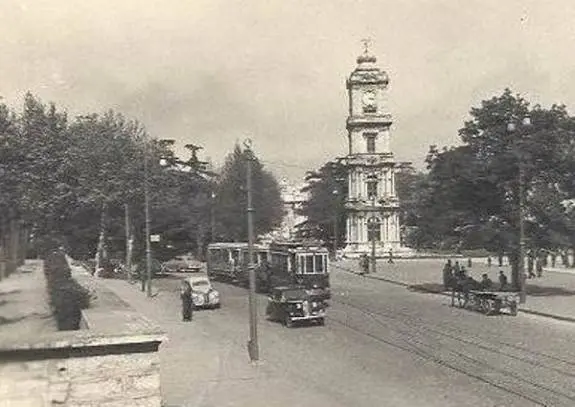
The 27-meter tower cost the treasury 1,210,550 kuruş and reused stone from the unfinished Aziziye Mosque, a project abandoned when Sultan Abdülaziz was deposed. Built in a Baroque and Empire style, it rises over 94 steps, with colorful geometric floor patterns on the stair landings and a pair of two-tiered fountains at its base. Its facade still carries barometers labeled, in Ottoman Turkish, “Storm—Wind, Rain—Unsettled, Fine Weather, Steady Weather.” An Ottoman coat of arms, complete with scales and crossed swords, was added to the second-floor pediments in 1882 under Abdülhamid II.
The clock itself came from the French maker Paul Garnier and was installed by the court’s chief clockmaker, Johann Meyer. One oddity remains. The sea-facing dial still runs on its own mechanism, separate from the other three. Part of the system was electrified in 1979, and today the clocks are wound by hand once a week. Over more than a century, the tower has quietly witnessed Ottoman and Republican history: Sultan Vahdettin’s departure into exile, Atatürk’s death, and a 1969 protest against the arrival of the U.S. Sixth Fleet.
Its most recent brush with history came during the 2013 Gezi Park protests, when Istanbul’s governor at the time, Hüseyin Avni Mutlu, chose the clock tower’s café as the meeting point to negotiate with demonstrators at midnight on June 13.
5. Yıldız Clock Tower: an Ottoman landmark leaning West

Abdülhamid II’s appetite for clock towers reached Beşiktaş’s Yıldız Palace complex too. Sarkis Balyan built this one between 1889 and 1890 in the garden of Hamidiye Mosque. Hence the local nickname: Hamidiye Clock Tower. Its Ottoman and Neo-Gothic design, a 20-meter octagonal shaft with chamfered corners, puts it directly beside one of the city’s Islamic landmarks while visually gesturing toward Europe.
The tower holds a thermometer and barometer on its second floor, their dials still labeled in Ottoman Turkish terms for unsettled, windy, and rainy weather, and four inscribed panels on the ground floor. In 1905, it witnessed a startling act of political violence: on July 21, the Armenian Revolutionary Federation attempted to assassinate Abdülhamid II with a bomb outside Hamidiye Mosque. The sultan survived. The poet Tevfik Fikret later wrote verse reflecting on how close the attempt had come. The tower itself underwent restoration in 1993 and still stands watch over the palace grounds.
6. Tophane Clock Tower: the oldest one still standing
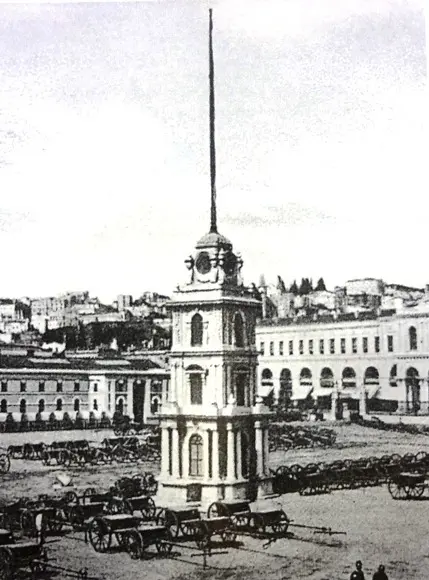
Istanbul’s oldest surviving clock tower isn’t the grand one at Dolmabahçe. It’s this one, beside Nusretiye Mosque in Tophane, which earns it the alternate name Nusretiye Clock Tower. Sultan Abdülmecid commissioned it between 1848 and 1849, though nobody has confirmed who designed it. Most sources credit Bali Balyan. Four matching facades taper upward across the structure’s height, with Ionic column heads and Empire-style ornament, and the sultan’s monogram sits above the sea-facing entrance. At just 15 meters, it’s modest next to its successors: Dolmabahçe’s clock tower reaches 27 meters, and Beyazıt’s fire tower, at 85, stands more than five times taller.
Its clock face still carries the word “Zenith” written in Old Turkish script. A fire damaged the tower in 1913, and during the road-widening projects of the 1950s, under Prime Minister Adnan Menderes, it was moved from its original waterfront spot to where it stands now, across from the customs warehouses near what is today Istanbul Modern’s garden. It’s easy to walk past it on the way to the museum without guessing it’s the oldest clock tower in the city. Of its original four clock faces, only two remain, and the glass over them is cracked. Inside, the English-made clockwork has stopped.
A restoration tied to Istanbul’s year as European Capital of Culture in 2010 was announced but never carried out. For the city’s oldest clock tower, that’s a long wait on a clock that has already stopped.
7. Etfal Hospital Clock Tower: the saddest story among the towers of Istanbul
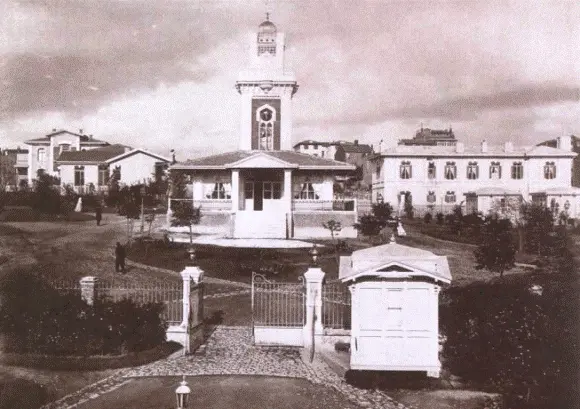
The last tower began as a father’s memorial. Sultan Abdülhamid II’s infant daughter, Hatice Sultan, died of diphtheria. She was eight months old. In her memory, he commissioned Hamidiye Etfal Hospital, today’s Şişli Etfal Hospital. The Italian architect Raimondo D’Aronco designed a clock tower for the hospital garden, built in 1907 under the supervision of Mahmut Şükrü Bey, a professor at the imperial engineering school. The sultan added a small prayer room at its base the same year. Of the hospital’s original buildings, only those two still stand. That makes it the third tower here tied to Abdülhamid II, after Dolmabahçe and Yıldız, and the only one he built out of grief.
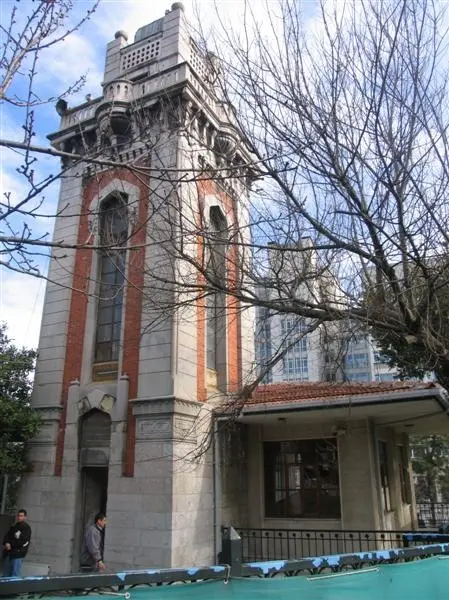
Roughly 20 meters tall on a square plan, the tower alternates red brick with white marble, and tall, pointed-arch windows run up its central axis on every floor. A spiral iron staircase leads to the clock room, and four inscribed panels bearing Abdülhamid II’s monogram decorate its front face. Near the top, a balcony-gallery wraps around all four sides, its marble railing propped up by a row of decorative brackets, giving the structure a silhouette that the city’s residents likened to a bowler hat pulled low over a head tilted toward the sky.
Sources: Galata Tower Museum, Ministry of Culture and Tourism (muze.gov.tr), Maiden’s Tower official site (kizkulesi.gov.tr), Dolmabahçe Palace, National Palaces Administration (Milli Saraylar)



Bir yanıt yazın