
Lake Baikal: 6 Facts About the World’s Oldest, Deepest Lake


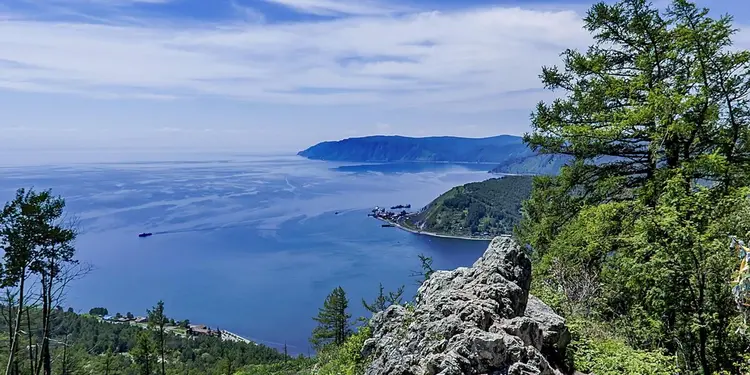
Lake Baikal sits in southern Siberia, in Russia, and holds two records at once: it is the oldest lake on Earth and the deepest. Its clear water earned it the nickname “the Blue Eye of Siberia,” and it has been a UNESCO World Heritage Site since 1996.
1. The world’s oldest lake, with its own seal

Lake Baikal is estimated to be 25 to 30 million years old, the oldest lake in the world. Lakes feel permanent. They aren’t: most fill up with sediment and vanish within a few tens of thousands of years.
Baikal simply kept going.
It has gone by many names. Chinese records from the Han dynasty called it Běihǎi, the “North Sea,” while the Kurykans, Buryats, and Yakuts who lived along its shores each had names of their own for it.
Long isolation gave the lake an ecosystem found nowhere else. Its best-known resident? The Baikal seal, one of the few seal species that lives only in fresh water.
2. Lake Baikal is the deepest lake on the planet

The lake lies between Irkutsk Oblast and the Republic of Buryatia. The numbers are hard to grasp. Covering about 31,722 km², it runs 636 km from end to end and reaches 79 km at its widest, with roughly 23,600 km³ of water filling the basin.
The deepest point sits at 1,642 meters, and the average depth is about 744 meters. That puts the lake floor around 1,187 meters below sea level. Beneath that floor lies roughly 7 km of sediment, and the rift floor itself sits 8 to 11 km below the surface, which makes it one of the deepest continental rifts anywhere on Earth. The rift is young and active. It widens by about 4 mm a year, earthquakes shake the region every few years, and hot springs bubble up along the faults. Underwater, the lake splits into three basins: the North (about 900 m deep), the Central (about 1,600 m), and the South (about 1,400 m).
All that depth was bound to draw record hunters. In 1990, Anatoly Sagalevich took a Pisces submersible down to 1,637 meters, the deepest freshwater dive on record. Russia tried again in 2008, sending the Mir-1 and Mir-2 submersibles toward 1,592 meters for geological and biological research. They stopped at 1,580 meters. Remarkably, the 1990 record still stands.
3. A hotspot of biodiversity

Scientists have recorded more than 1,000 plant species and 2,500 animal species in Lake Baikal. Nobody knows the real totals, though they are likely much higher. Endemism runs high. About 90% of its ostracods, more than 350 amphipod species and subspecies, and over half of its fewer than 65 native fish species are endemic, which means the lake is the only place on Earth where they occur. That is what 25 to 30 million years of isolation buys. The star of the show is the Baikal seal, which lives here and nowhere else. On land, the shoreline forests shelter bears, wolves, foxes, several kinds of weasel, and deer.
Birders can count 236 species around the lake, 29 of them waterfowl.
4. A UNESCO World Heritage Site

UNESCO added Lake Baikal to its World Heritage List in 1996, placing it among Russia’s natural World Heritage Sites in the same league as the Golden Mountains of Altai and the Volcanoes of Kamchatka. What sets it apart, even from those? The combination: extreme age, extreme depth, and a living laboratory of species that evolved in isolation for millions of years. That status comes with scrutiny. The IUCN World Heritage Outlook, which tracks the condition of natural World Heritage Sites, rated the lake’s conservation outlook as “significant concern” in its 2025 assessment.
5. Cold climate, astonishingly clear water

The huge body of water softens the local climate a little. This is still Siberia, though. Winter air temperatures drop to around −19 °C (−2 °F) and the surface stays frozen for four to five months, roughly from January to May or June, while summer highs reach only about 14 °C (57 °F). The water stays cold too. In August, the main parts of the lake warm up to about 16 °C (61 °F); shallow bays in the south can reach 20 to 24 °C. Below about 300 meters, the water holds at about 3.1 to 3.4 °C.
Lake Baikal holds about 22 to 23% of the world’s fresh surface water. It is also famously clear. In winter, you can see 30 to 40 meters down; in summer, plankton cuts visibility to 5 to 8 meters. That winter clarity is why so many photos of Baikal’s ice look like a sheet of glass laid over deep water.
6. Two seasons, two very different trips

Lake Baikal has two main tourist seasons. They could hardly be more different. The ice season usually runs from mid-January to mid-April, when the ice reaches up to 140 cm thick: enough for ordinary cars to drive on, although heavy vehicles such as tour buses are kept off. The clear ice, often cracked into striking patterns, draws people out to walk, skate, cycle, and fish through holes in the ice.
The thaw is the dangerous part.
As temperatures rise in spring, the ice weakens, especially where currents run underneath, and people and vehicles do fall through. No photo is worth that risk: if you visit late in the season, stick to routes that locals and guides confirm are safe.
Summer is for hiking and wildlife. The Great Baikal Trail network includes a popular coastal route from the village of Listvyanka to Bolshoye Goloustnoye. Then there are the boats: small ones take visitors out for birdwatching, fishing, and, with luck, a look at the Baikal seal.
Sources: Wikipedia: Lake Baikal, Wikipedia: Baikal seal, IUCN World Heritage Outlook: Lake Baikal




Bir yanıt yazın