
15 Things That Are Rude in Other Countries


Handing someone flowers or eating with your fingers feels perfectly normal at home, yet plenty of ordinary habits are considered rude in other countries. Every culture has its own unwritten rules, and visitors are quietly expected to follow them. These 15 are worth knowing before you pack.
1. Russia: never give an even number of flowers

In Russia and several other Eastern European countries, an even number of flowers is a bad sign, because even-numbered bouquets are reserved for funerals and graves, which is why handing one to a living person can land so awkwardly.
The fix is simple. Count the stems and make sure the total is odd.
2. China: go easy on direct eye contact with seniors

Steady eye contact signals honesty and respect in many Western countries. China reads it differently. Holding someone’s gaze for a long time, especially an older person or a boss, can come across as a challenge rather than courtesy.
The safer choice with someone senior? A softer, more intermittent gaze. Treat it as a tendency rather than a hard rule, though; norms shift with age, setting and region.
3. Thailand: never disrespect the royal family

Disrespecting the Thai monarchy is not just bad manners; it’s a crime. Under Section 112 of Thailand’s Criminal Code, defaming, insulting or threatening the King, the Queen, the heir apparent or the regent carries a prison sentence of three to 15 years per count. That respect extends to everyday objects. Thai banknotes and coins carry the King’s portrait, so stepping on a dropped note or coin to stop it rolling away is deeply offensive. Pick it up with your hand instead.
4. Norway: don’t ask people how often they go to church

Norway is dotted with beautiful old churches. Only a small share of Norwegians attend services regularly, though, and since religion is generally treated as a private matter, asking someone how often they go to church is likely to feel intrusive.
Stick to the scenery, the weather or the outdoors. Those topics rarely go wrong.
5. India: take your shoes off in temples and homes

In India, shoes come off before you enter a traditional temple. Most homes follow the same rule. Unless your host says otherwise, leave your shoes at the door; some people even keep a pair of slippers just for indoors, whether at home or in their shop, and those slippers never go outside.
6. Germany: don’t wish anyone a happy birthday early

Germans take birthday timing seriously. Congratulating someone before the actual day is widely believed to bring bad luck, so early wishes, cards or parties are avoided.
Wait until the day itself, or send your message a little late.
Late is fine; early is not.
7. UAE: no kissing in public

Public displays of affection in the United Arab Emirates are more than frowned upon. Decency laws restrict them. Visitors to Dubai have been jailed for kissing in public.
The sensible rule while you’re there: hold back on kisses and close contact in public spaces, even with your partner.
8. Singapore: check the breed rules before bringing a dog

Singapore keeps a firm list of dog breeds it does not allow at all. According to the city-state’s Animal and Veterinary Service, these are Pit Bull types (including the American Pit Bull Terrier, American Staffordshire Terrier, Staffordshire Bull Terrier and American Bulldog), Akita, Boerboel, Dogo Argentino, Fila Brasileiro, Neapolitan Mastiff, Tosa and Perro de Presa Canario, plus crosses of these breeds.
That doesn’t mean Singapore shuts the door on dogs. Other breeds can come in. The import conditions are strict, so if your travel plans include a four-legged companion, read the official rules long before you book.
9. United States: watch where you cross the street

In many American cities, pedestrians wait for the walk signal even when the road is completely empty. Visitors often notice the habit only when they’re the one person stepping off the curb while everyone else stays put. Crossing against the light or in the middle of the block, known as jaywalking, can still earn you a ticket in some places. The rules are changing, though. California limited jaywalking tickets from January 2023, and New York City legalized crossing at any time in 2024. Elsewhere, local rules vary. The walk signal is the safest bet.
10. France: don’t rush through a restaurant meal

The French are famously proud of their language. And of their food. A sit-down meal is often built around several courses, and treating it like a quick refueling stop can seem a little dismissive of the kitchen.
Slow down. Taking your time, trying more than one course and finishing what’s on your plate all read as compliments to the chef.
11. Switzerland: think twice before gifting a knife

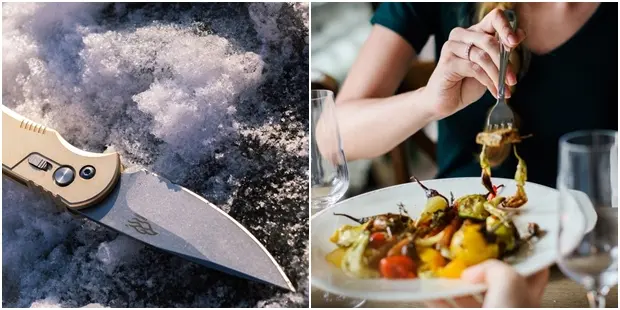
In Switzerland and several other countries, a knife or other sharp object given as a gift is said to “cut” the friendship and bring bad luck to the person who receives it.
A good knife can still make a fine present. There’s a workaround. Traditionally, the recipient hands over a small coin in return, turning the gift into a symbolic purchase.
12. New Zealand: never mistake a Kiwi for an Australian

To outsiders, the accents may sound similar. New Zealanders do not enjoy being taken for Australians, though, and comparing the two countries, or asking a New Zealander about “your” Australia, is a fast way to cause irritation.
Not sure? Ask where someone is from rather than guessing.
13. Chile: put down the fries and pick up a fork

In Chile, eating with your hands in front of others is generally considered bad manners at the table.
It sounds fussy, but the rule even covers finger food that most of the world eats by hand. Fries included. Like the stem count in Russia, it’s a small detail, and small details are exactly what people notice. Use your knife and fork.
14. Japan: stand on the correct side of the escalator

Escalators in Japan come with their own etiquette. In Tokyo and most other Japanese cities, people who want to stand keep to the left, while in Osaka they keep to the right, leaving the other side clear.
Even this rule is in flux: Tokyo metro stations display posters asking riders not to walk at all but to stand on either side.
Honestly, the easiest move is to copy the locals around you.
15. Brazil: avoid the “OK” hand sign

Touching thumb and forefinger into a circle means “all good” in much of the world. Not in Brazil. There, and in many other parts of Latin America, it can read as a vulgar insult.
U.S. Vice President Richard Nixon learned this the hard way in the 1950s, when a crowd in Brazil took offense at the sign.
A thumbs-up is the safer way to say everything’s fine.
Sources: Animal and Veterinary Service Singapore (NParks), prohibited dog breeds, Wikipedia, Lèse-majesté in Thailand, Wikipedia, Jaywalking, Wikipedia, Escalator, Wikipedia, OK gesture





















Bir yanıt yazın