
10 Historical Places in Ankara Worth the Trip


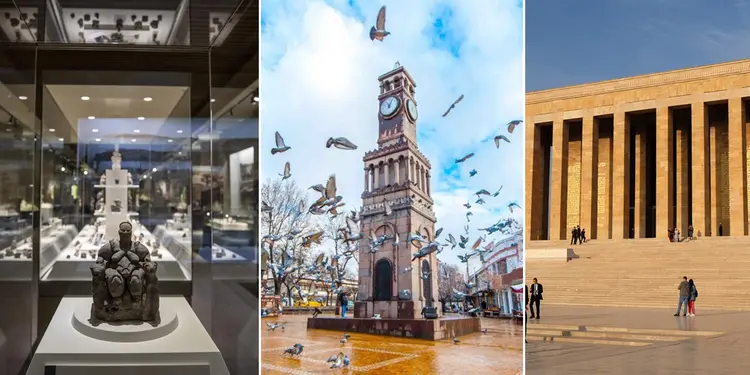
Ankara is the capital of Türkiye, and most visitors treat it as a government town to pass through on the way to Cappadocia. That is a mistake, because the historical places in Ankara run from Phrygian kings and Roman emperors to the founding of the modern republic, often within walking distance of each other. These 10 sites cover more than 3,000 years, most of them in the old Ulus and Altındağ quarter around the castle.
1. Anıtkabir

Anıtkabir is the mausoleum of Mustafa Kemal Atatürk, the founder of the Turkish Republic. Almost every visitor starts here. It sits on a hill called Anıttepe and has two main parts: the Monument Block, with the Road of Lions, the ceremonial square and the mausoleum, and the wooded Peace Park around it. The complex has 10 towers. Beneath the mausoleum, the Atatürk and War of Independence Museum, opened in 2002, displays his belongings alongside panoramas of the war. İsmet İnönü, the republic’s second president, is also buried here, in a tomb facing Atatürk’s. Expect a changing of the guard and a hushed, formal atmosphere.
2. Ankara Castle

Nobody knows exactly when Ankara Castle was first built. A fortification stood on the hill long before the Galatians, a Celtic people, settled the area in the 3rd century BC, and the walls you see today were rebuilt many times, with Roman and Byzantine stones reused in plain sight.
The inner citadel has two gates and 42 towers, most of them five-sided, while an outer ring of walls wraps around it. Its lanes are still lived in. Festivals run here through the year.
Climb to the top for the widest view over the city.
3. Roman Baths

Built under Emperor Caracalla in the early 3rd century AD and honoring Asclepius, the Greek god of healing, the Roman Baths in Altındağ sit on top of an ancient mound, with Roman layers above and the remains of a Phrygian settlement below.
What survives is mostly low walls. Rows of small brick columns once held up the floors, so hot air could circulate underneath. The warm and hot rooms were unusually large. Picturing all this takes some imagination. Still, the open-air site rewards anyone who has wondered how a Roman sauna actually worked.
4. Hamamönü

Hamamönü is one of Ankara’s oldest neighborhoods, named after the Karacabey Hamamı, a 15th-century Turkish bath. It still stands. Restoration work since the 2000s has turned its streets of timber-framed Ottoman houses into a quarter of cafés, craft shops and small galleries, and among them is the Mehmet Akif Ersoy Museum House, where the poet who wrote the Turkish national anthem’s lyrics once lived. On weekends, art and cultural events fill the streets. No stop on this list is livelier.
5. Column of Julian

Locals call it Belkıs Minaresi, the “Minaret of the Queen of Sheba.” It has nothing to do with either.
The Column of Julian is a Roman column about 15 m (49 ft) tall. It dates to 362 AD. That year Emperor Julian set out against the Persians on a route through Ankara, and when residents heard he would stay in the city, they raised the column in his honor. In 1934 it was moved to the square in front of the Ankara Governorship in Ulus, where it stands today.
6. Gordion

Gordion was the capital of ancient Phrygia, the kingdom of King Midas, and people lived on the site from the Early Bronze Age onward; today it lies at Yassıhöyük near Polatlı, roughly 70 to 80 km (about 45 to 50 miles) southwest of Ankara. Plan a half-day trip. UNESCO listed the site in 2023. Its giant burial mound, Tumulus MM, rises more than 50 m (164 ft) and is generally thought to belong to Midas’s father, Gordias. The Gordion Museum, opened in 1963, shows finds from Bronze Age pottery to imported Greek ceramics, Hellenistic and Roman pieces.
7. War of Independence Museum

This modest stone building in Ulus housed the first Grand National Assembly of Türkiye until 1924. Parliament then moved to larger quarters. It became a museum in 1961.
First called the Grand National Assembly Museum, it was restored and reopened on 23 April 1981 as the War of Independence Museum, and inside are photographs, documents and furniture from the war years and the founding of the republic. So is the original assembly hall, whose school-style wooden desks look more like a village classroom than a parliament.
8. Roman Theater

The Roman Theater lies on the slope below Ankara Castle in the Ulus area, and it was found by accident in 1982 when builders started digging foundations.
Excavations ran until 1986. Its exact construction date is unknown, so the usual 2nd-century AD dating is best read as an estimate. The digs did turn up many sculptures, and most of them are now on display in the Museum of Anatolian Civilizations, a few minutes’ walk uphill. That makes the theater a two-part visit: the ruins on the slope, then the statues indoors.
9. Museum of Anatolian Civilizations

Time for one museum in Ankara? Make it this one.
The Museum of Anatolian Civilizations sits on the south side of Ankara Castle, inside a 15th-century Ottoman covered market and a neighboring inn. The collection runs in order from the Paleolithic through the Hittites, Phrygians and Urartians to the Roman and Ottoman periods, so a single walk-through doubles as a crash course in Anatolian history. It was named the first European Museum of the Year in 1997.
10. Temple of Augustus

The Temple of Augustus in Altındağ went up around 25 to 20 BC, on a spot that is believed to have been sacred even earlier to the Phrygian deities Cybele and Men. Turkish sources credit Pylaemenes, a member of the last Galatian ruling family, with building it as a sign of loyalty to Emperor Augustus. Byzantines made it a church. The real treasure is the walls. They carry a copy of the Res Gestae, Augustus’s own account of his achievements, in Latin and Greek. With the original in Rome lost, this is the most complete copy to survive. The temple stands right beside Hacı Bayram Mosque; if you step inside the mosque too, cover your shoulders and knees, and women should bring a headscarf.
Sources: Anıtkabir (official site), Wikipedia: Gordion, Wikipedia: Museum of Anatolian Civilizations




Bir yanıt yazın