
Adana Stone Bridge: 9 Facts About an Ancient Crossing


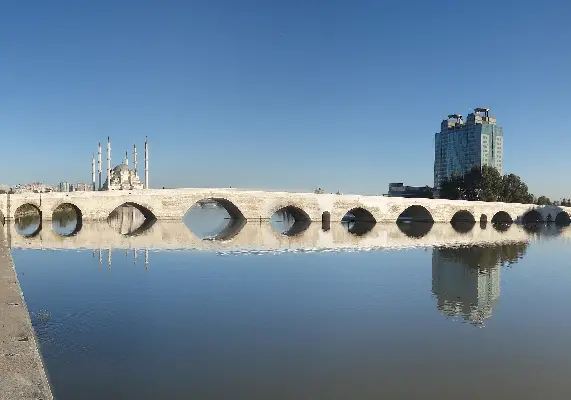
The Adana Stone Bridge, known locally as Taşköprü, links the Seyhan and Yüreğir sides of Adana in southern Türkiye across the Seyhan River. Probably built in the first half of the 2nd century AD, it’s counted among the oldest bridges in the world still in use, and it carried cars until 2007. Nobody agrees on who built it, which is half the fun.
1. The Hittites get the first claim
Some archaeologists link the crossing to the Hittites. Two stories carry the claim. In one reading, a Hittite king describes a war against a city called “Adania,” with a river in front of it and a bridge over the river; another tradition says King Hattusili I passed through Adana on his way to Syria and had a bridge built across the Sarus, as the river was then called.
The honest answer: nobody knows. At most, it may have been an earlier crossing at the same spot.

2. Was it Hadrian’s bridge?
The French historian Victor Langlois, who visited Adana in 1852 and 1853, credited the bridge to the Roman emperor Hadrian, who ruled from 117 to 138 AD and toured Anatolia in those years. Langlois also mentioned an inscription. It bore Hadrian’s name and had been visible about two decades before his visit. It has since disappeared—a frustrating gap for anyone hoping to settle the question.

3. Or the work of an architect named Auxentius?
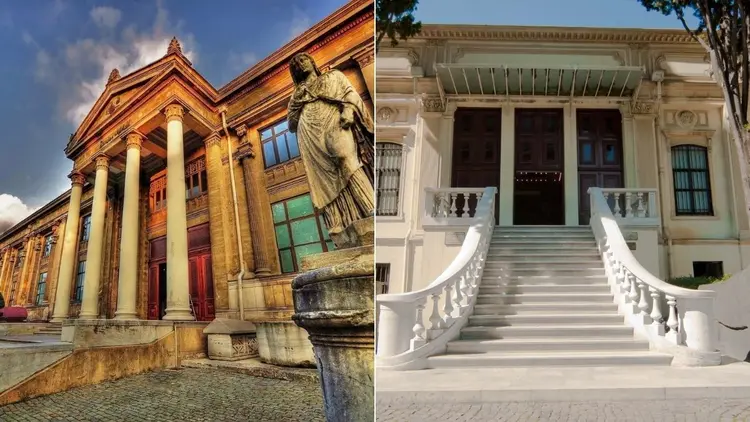
A Greek inscription in the Adana Archaeological Museum praises a man called Auxentius for a structure “built on arches, for eternity,” one that succeeded where earlier, less skilled attempts had failed against the river’s waves. Auxentius was a late 4th-century Roman architect. Some accounts take the inscription as proof that he built Taşköprü. Probably not. Read in full, the 12-line text seems to describe an aqueduct feeding waterwheels, not the bridge.

4. The legend of the king’s daughter
The bridge inspired folklore too. A soothsayer warned the king of Adania that a snake would kill his daughter, so he sent her to an island in the middle of the river. The snake reached the island anyway, hidden in a basket of grapes. It killed her. In her memory, the story goes, the king built the bridge and buried gold under its piers, so it could be rebuilt if it ever fell.
No one has reported finding the gold.

5. A toll for crossing
According to the 17th-century Ottoman travel writer Evliya Çelebi, the Abbasid caliph al-Ma’mun added gates and battlements at both ends, which let the crossing collect tolls. Harun al-Rashid gets credit too. Another Abbasid caliph, he reportedly tied the bridge to the city’s fortifications. The gates are gone. Traces of a fortress wall and other remains are said to survive nearby.

6. Not a tower after all
For a long time, people believed that Mahmut Pasha, a governor of Adana, had built a tower on the bridge to watch the sunset. Old photographs tell a different story. What they show is a structure as tall as a two-story building, with rows of windows, that has been described as a covered market rather than a tower. Records also mention a pavilion on four columns that he placed midway across. It was later demolished.

7. A bridge that kept changing shape
The deck was originally thought to be no more than about 3 m wide; early 20th-century widening brought it to around 8 m, and today, including sidewalks, the bridge is about 310 m long and 11.4 m wide, roughly four times its first width. It has 21 arches. Fifteen are main arches; the other six are small relief arches inside the larger piers. Not all of it is visible. Parts of the approaches at both ends were buried when the riverbanks were reinforced, so some of the old structure now sits underground. That kind of growth is common with working bridges: each era adds a lane before anyone thinks to add a plaque.

8. The latest restoration
Ottoman repairs came under Ahmed III, Abdülmecid I and Abdul Hamid II, and in 1948 Türkiye’s State Highway agency (Karayolları) carried out a major restoration of its own. None of these repairs, as far as anyone knows, dipped into the legendary gold under the piers. The 1948 work didn’t last. Decades of traffic wore the bridge down again. Then came 2006. The city council and the local Chamber of Architects backed a new restoration project prepared by the architect Mehmet Pekcan Işık. Since 2007, the bridge has been open only to pedestrians, which makes for a pleasant walk across the river.

9. Bonus: the bridge in a folk song
Taşköprü has found its way into Turkish folk music. The well-known folk song (türkü) “Adana Köprübaşı,” meaning “the bridgehead of Adana,” opens with an invitation to stroll together in front of friend and foe alike, and the bridge it sings about is widely taken to be this one, though that’s a reading, not a certainty.
Sources: Wikipedia, Stone Bridge (Adana), Hürriyet Daily News, Historic Roman-era bridge in Adana





Bir yanıt yazın