
17 Forbidden Places in the World You Can’t Visit


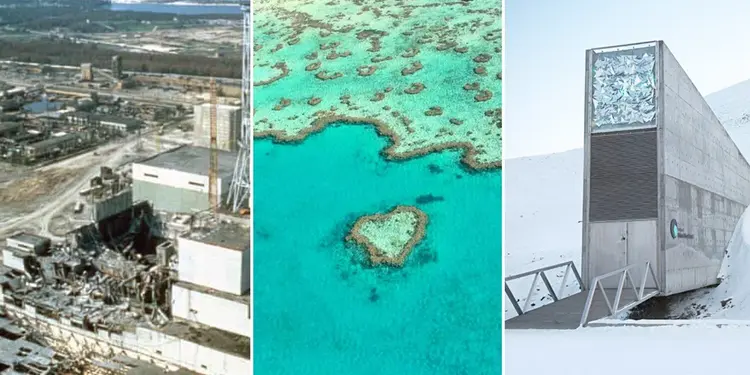
Some of the most famous forbidden places in the world are closed for very different reasons: venomous snakes, fragile paint, radiation, state secrets or a single handwritten recipe. A few let you peek from the outside, and some can only be seen from the air. None of them will let you simply walk in.
1. Queimada Grande, Brazil’s Snake Island, tops the forbidden places in the world

Ilha da Queimada Grande, better known as Snake Island, is a 43-hectare island off the coast of São Paulo state in Brazil. One species makes it famous. The golden lancehead, a critically endangered and highly venomous pit viper, lives here and nowhere else. Old estimates put the population in the hundreds of thousands, and the rumor of one to five snakes per square meter still circulates online.
The first systematic study told a calmer story: roughly 2,000 to 4,000 snakes, packed into the island’s patch of rainforest. Still plenty. The vipers live mostly on migrating birds, and their venom evolved to kill prey before it can fly off. The Brazilian Navy keeps the island closed to the public, for the safety of people and snakes alike. Only vetted research teams may land.
2. Lascaux Cave, France

Snake Island is easy to give up. Lascaux hurts more. Found by a teenager in southwestern France in 1940, the cave holds some of the most famous prehistoric paintings ever studied: horses, deer, aurochs and other animals painted around 17,000 years ago or more, in the Upper Paleolithic. It opened to the public in 1948, and about 1,200 visitors a day brought heat, humidity and carbon dioxide with them, which, along with the lighting, fed the fungi and lichen that began spreading across the walls. In 1963 the cave closed for good. Visitors today tour full-scale replicas nearby, including Lascaux IV, which opened in 2016.
3. Ise Grand Shrine, Japan

Tradition traces this Shinto shrine back about 2,000 years, and since the late 7th century its main sanctuaries have been torn down and rebuilt every 20 years in a ceremony called Shikinen Sengū. The cycle reflects Shinto ideas of death and renewal. It is also practical: rebuilding once a generation keeps the old shinmei-zukuri building style alive, and it replaces the wood before it has time to rot.
Every detail must be copied each time, which makes the shrine one of the most expensive structures in Japan. The 2013 rebuild, the 62nd, cost about 57 billion yen (approx. $550 million at the time), paid entirely by private donations. Most of that work stays hidden. Visitors can walk the forest paths, pray at the gate and glimpse the thatched roofs above tall fences, but the inner sanctuaries are closed to the public; only priests and members of the imperial household go further.
4. Svalbard Global Seed Vault, Norway

Dug into a mountain on Spitsbergen, a remote Arctic island in Norway’s Svalbard archipelago, the seed vault is a backup drive for the world’s crops. Its roughly 1,000 square meters (11,000 sq ft) can hold 4.5 million seed samples, and more than 1.3 million are already stored there, deposited by gene banks from around the world. If a disaster wipes out a crop in its home region, a copy is waiting in the permafrost. The vault sits 130 m above sea level, deep inside the rock. It is built to ride out earthquakes, rising seas, even a nuclear strike.
Nobody works there permanently. Only depositors can access their own boxes.
5. Vatican Apostolic Archive

Millions of people visit Vatican City every year, yet one corner of the tiny sovereign state stays firmly closed.
The Vatican Apostolic Archive, known until 2019 as the Vatican Secret Archive, was set up in 1612 to gather the Church’s records in one place, from papal correspondence to state papers. It stayed shut to outsiders until 1881, when Pope Leo XIII opened a reading room to scholars. Today the rule is barely looser. Only qualified researchers from higher-education institutions, with an approved entry card and a letter of introduction, can get in. Browsing the shelves is out. With only five requested items allowed out at a time, researchers need to know exactly what they are looking for.
6. The Coca-Cola recipe vault, Atlanta

The World of Coca-Cola museum in Atlanta, Georgia, is home to a vault said to guard the company’s secret formula. Visitors can see the vault itself. What is inside is off-limits. The handwritten formula spent decades in an Atlanta bank vault from 1925 until December 2011, when it moved to its current home at the museum.
The secret may be less airtight than the steel suggests. In 2011 the radio show This American Life published a recipe found in an old recipe book that had been reprinted in an Atlanta newspaper in 1979. Coca-Cola’s archivist conceded it “could be a precursor” to the original 1886 formula, but the company insists it is not the drink sold today.
7. Surtsey Island, Iceland

In November 1963, an undersea eruption off the south coast of Iceland began building a brand-new island, and it did not stop until 1967. Scientists rarely get to watch an island being born. They made the most of it: Surtsey was declared a nature reserve in 1965, while lava was still flowing, and has served ever since as a lab for how life colonizes bare rock without human help. Molds, fungi, mosses and nesting seabirds have all arrived on their own.
Not everything did. A tomato plant once sprouted on the island, traced to a visitor who had relieved himself carelessly, and it was promptly pulled up. Only a handful of scientists may land, and they check themselves and their gear for stray seeds; everyone else sees Surtsey from a small plane.
8. Heard Island and Mawson Peak, Australia

Some islands are off-limits for your own good. Heard Island is an Australian territory in the southern Indian Ocean, a sub-Antarctic speck about 4,100 km southwest of Perth and 1,700 km north of Antarctica. Its Big Ben volcano rises to 2,745 m at Mawson Peak. It is still active: lava has flowed roughly once a year since 2008. Then there is the wind. Average monthly winds run at about 26 to 33 km/h (16 to 21 mph), with gusts of up to 180 km/h (110 mph). Unauthorized entry has been banned since 2014, and even approved visitors must complete training and follow strict quarantine rules before making the long sea voyage.
9. Montserrat’s exclusion zone

Nobody lives near Mawson Peak. The Caribbean island of Montserrat was not so lucky. When the Soufrière Hills volcano woke up in 1995, the capital, Plymouth, was evacuated, and as the eruptions continued, the town was abandoned for good, buried under ash like a modern-day Pompeii. The volcano is quieter now than in the 1990s. It has not gone to sleep.
So a large part of the island’s south remains an exclusion zone, closed to residents and visitors alike.
10. Chernobyl Nuclear Power Plant, Ukraine

After the 1986 meltdown at the Chernobyl Nuclear Power Plant in Ukraine, authorities sealed off a zone with a 30 km (19 mi) radius around Reactor 4. Settling there is still not officially allowed. Around 200 older residents quietly returned to their villages anyway. For about a decade, licensed guides ran day trips from Kyiv, and the zone became one of the strangest tourist attractions in Europe.
That chapter is closed for now. Access passes were suspended in April 2022 under martial law after Russia’s invasion, and the zone remains closed to tourists, with authorities planning to keep it that way until the fighting ends.
11. Area 51, USA

Area 51 owes its fame to two things: theories that the US government studies aliens there, and the fact that nobody gets in to check. The Nevada desert site was not officially acknowledged until 2013, when declassified CIA documents described it as a testing ground for spy planes. Then came the internet. A joke Facebook event called “Storm Area 51, They Can’t Stop All of Us” drew about 2 million “going” replies for September 20, 2019. On the day, about 150 people actually turned up at the gates. Roughly 1,500 went to nearby festivals instead.
12. Room 39, North Korea

If Area 51 hides aircraft, North Korea’s Room 39 is said to hide money. Officially Bureau 39 of the Workers’ Party of Korea, the name refers to a whole secretive department, and it is also believed to be a real office inside a party building in Pyongyang. Its job, according to defectors, is to keep foreign currency flowing to the country’s leaders. Counterfeit $100 bills, methamphetamine and heroin production, insurance fraud and even cryptocurrency hacking have all been linked to it, alongside some legal businesses. Estimates of what it brings in range from about $500 million to $2 billion a year.
None of it is easy to check. North Korea is simply too closed.
13. Poveglia, Italy’s Plague Island

Poveglia is a small island in the Venetian Lagoon in northern Italy, used as a quarantine station from 1793 and long after. Its reputation runs far ahead of the records. Popular stories claim that 100,000 or more plague victims lie in its pits and that half its soil is human ash, but these figures trace back to a 2009 ghost-hunting TV show; one Venetian historian puts the island’s plague deaths closer to 20.
The darker legend has a similar problem. In 1922 the buildings became a care home for the elderly, sometimes described as a psychiatric hospital, and tales of a mad doctor’s experiments grew from there with little evidence behind them. The facility closed in 1968. Poveglia remains Italian state property, and its abandoned buildings are off-limits, though a citizens’ association won a six-year concession in 2025 to turn the northern part into a public park.
14. North Brother Island, New York

New York has an abandoned quarantine island of its own. From the 1880s, North Brother Island in the East River housed Riverside Hospital, which treated patients with infectious diseases. Its most famous patient was Mary Mallon, better known as Typhoid Mary, the first person in the United States identified as a healthy carrier of the typhoid bacterium. Working as a cook in the early 1900s, she made dozens of people sick without ever feeling ill herself. She was quarantined on the island for about three years and then released. She went back to cooking. Under another name, she spread the disease again, and in 1915 she was sent back to the island against her will, where she lived until her death in 1938.
Today the overgrown island serves a happier purpose as a refuge for herons and other wading birds. The public is not allowed. The city grants permits only for compelling academic or scientific reasons.
15. Heart Reef, Australia

Part of Australia’s Great Barrier Reef, in the Whitsundays region of Queensland, Heart Reef may be the most photogenic coral formation on the planet. A local pilot spotted its heart shape from the air in 1975. It has starred in countless Instagram posts and tourism campaigns since. The formation is protected. Snorkeling and diving on it are not allowed; in-water trips go to nearby pontoons and lagoons in Hardy Reef instead. Want the classic photo? That means paying for a helicopter or seaplane flight.
16. Church of Our Lady Mary of Zion, Ethiopia

Ethiopia’s Orthodox Church says it holds the Ark of the Covenant, kept in the Chapel of the Tablet beside the Church of Our Lady Mary of Zion in the city of Aksum. The guard is tight enough to give even Indiana Jones pause. Legend says the monks protecting it are trained to stop intruders with their bare hands, which may or may not be true. What is documented is stranger: only one guardian monk may see the Ark, he is appointed for life by his predecessor, and he spends the rest of his days confined to the chapel, praying and burning incense before it.
That secrecy means no archaeologist has been able to examine the Ark.
So has anyone outside the chapel ever seen it? One man claims to have. Edward Ullendorff, a British scholar of Ethiopian studies, said in 1992 that he had inspected it in 1941 as a British Army officer, and that it was an empty, medieval-era construction.
17. Maya Bay, Thailand

Maya Bay is the one entry on this list that reopened. After The Beach, starring Leonardo DiCaprio, came out in 2000, the cove on Thailand’s Koh Phi Phi Leh became a tourism magnet, and the crowds and boats wrecked much of its coral. Thailand closed the bay in 2018 to let the ecosystem recover. It reopened in early 2022. The terms are stricter now: boats can no longer pull up to the beach, swimming is banned, and visits are capped at an hour, with only a limited number of people allowed at a time. Lascaux, sealed since 1963, never got that second chance.
Sources: Wikipedia, Chernobyl Exclusion Zone, Wikipedia, Storm Area 51, Tourism Whitsundays, How to See Heart Reef



Bir yanıt yazın