
Maras Salt Mines in Peru: 12 Things to Know


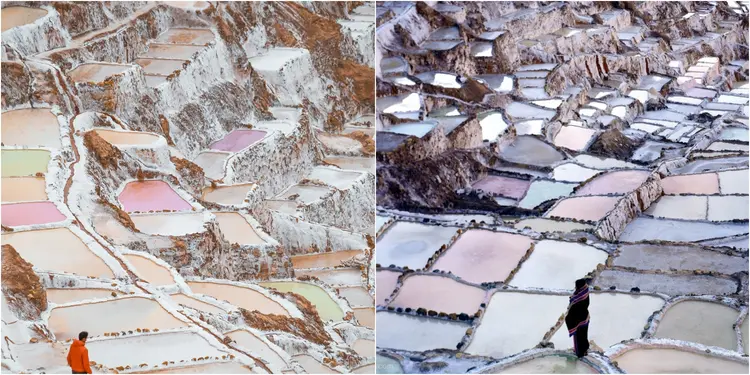
Picture a mountainside in Peru covered in thousands of small white, pink and brown pools, stacked like a giant honeycomb. Those are the Maras salt mines. Local families in the Sacred Valley still harvest salt there by hand, as people in the area have for many centuries.
1. A salt valley high above sea level, northwest of Cusco

The ponds sit at about 3,200 m (10,500 ft) in the Urubamba Province of the Cusco Region, roughly 50 km (31 miles) by road northwest of the city of Cusco. Most visitors arrive on a day tour from Cusco, often combined with the circular Inca terraces of Moray nearby.
The altitude is worth taking seriously. Just flown in? Give yourself a day or two in Cusco first.
2. Locals call it Salineras de Maras

The site lies in the Sacred Valley of the Incas, the stretch of the Urubamba River valley between Cusco and Machu Picchu. Its Spanish name is Salineras de Maras, after the nearby village of Maras. English is less settled: “Maras salt mines,” “Maras salt pans” and “Maras salt ponds” all mean the same place.
3. Everything starts with one salty spring

All of this comes from a single source of very salty water rising from the mountain above the ponds. The water is usually explained as having passed through ancient salt deposits buried deep inside the Andes, though the spring’s exact origin is still described as something of a mystery.
From the top of the slope, a main channel carries the water down. Then it splits. And splits again, into smaller and smaller channels that feed each pond in turn.
4. The sun does the rest

Each pond gets a few centimeters of salt water. Then the channel is blocked off, and the sun starts working. After about three days of evaporation the pond is filled again, and once that cycle has repeated for roughly a month, the salt layer at the bottom is several centimeters thick and ready to be raked out.
5. A legend says the water is a brother’s tears

The best-known local story ties the spring to the founding myth of the Incas. Ayar Cachi, one of the legendary Ayar siblings, was said to be so powerful that the others grew afraid of him and sealed him inside a cave. His tears, the story goes, seeped into the mountain and became the salty spring that feeds Maras. Geology may have the last word on the salt. The legend still gets told on almost every tour.
6. There are thousands of separate ponds

The exact number depends on who is counting. Estimates run from more than 3,000 to about 4,500 pools. Each one is small, around 5 square meters and about 30 cm deep, which is why the whole slope looks like a patchwork from above.
7. The ponds belong to local families

Every pond is owned by a family from the communities of Maras or Pichingoto, and ownership passes down through the generations. Outsiders cannot buy in: ponds can only be sold to residents of those two communities.
Sales are handled together.
A company owned by local residents, Marasal S.A., runs the administration and markets the salt, much of which is still broken up by hand, dried and carried off the slope by the families themselves. For many households, it remains a key source of income.
8. People were making salt here before the Incas

The Inca Empire certainly made use of Maras, but it did not start it. Archaeologists have found pottery at the site from cultures much older than the Incas, which points to salt production stretching back well over a thousand years. After the Spanish conquest, descendants of Inca nobility were still recorded as owners in the 16th century. In 1969 the Peruvian state took over extraction. Local communities won it back in 1980.
9. A site valued for its history as much as its looks

Peru declared the salt mines part of the nation’s cultural heritage in 1998. In 2019, the government put them forward for UNESCO World Heritage status, and they are on UNESCO’s tentative list. The photos tell only half the story. The other half is a working tradition that has outlived empires.
10. Minerals and seasons decide the colors

Minerals in the water, including magnesium, calcium and potassium, help give the salt its tint. The season matters too. In the dry season, from May to October, the salt builds up faster and tends to be white or pink, while in the rainy months from November to April it gathers more slowly and often turns brown. The steep valley ends up streaked with shades of white, pink and brown. Which season looks better in photos? Many visitors would say the dry one.
11. Maras salt is sold as a gourmet product

The top layer of each harvest becomes table salt, and the finer pink variety is sold to cooks and visitors as a specialty salt. It is often marketed as healthier because of its minerals. That pitch oversells it. The salt is still mostly sodium chloride, the trace minerals come in small amounts, and its real appeal is flavor, texture and where it comes from. Shops at the site also sell salt-based chocolates, sweets and body creams.
12. One of Peru’s most memorable sights

Truth is, plenty of places in Peru are scenic. Few combine natural setting, deep history and a living local trade on one hillside.
In the high season, more than 1,500 people a day come to see the Maras salt mines, and most leave with a bag of salt in their luggage.


Bir yanıt yazın